

162
3. Beyond the One-Way Wave Equation
(a)
(b)
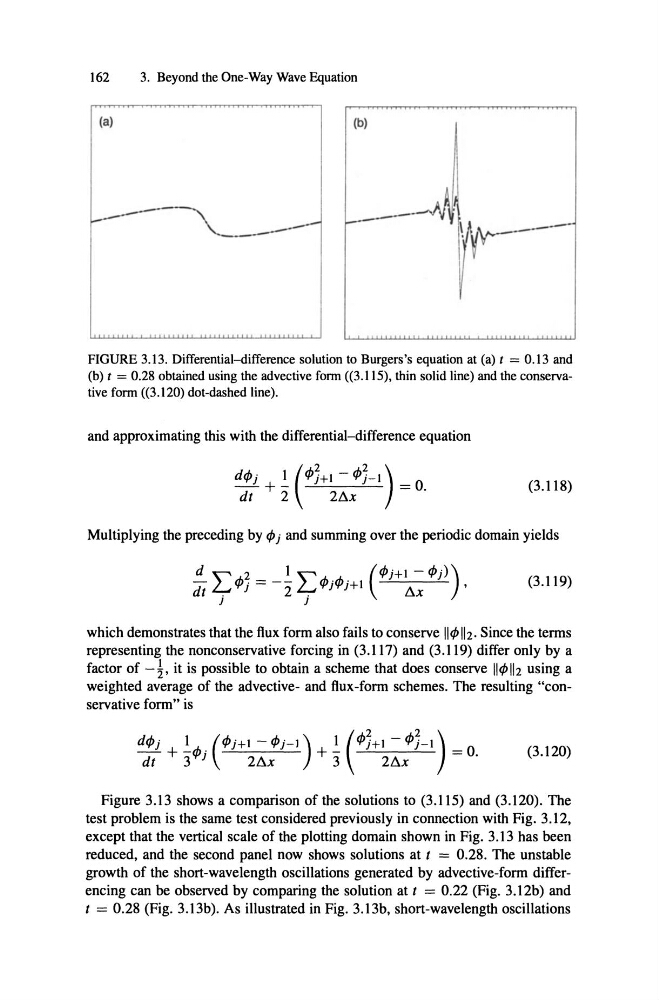
FIGURE 3.13. Differential-difference solution to Burgers's equation at (a) t = 0.13 and
(b) t = 0.28 obtained using the advective form «3.115), thin solid line) and the conservative form «3.120) dot-dashed line).
and approximating this with the differential-difference equation
dr/Jj
-+- dt
1 (r/J7+1 - r/J7- 1)
2
2ßx
=0.
(3.118)
Multiplying the preceding by r/Jj and summing over the periodic domain yields
(3.119)
which demonstrates that the flux form also fails to conserve 1Ir/J112. Since the terms
representing the nonconservative forcing in (3.117) and (3.119) differ only by a
factor of -
it is possible to obtain a scheme that does conserve 1Ir/J 112 using a
weighted average of the advective- and flux-form schemes . The resulting "conservative form" is
(3.120)
Figure 3.13 shows a comparison of the solutions to (3.115) and (3.120). The
test problem is the same test considered previously in connection with Fig. 3.12,
except that the vertical scale of the plotting domain shown in Fig. 3.13 has been
reduced, and the second panel now shows solutions at t = 0.28. The unstable
growth of the short-wavelength oscillations generated by advective-form differencing can be observed by comparing the solution at t = 0.22 (Fig. 3.12b) and
t = 0.28 (Fig. 3.13b). As illustrated in Fig. 3.13b, short-wavelength oscillations
3. Beyond the One-Way Wave Equation
(a)
(b)
FIGURE 3.13. Differential-difference solution to Burgers's equation at (a) t = 0.13 and
(b) t = 0.28 obtained using the advective form «3.115), thin solid line) and the conservative form «3.120) dot-dashed line).
and approximating this with the differential-difference equation
dr/Jj
-+- dt
1 (r/J7+1 - r/J7- 1)
2
2ßx
=0.
(3.118)
Multiplying the preceding by r/Jj and summing over the periodic domain yields
(3.119)
which demonstrates that the flux form also fails to conserve 1Ir/J112. Since the terms
representing the nonconservative forcing in (3.117) and (3.119) differ only by a
factor of -
it is possible to obtain a scheme that does conserve 1Ir/J 112 using a
weighted average of the advective- and flux-form schemes . The resulting "conservative form" is
(3.120)
Figure 3.13 shows a comparison of the solutions to (3.115) and (3.120). The
test problem is the same test considered previously in connection with Fig. 3.12,
except that the vertical scale of the plotting domain shown in Fig. 3.13 has been
reduced, and the second panel now shows solutions at t = 0.28. The unstable
growth of the short-wavelength oscillations generated by advective-form differencing can be observed by comparing the solution at t = 0.22 (Fig. 3.12b) and
t = 0.28 (Fig. 3.13b). As illustrated in Fig. 3.13b, short-wavelength oscillations