

3.6 Nonlinear Instability
161
(a)
(b)
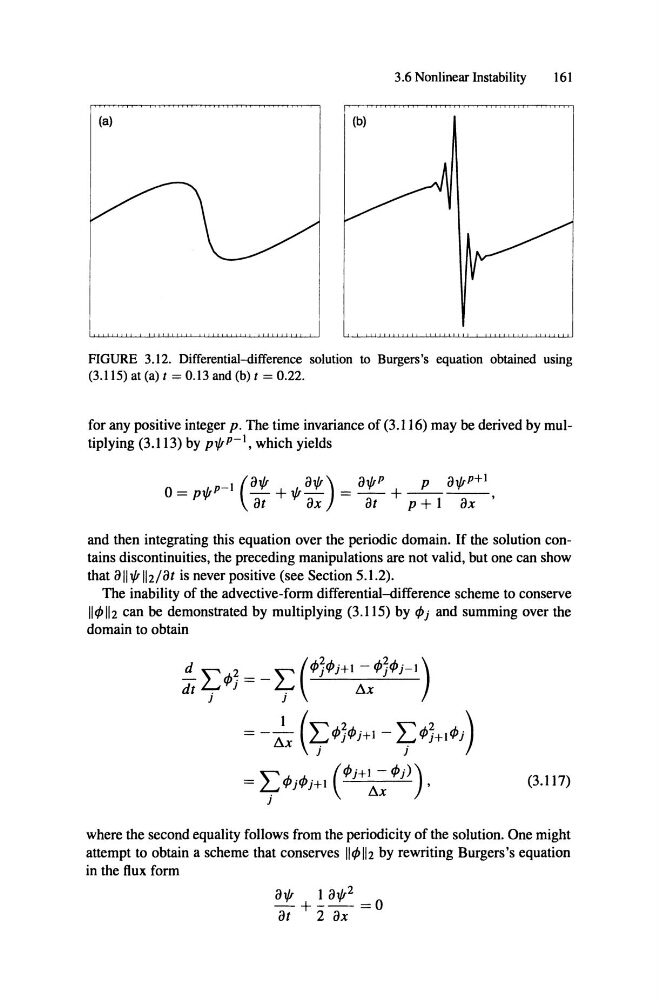
FIGURE 3.12. Differential-difference solution to Burgers's equation obtained using
(3.115) at (a) t = 0.13 and (b) t = 0.22.
for any positive integer p. The time invariance of (3.116) may be derived by multiplying (3.113) by p1/lp-l, which yields
0= p1/lp-l (a1/l + 1/1 a1/l) = a1/lp + _p_ a1/lp+l ,
at
ax
at
p + 1 ax
and then integrating this equation over the periodic domain. If the solution contains discontinuities, the preceding manipulations are not valid, but one can show
that a1 1 1/1 112/at is never positive (see Section 5.1.2) .
The inability of the advective-form differential-difference scheme to conserve
114> 112 can be demonstrated by multiplying (3.115) by 4>j and summing over the
domain to obtain
(3.117)
where the second equality follows from the periodicity of the solution. One might
attempt to obtain a scheme that conserves 114>112 by rewriting Burgers's equation
in the flux form
161
(a)
(b)
FIGURE 3.12. Differential-difference solution to Burgers's equation obtained using
(3.115) at (a) t = 0.13 and (b) t = 0.22.
for any positive integer p. The time invariance of (3.116) may be derived by multiplying (3.113) by p1/lp-l, which yields
0= p1/lp-l (a1/l + 1/1 a1/l) = a1/lp + _p_ a1/lp+l ,
at
ax
at
p + 1 ax
and then integrating this equation over the periodic domain. If the solution contains discontinuities, the preceding manipulations are not valid, but one can show
that a1 1 1/1 112/at is never positive (see Section 5.1.2) .
The inability of the advective-form differential-difference scheme to conserve
114> 112 can be demonstrated by multiplying (3.115) by 4>j and summing over the
domain to obtain
(3.117)
where the second equality follows from the periodicity of the solution. One might
attempt to obtain a scheme that conserves 114>112 by rewriting Burgers's equation
in the flux form