

154
3. Beyond the One-Way Wave Equation
o
(a)
. :"' l
,
,
"' 1' 1L I
0.4
0.6
I
"
1 I
-7tlZ
(b)
,
, ,
, ,
, ,
, , ,
, ,
, ,
,
,
,' r
(f °T
8
Y
-lt lL..1.---'----'-----'-_
0.8
I "
\"
I
i
'i-' -:,f.
I
-'----_--'-----'------'----'-----,
,
_
, , , ,
, ,
nJZ
lt
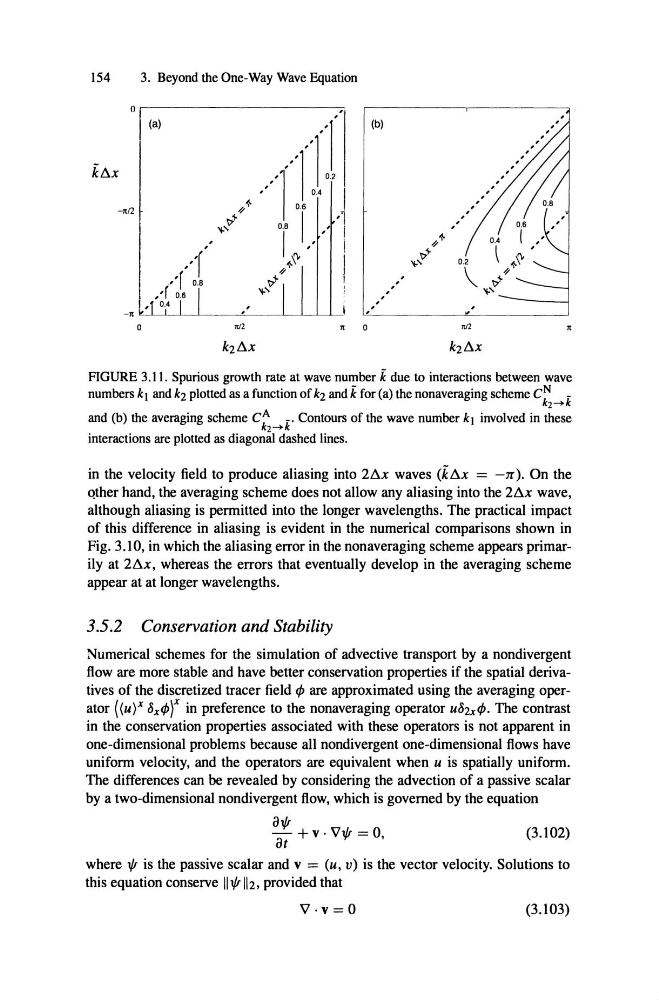
FIGURE 3.11. Spurious growth rate at wave number k due to interactions between wave
numbers kl and kz plotted as a function of kz and kfor (a) the nonaveraging scheme C N -
kz--+k
and (b) the averaging scheme CA _. Contours of the wave number kl involved in these
kz--+k
interactions are plotted as diagonal dashed Iines.
in the velocity field to produce aliasing into 2ßx waves (kSx = -n). On the
other hand, the averaging scheme does not allow any aliasing into the 2ßx wave,
although aliasing is pennitted into the longer wavelengths. The practical impact
of this difference in aliasing is evident in the numerical comparisons shown in
Fig. 3.10, in which the aliasing error in the nonaveraging scheme appears primarily at 2ßx, whereas the errors that eventually develop in the averaging scheme
appear at at longer wavelengths.
3.5.2 Conservation and Stability
Numerical sehemes for the simulation of adveetive transport by a nondivergent
ftow are more stable and have better eonservation properties if the spatial derivatives of the discretized tracer field cP are approximated using the averaging operator ((u) X8 xcPt in preference to the nonaveraging operator U82xcP . The contrast
in the conservation properties associated with these operators is not apparent in
one-dimensional problems because all nondivergent one-dimensional ftows have
uniform velocity, and the operators are equivalent when u is spatially uniform.
The differenees ean be revealed by considering the advection of a passive scalar
by a two-dimensional nondivergent ftow, which is govemed by the equation
-
01/1
ot
+ v . "111/1 = 0,
(3.102)
where 1/1 is the passive seal ar and v = (u, v) is the veetor velocity. Solutions to
this equation conserve 111/1 112, provided that
V·v=O
(3.103)
3. Beyond the One-Way Wave Equation
o
(a)
. :"' l
,
,
"' 1' 1L I
0.4
0.6
I
"
1 I
-7tlZ
(b)
,
, ,
, ,
, ,
, , ,
, ,
, ,
,
,
,' r
(f °T
8
Y
-lt lL..1.---'----'-----'-_
0.8
I "
\"
I
i
'i-' -:,f.
I
-'----_--'-----'------'----'-----,
,
_
, , , ,
, ,
nJZ
lt
FIGURE 3.11. Spurious growth rate at wave number k due to interactions between wave
numbers kl and kz plotted as a function of kz and kfor (a) the nonaveraging scheme C N -
kz--+k
and (b) the averaging scheme CA _. Contours of the wave number kl involved in these
kz--+k
interactions are plotted as diagonal dashed Iines.
in the velocity field to produce aliasing into 2ßx waves (kSx = -n). On the
other hand, the averaging scheme does not allow any aliasing into the 2ßx wave,
although aliasing is pennitted into the longer wavelengths. The practical impact
of this difference in aliasing is evident in the numerical comparisons shown in
Fig. 3.10, in which the aliasing error in the nonaveraging scheme appears primarily at 2ßx, whereas the errors that eventually develop in the averaging scheme
appear at at longer wavelengths.
3.5.2 Conservation and Stability
Numerical sehemes for the simulation of adveetive transport by a nondivergent
ftow are more stable and have better eonservation properties if the spatial derivatives of the discretized tracer field cP are approximated using the averaging operator ((u) X8 xcPt in preference to the nonaveraging operator U82xcP . The contrast
in the conservation properties associated with these operators is not apparent in
one-dimensional problems because all nondivergent one-dimensional ftows have
uniform velocity, and the operators are equivalent when u is spatially uniform.
The differenees ean be revealed by considering the advection of a passive scalar
by a two-dimensional nondivergent ftow, which is govemed by the equation
-
01/1
ot
+ v . "111/1 = 0,
(3.102)
where 1/1 is the passive seal ar and v = (u, v) is the veetor velocity. Solutions to
this equation conserve 111/1 112, provided that
V·v=O
(3.103)