

150
3. Beyondthe One-WayWaveEquation
into the 2N + I points
rrj
Xj=/i'
j=-N •...• N
and suppose that the initial data are representable as the sum of the Fourier modes
in the set {eo. e i Nx/2• e- i Nx/2 • eiNx}. This set offour modes is closed under multiplication on the discrete mesh due to aliasing error; for example,
Let C and cP be arbitrary combinations of these four Fourier modes. Under the
assumption that C is real, the velocity
c(Xj) = Co + Cn/2eirrj/2 + C_n/2e-irr j /2 + cne i rrj
may be altematively expressed as
c(x j) = Co + (c
i rrj•
(3.92)
where the coefficients Co, c-, Ci. and C n are all real. Assuming that cP is also real.
it may be written in the similar form
(3.93)
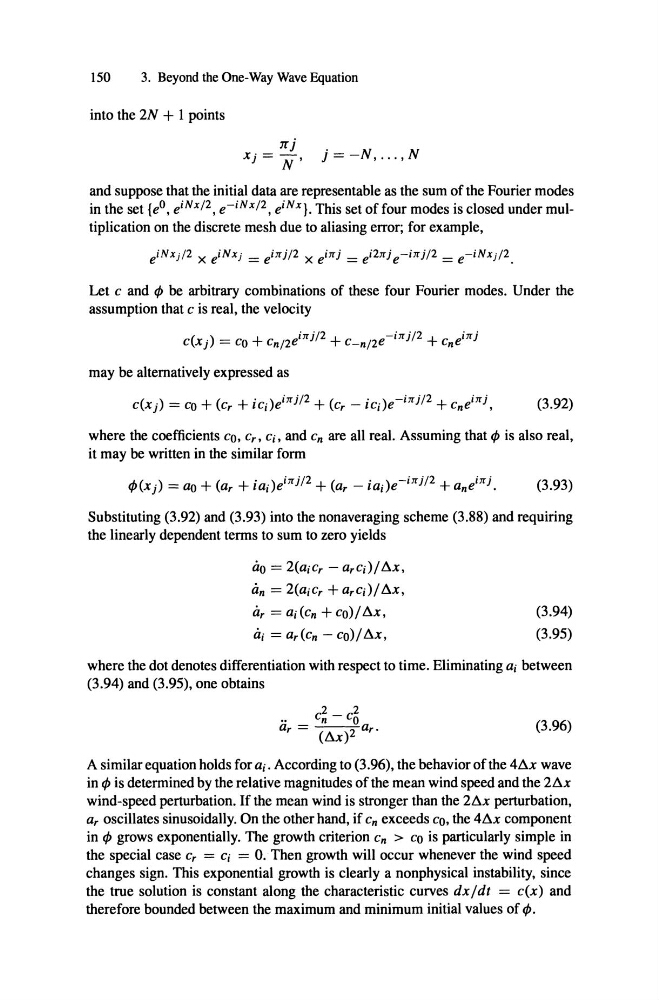
Substituting (3.92) and (3.93) into the nonaveraging scheme (3.88) and requiring
the linearly dependent terms to sum to zero yields
äo = 2(aiCr - arCi)/ tsx,
än = 2(aiCr +arCi)/I:i.X.
är = ai(cn + co)/ Sx ,
ä i = ar(c n - co)/l:i.x.
(3.94)
(3.95)
where the dot denotes differentiation with respect to time . Eliminating a; between
(3.94) and (3.95). one obtains
••
C 2 _ c 2
n
0
a; = (l:i.x)2 a- ,
(3.96)
A similar equation holds for ai. According to (3.96), the behavior of the 4l:i.x wave
in cP is determined by the relative magnitudes of the mean wind speed and the 2l:i.x
wind -speed perturbation. If the mean wind is stronger than the 2l:i.x perturbation,
a; oscillates sinusoidally. On the other hand, if C n exceeds Co. the 4l:i.x component
in cP grows exponentially. The growth criterion C n > Co is particularly simple in
the special case C r = Ci = 0.·Then growth will occur whenever the wind speed
changes sign. This exponential growth is c1early a nonphysical instability, since
the true solution is constant along the characteristic curves dxfdt = c(x) and
therefore bounded between the maximum and minimum initial values of cP.
3. Beyondthe One-WayWaveEquation
into the 2N + I points
rrj
Xj=/i'
j=-N •...• N
and suppose that the initial data are representable as the sum of the Fourier modes
in the set {eo. e i Nx/2• e- i Nx/2 • eiNx}. This set offour modes is closed under multiplication on the discrete mesh due to aliasing error; for example,
Let C and cP be arbitrary combinations of these four Fourier modes. Under the
assumption that C is real, the velocity
c(Xj) = Co + Cn/2eirrj/2 + C_n/2e-irr j /2 + cne i rrj
may be altematively expressed as
c(x j) = Co + (c
i rrj•
(3.92)
where the coefficients Co, c-, Ci. and C n are all real. Assuming that cP is also real.
it may be written in the similar form
(3.93)
Substituting (3.92) and (3.93) into the nonaveraging scheme (3.88) and requiring
the linearly dependent terms to sum to zero yields
äo = 2(aiCr - arCi)/ tsx,
än = 2(aiCr +arCi)/I:i.X.
är = ai(cn + co)/ Sx ,
ä i = ar(c n - co)/l:i.x.
(3.94)
(3.95)
where the dot denotes differentiation with respect to time . Eliminating a; between
(3.94) and (3.95). one obtains
••
C 2 _ c 2
n
0
a; = (l:i.x)2 a- ,
(3.96)
A similar equation holds for ai. According to (3.96), the behavior of the 4l:i.x wave
in cP is determined by the relative magnitudes of the mean wind speed and the 2l:i.x
wind -speed perturbation. If the mean wind is stronger than the 2l:i.x perturbation,
a; oscillates sinusoidally. On the other hand, if C n exceeds Co. the 4l:i.x component
in cP grows exponentially. The growth criterion C n > Co is particularly simple in
the special case C r = Ci = 0.·Then growth will occur whenever the wind speed
changes sign. This exponential growth is c1early a nonphysical instability, since
the true solution is constant along the characteristic curves dxfdt = c(x) and
therefore bounded between the maximum and minimum initial values of cP.