

3.3 Splittinginto Fractional Steps
133
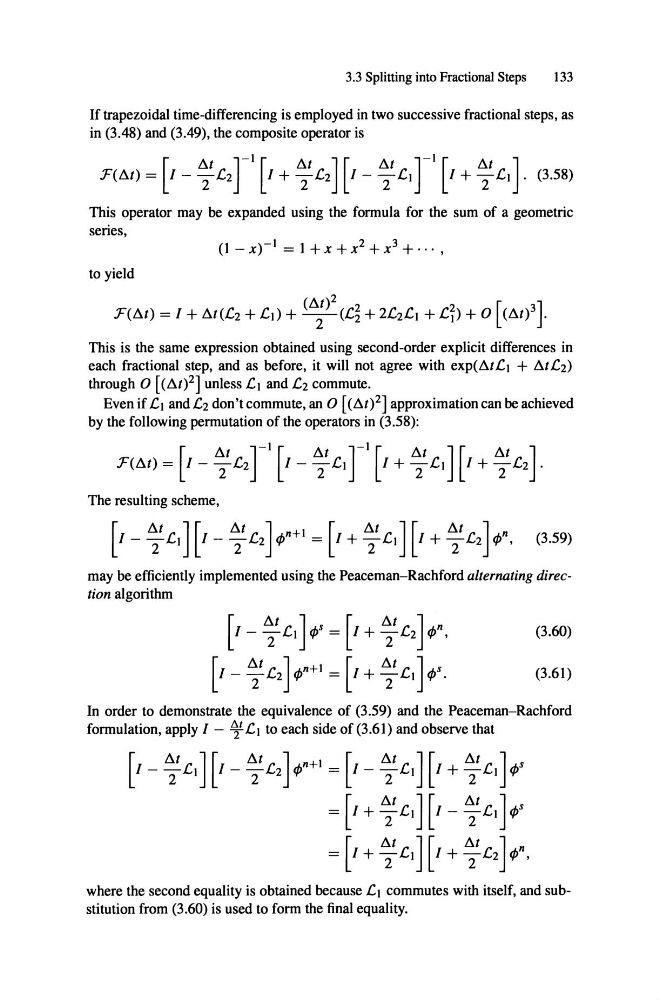
If trapezoidal time-differencing is employed in two successive fractional steps, as
in (3.48) and (3.49), the composite operator is
This operator may be expanded using the fonnula for the sum of a geometrie
series,
(l - x)-I = I + x + x 2 + x 3 + ... ,
to yield
F(tJ.t) = I + tJ.t(L2 + LI) + (tJ.;)2
+ 2L2LI +
+ 0 [(tJ.t)3].
This is the same expression obtained using second-order explicit differences in
each fractional step, and as before, it will not agree with exp(tJ.tLI + tJ.tL2)
through 0 [(tJ.t)2] unless LI and L2 commute.
Even if LI and L2 don't commute, an 0 [(tJ.t)2] approximation can be achieved
by the following permutation of the operators in (3.58) :
The resulting scheme,
(3.59)
may be efficiently implemented using the Peaceman-Rachford alternating direction algorithm
[1 - LI] rjJs = [1 + L2] rjJn,
[1- L2] rjJn+1 = [I + LI] rjJs.
(3.60)
(3.61)
In order to demonstrate the equivalence of (3.59) and the Peaceman-Rachford
fonnulation, apply I -
LI to each side of (3.61) and observe that
[1- LI] [1- L2] rjJn+1 = [1- LI] [I + LI] rjJs
= [1 + LI] [1 _ LI] rjJs
= [1 + LI] [1 + L2] «.
where the second equality is obtained because LI commutes with itself, and sub -
stitution from (3.60) is used to form the final equality.
133
If trapezoidal time-differencing is employed in two successive fractional steps, as
in (3.48) and (3.49), the composite operator is
This operator may be expanded using the fonnula for the sum of a geometrie
series,
(l - x)-I = I + x + x 2 + x 3 + ... ,
to yield
F(tJ.t) = I + tJ.t(L2 + LI) + (tJ.;)2
+ 2L2LI +
+ 0 [(tJ.t)3].
This is the same expression obtained using second-order explicit differences in
each fractional step, and as before, it will not agree with exp(tJ.tLI + tJ.tL2)
through 0 [(tJ.t)2] unless LI and L2 commute.
Even if LI and L2 don't commute, an 0 [(tJ.t)2] approximation can be achieved
by the following permutation of the operators in (3.58) :
The resulting scheme,
(3.59)
may be efficiently implemented using the Peaceman-Rachford alternating direction algorithm
[1 - LI] rjJs = [1 + L2] rjJn,
[1- L2] rjJn+1 = [I + LI] rjJs.
(3.60)
(3.61)
In order to demonstrate the equivalence of (3.59) and the Peaceman-Rachford
fonnulation, apply I -
LI to each side of (3.61) and observe that
[1- LI] [1- L2] rjJn+1 = [1- LI] [I + LI] rjJs
= [1 + LI] [1 _ LI] rjJs
= [1 + LI] [1 + L2] «.
where the second equality is obtained because LI commutes with itself, and sub -
stitution from (3.60) is used to form the final equality.