

132
3. Beyondthe One-Way Wave Equation
It might appear that this splitting requires 50% more computation than the binary
products considered previously. However, since
[.1"\ (Llt/2)][.1"\ (Llt/2)] = [.1"\ (Llt)] + 0 [(Llt)3].
two consecutive .1"\-integration steps of length Llt /2 may be combined into a single .1"\-integration of length Llt without sacrificing second-order accuracy. Thus,
if the physical solution is not required at every time step, aseries of consecutive
steps involving the operator (3.57) can be consolidated as
[.1"\ (M/2)][.1"z(Llt)][.1"\ (Llt)] · · · [.1"z(Llt)][.1"\ (Llt/2)] ,
where a single half step has been performed at the beginning and the end of the interval and all other steps are full steps of length Llt. Such consolidation can greatly
improve efficiency in problems where the approximate solution is not needed at
every time step (e.g., if the solution is required only once every 100 time steps for
output to a plotting program).
Problems can be split into more than two subproblems, although if the individual operators do not commute, the effort required to evaluate an 0 [(Llt)Z] split
can be substantial. If the original problem is approximated by aseries of numerical operators Fi, .1"z, .. ., .1"N and the least accurate of the .1"j is 0 [(Llt)n], then
the simplest fractional step splitting
is O(Llt) unless all the individual operators commute, in which case the accuracy
is 0 [(Llt)n]. When.1"\ , .1"z, . . .,.1"N don 't commute, 0 [(M)Z] accuracy can be
obtained using higher-dimensional forms ofthe Strang splitting (3.57). In the case
of three operators, the Strang splitting is
[.1"\ (Llt /2)][.1"z(Llt /2)][.1"3(Llt)][.1"z(Llt /2)][.1"\ (Llt /2)] .
3.3.2 Split Implicit Schemes
Although Strang splitting can be used to obtain second-order accuracy when explicit time-differencing is used in the individual fractional steps, other techniques
are required when the time-differencing is implicit. The trapezoidal scheme is the
most important second-order implicit time difference used in split schemes. The
trapezoidal approximation to the general partial differential equation (3.51) may
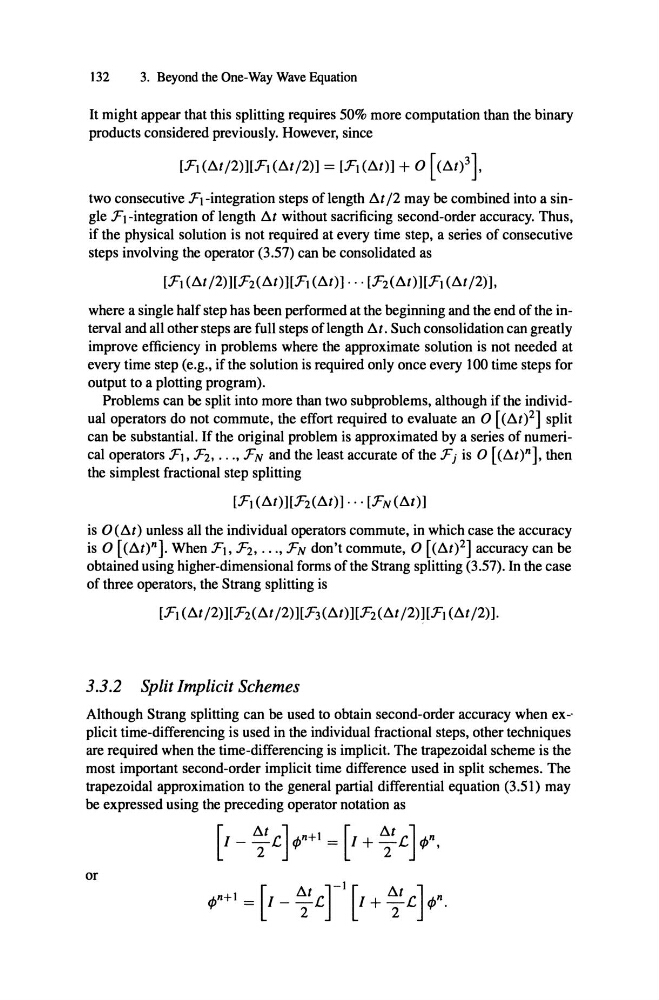
be expressed using the preceding operator notation as
or
ljJn+ \ = [I _ [,] -\ [I + i:] ljJn .
3. Beyondthe One-Way Wave Equation
It might appear that this splitting requires 50% more computation than the binary
products considered previously. However, since
[.1"\ (Llt/2)][.1"\ (Llt/2)] = [.1"\ (Llt)] + 0 [(Llt)3].
two consecutive .1"\-integration steps of length Llt /2 may be combined into a single .1"\-integration of length Llt without sacrificing second-order accuracy. Thus,
if the physical solution is not required at every time step, aseries of consecutive
steps involving the operator (3.57) can be consolidated as
[.1"\ (M/2)][.1"z(Llt)][.1"\ (Llt)] · · · [.1"z(Llt)][.1"\ (Llt/2)] ,
where a single half step has been performed at the beginning and the end of the interval and all other steps are full steps of length Llt. Such consolidation can greatly
improve efficiency in problems where the approximate solution is not needed at
every time step (e.g., if the solution is required only once every 100 time steps for
output to a plotting program).
Problems can be split into more than two subproblems, although if the individual operators do not commute, the effort required to evaluate an 0 [(Llt)Z] split
can be substantial. If the original problem is approximated by aseries of numerical operators Fi, .1"z, .. ., .1"N and the least accurate of the .1"j is 0 [(Llt)n], then
the simplest fractional step splitting
is O(Llt) unless all the individual operators commute, in which case the accuracy
is 0 [(Llt)n]. When.1"\ , .1"z, . . .,.1"N don 't commute, 0 [(M)Z] accuracy can be
obtained using higher-dimensional forms ofthe Strang splitting (3.57). In the case
of three operators, the Strang splitting is
[.1"\ (Llt /2)][.1"z(Llt /2)][.1"3(Llt)][.1"z(Llt /2)][.1"\ (Llt /2)] .
3.3.2 Split Implicit Schemes
Although Strang splitting can be used to obtain second-order accuracy when explicit time-differencing is used in the individual fractional steps, other techniques
are required when the time-differencing is implicit. The trapezoidal scheme is the
most important second-order implicit time difference used in split schemes. The
trapezoidal approximation to the general partial differential equation (3.51) may
be expressed using the preceding operator notation as
or
ljJn+ \ = [I _ [,] -\ [I + i:] ljJn .