

130
3. Beyond the One-Way WaveEquation
where the exponential of the operator E is defined by the infinite series
t
2
exptr C) = I + tL + Z.c
t
3
2
+ 6.c
3
+ ... ,
and I is the identity operator. The change in 1/F over one time step is therefore
1/F(t + ßt) = exp[(ßt + t).c] = exp(ßt.c) exp(t.c) = exp(ßt.c)1/F(t).
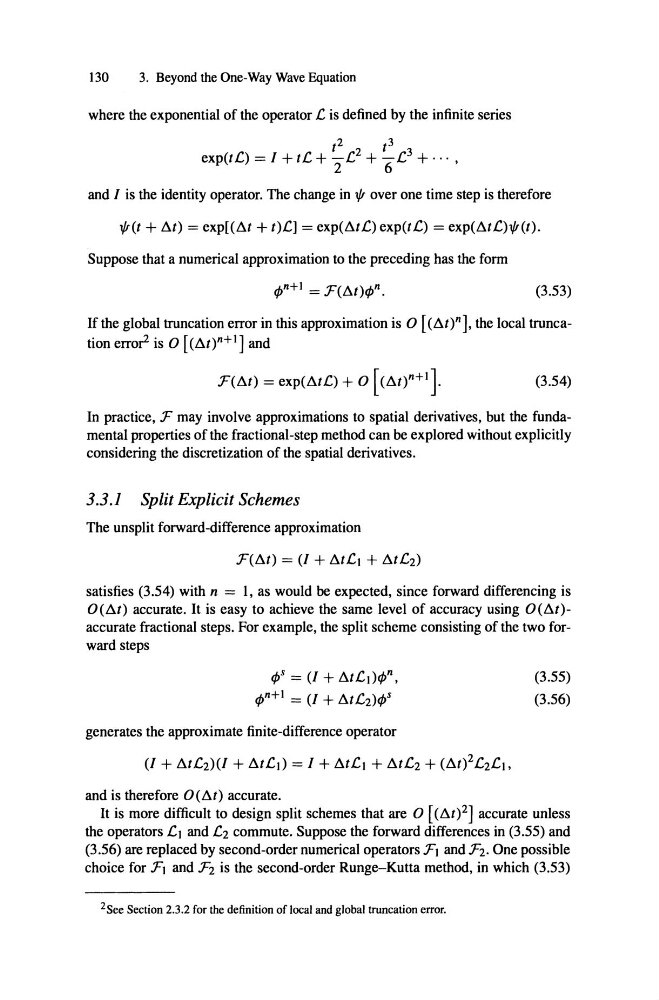
Suppose that a numerical approximation to the preceding has the form
(3.53)
If the global truncation error in this approximation is 0 [( M)n], the local truncation error' is 0 [( M )n+I] and
F(ßt) = exp(M.c) + 0 [(ßtt+I).
(3.54)
In practice, F may involve approximations to spatial derivatives, but the fundamental properties ofthe fractional-step method can be explored without explicitly
considering the discretization of the spatial derivatives.
3.3.1 Split Explicit Schemes
The unsplit forward-difference approximation
satisfies (3.54) with n = I, as would be expected, since forward differencing is
O(ßt) accurate. It is easy to achieve the same level of accuracy using O(ßt)accurate fractional steps . For example, the split scheme consisting of the two forward steps
r/lS = (l + M.cI)r/ln ,
r/ln+1 = (l + M.c2)r/ls
generates the approximate finite-difference operator
(3.55)
(3.56)
and is therefore O(ßt) accurate.
It is more difficult to design split schemes that are 0 [(Mf] accurate unless
the operators .cl and .c2 commute. Suppose the forward differences in (3.55) and
(3.56) are replaced by second-order numerical operators FI and F2. One possible
choice for FI and F2 is the second-order Runge-Kutta method, in which (3.53)
2See Section 2.3.2for the definit ion of local and global truncation error.
3. Beyond the One-Way WaveEquation
where the exponential of the operator E is defined by the infinite series
t
2
exptr C) = I + tL + Z.c
t
3
2
+ 6.c
3
+ ... ,
and I is the identity operator. The change in 1/F over one time step is therefore
1/F(t + ßt) = exp[(ßt + t).c] = exp(ßt.c) exp(t.c) = exp(ßt.c)1/F(t).
Suppose that a numerical approximation to the preceding has the form
(3.53)
If the global truncation error in this approximation is 0 [( M)n], the local truncation error' is 0 [( M )n+I] and
F(ßt) = exp(M.c) + 0 [(ßtt+I).
(3.54)
In practice, F may involve approximations to spatial derivatives, but the fundamental properties ofthe fractional-step method can be explored without explicitly
considering the discretization of the spatial derivatives.
3.3.1 Split Explicit Schemes
The unsplit forward-difference approximation
satisfies (3.54) with n = I, as would be expected, since forward differencing is
O(ßt) accurate. It is easy to achieve the same level of accuracy using O(ßt)accurate fractional steps . For example, the split scheme consisting of the two forward steps
r/lS = (l + M.cI)r/ln ,
r/ln+1 = (l + M.c2)r/ls
generates the approximate finite-difference operator
(3.55)
(3.56)
and is therefore O(ßt) accurate.
It is more difficult to design split schemes that are 0 [(Mf] accurate unless
the operators .cl and .c2 commute. Suppose the forward differences in (3.55) and
(3.56) are replaced by second-order numerical operators FI and F2. One possible
choice for FI and F2 is the second-order Runge-Kutta method, in which (3.53)
2See Section 2.3.2for the definit ion of local and global truncation error.