

3.2 Three or More IndependentVariables
125
the flow has made exactly one circuit around the domain. The solution obtained
using (3.31) is shown in Fig. 3.5a; that obtained using the CTU method appears
in Fig. 3.5b, and the true solution is plotted in Fig. 3.5d. Since they are first-order
methods, both upstream solutions are heavily damped. The solution generated by
the two-dimensional upstream method has also developed a pronounced asyrnmetry, whereas that produced by the eTU method appears axisymmetric. The eTU
solution is, however, damped slightly more than the two-dimensional upstream
solution.
The tendency of the two-dimensional upstream scheme to distort the solution
as shown in Fig. 3.5a can be understood by noting that (3.31) is a second-order
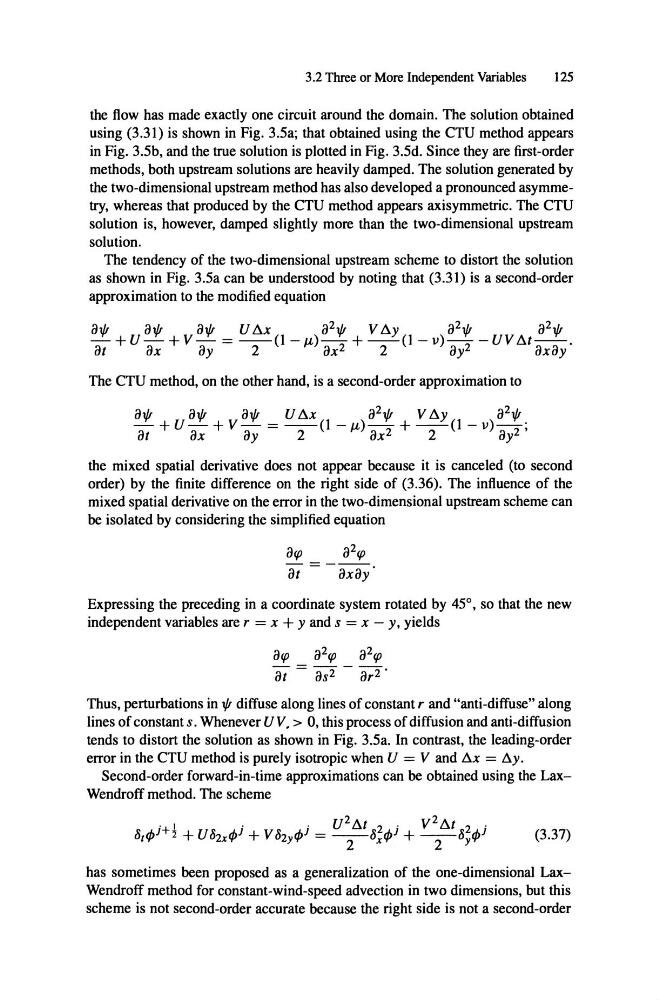
approximation to the modified equation
The eTU method, on the other hand, is a second-order approximation to
the mixed spatial derivative does not appear because it is canceled (to second
order) by the finite difference on the right side of (3.36). The influence of the
mixed spatial derivative on the error in the two-dimensional upstream scheme can
be isolated by considering the simplified equation
ßqJ
ß2qJ
- = - - -
ßt
ßxßy
Expressing the preceding in a coordinate system rotated by 45°, so that the new
independent variables are r = x + y and s = x - y, yields
Thus, perturbations in 1/1 diffuse along lines of constant r and "anti-diffuse" along
lines of constant s. Whenever U V. > 0, this process of diffusion and anti-diffusion
tends to distort the solution as shown in Fig. 3.5a. In contrast, the leading-order
error in the eTU method is purely isotropie when U = V and ßx = ßy.
Second-order forward-in-time approximations can be obtained using the LaxWendroff method . The scheme
(3.37)
has sometimes been proposed as a generalization of the one-dimensional LaxWendroff method for constant-wind-speed advection in two dimensions, but this
scheme is not second-order accurate because the right side is not a second-order
125
the flow has made exactly one circuit around the domain. The solution obtained
using (3.31) is shown in Fig. 3.5a; that obtained using the CTU method appears
in Fig. 3.5b, and the true solution is plotted in Fig. 3.5d. Since they are first-order
methods, both upstream solutions are heavily damped. The solution generated by
the two-dimensional upstream method has also developed a pronounced asyrnmetry, whereas that produced by the eTU method appears axisymmetric. The eTU
solution is, however, damped slightly more than the two-dimensional upstream
solution.
The tendency of the two-dimensional upstream scheme to distort the solution
as shown in Fig. 3.5a can be understood by noting that (3.31) is a second-order
approximation to the modified equation
The eTU method, on the other hand, is a second-order approximation to
the mixed spatial derivative does not appear because it is canceled (to second
order) by the finite difference on the right side of (3.36). The influence of the
mixed spatial derivative on the error in the two-dimensional upstream scheme can
be isolated by considering the simplified equation
ßqJ
ß2qJ
- = - - -
ßt
ßxßy
Expressing the preceding in a coordinate system rotated by 45°, so that the new
independent variables are r = x + y and s = x - y, yields
Thus, perturbations in 1/1 diffuse along lines of constant r and "anti-diffuse" along
lines of constant s. Whenever U V. > 0, this process of diffusion and anti-diffusion
tends to distort the solution as shown in Fig. 3.5a. In contrast, the leading-order
error in the eTU method is purely isotropie when U = V and ßx = ßy.
Second-order forward-in-time approximations can be obtained using the LaxWendroff method . The scheme
(3.37)
has sometimes been proposed as a generalization of the one-dimensional LaxWendroff method for constant-wind-speed advection in two dimensions, but this
scheme is not second-order accurate because the right side is not a second-order