

3.2 Three or More IndependentVariables
123
problem. Incontrast to the situation with centered-in-time schemes, it is, however,
possible to improve the stability of forward-in -time approximations to the twodimensional advection equation while simultaneously improving at least some
aspects of their accuracy.
One natural way to derive the upstream approximation to the one-dimensional
advection equation is through the method of characteristics (Courant et aI. 1952).
The true solution of the one-dimensional advection equation is constant along
characteristic curves whose slopes are dx / dt = U. The characteristic curve passing through the point [m.1.x, (j + 1).1.t] also passes through [(m - /L).1.x, j .1.t],
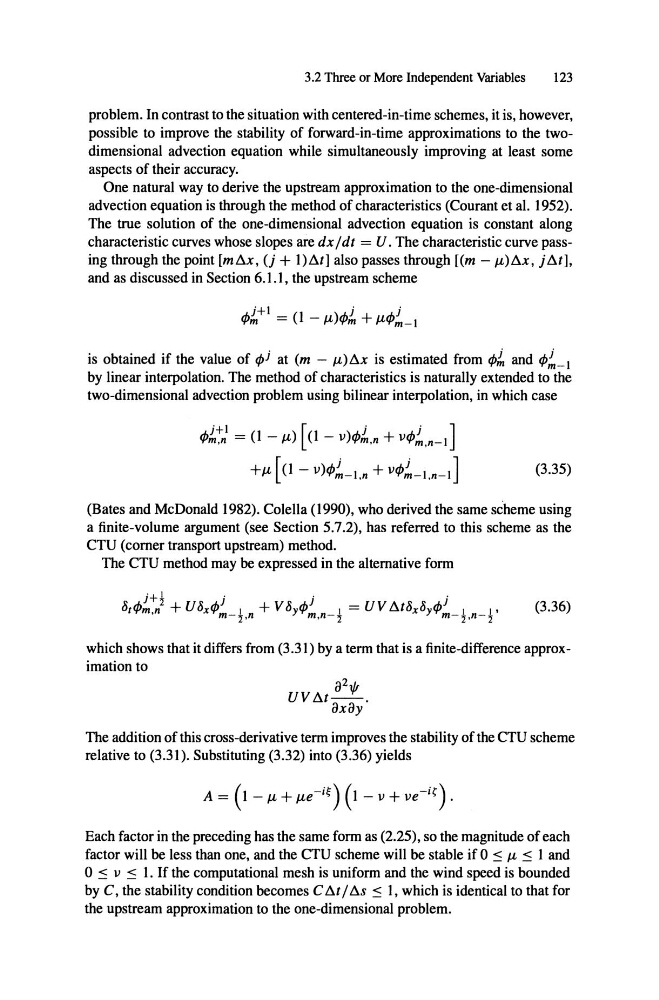
and as discussed in Section 6.1.1, the upstream scheme
is obtained if the value of ifJi at (m - /L).1.x is estimated from
and
by linear interpolation. The method of characteristics is naturally extended to the
two-dimensional advection problem using bilinear interpolation, in which case
«:
'+ 1 = (1 - /L) (1 - v)ifJfn.n +
[
,
'
]
+/L [(1 -
+
(3.35)
(Bates and McDonald 1982). Colella (1990), who derived the same scheme using
a finite-volume argument (see Section 5.7.2), has referred to this scheme as the
CTU (corner transport upstream) method.
The CTU method may be expressed in the alternative form
(3.36)
which shows that it differs from (3.31) by a term that is a finite-difference approximation to
8
2
1/1
UV.1.t-- .
8x8y
The addition of this cross-derivative term improves the stability of the CTU scheme
relative to (3.31). Substituting (3.32) into (3.36) yields
Each factor in the preceding has the same form as (2.25), so the magnitude of each
factor will be less than one, and the CTU scheme will be stable if 0 /L 1 and
o v 1. If the computational mesh is uniform and the wind speed is bounded
by C, the stability condition becomes C .1.t/.1.s
1, which is identical to that for
the upstream approximation to the one-dimensional problem.
123
problem. Incontrast to the situation with centered-in-time schemes, it is, however,
possible to improve the stability of forward-in -time approximations to the twodimensional advection equation while simultaneously improving at least some
aspects of their accuracy.
One natural way to derive the upstream approximation to the one-dimensional
advection equation is through the method of characteristics (Courant et aI. 1952).
The true solution of the one-dimensional advection equation is constant along
characteristic curves whose slopes are dx / dt = U. The characteristic curve passing through the point [m.1.x, (j + 1).1.t] also passes through [(m - /L).1.x, j .1.t],
and as discussed in Section 6.1.1, the upstream scheme
is obtained if the value of ifJi at (m - /L).1.x is estimated from
and
by linear interpolation. The method of characteristics is naturally extended to the
two-dimensional advection problem using bilinear interpolation, in which case
«:
'+ 1 = (1 - /L) (1 - v)ifJfn.n +
[
,
'
]
+/L [(1 -
+
(3.35)
(Bates and McDonald 1982). Colella (1990), who derived the same scheme using
a finite-volume argument (see Section 5.7.2), has referred to this scheme as the
CTU (corner transport upstream) method.
The CTU method may be expressed in the alternative form
(3.36)
which shows that it differs from (3.31) by a term that is a finite-difference approximation to
8
2
1/1
UV.1.t-- .
8x8y
The addition of this cross-derivative term improves the stability of the CTU scheme
relative to (3.31). Substituting (3.32) into (3.36) yields
Each factor in the preceding has the same form as (2.25), so the magnitude of each
factor will be less than one, and the CTU scheme will be stable if 0 /L 1 and
o v 1. If the computational mesh is uniform and the wind speed is bounded
by C, the stability condition becomes C .1.t/.1.s
1, which is identical to that for
the upstream approximation to the one-dimensional problem.