

116
3. Beyond the One-Way Wave Equation
In the above, the momentum equation (3.17) is first updated using forward differencing, and then the continuity equation (3.18) is integrated using backward
differencing. The backward difference does not introduce an implicit coupling
between the unknowns in the forward-backward scheme because u n +I is computed in (3.17) before it is required in (3.18). The overall stability and accuracy of
the forward-backward scheme is independent of which equation is updated first;
the continuity equation could be integrated first with a forward difference and then
the momentum equation could be advanced using a backward difference.
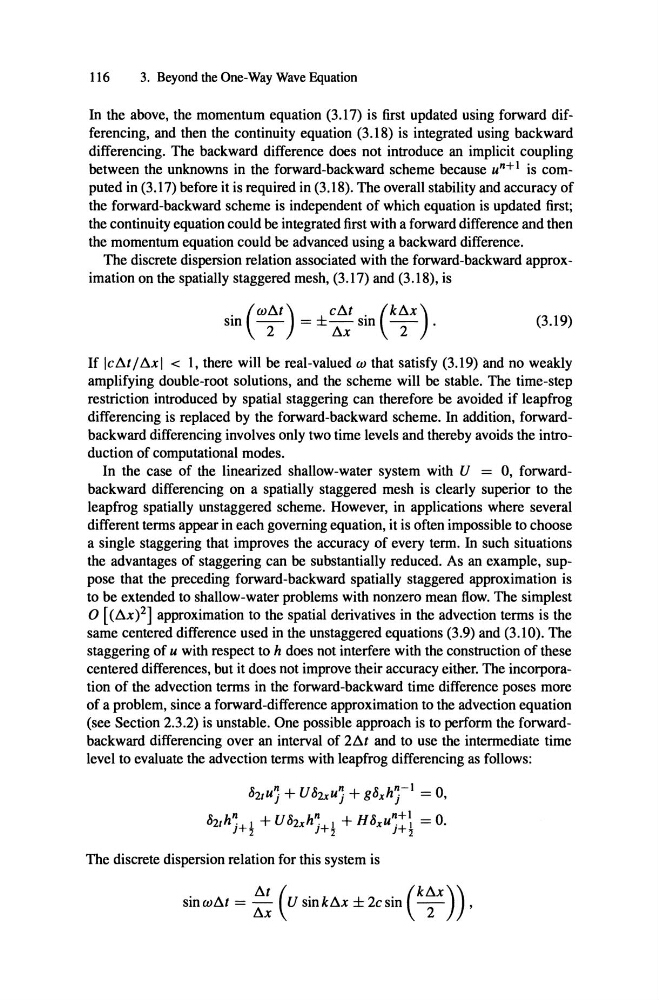
The discrete dispersion relation associated with the forward-backward approximation on the spatially staggered mesh, (3.17) and (3.18), is
sm
. (W!:J.t) -2- = ± e!:J.t !:J.x sm . (k!:J.X) -2- .
(3.19)
If le!:J.t / !:J.x I < 1, there will be real-valued W that satisfy (3.19) and no weakly
amplifying double-root solutions, and the scheme will be stable. The time-step
restriction introduced by spatial staggering can therefore be avoided if leapfrog
differencing is replaced by the forward-backward scheme. In addition , forwardbackward differencing involves only two time levels and thereby avoids the introduction of computational modes .
In the case of the linearized shallow-water system with U = 0, forwardbackward differencing on a spatially staggered mesh is clearly superior to the
leapfrog spatially unstaggered scheme. However, in applications where several
different terms appear in each goveming equation, it is often impossible to choose
a single staggering that improves the accuracy of every term. In such situations
the advantages of staggering can be substantially reduced. As an example, suppose that the preceding forward-backward spatially staggered approximation is
to be extended to shallow-water problems with nonzero mean flow. The simplest
o [(!:J.x)2] approximation to the spatial derivatives in the advection terms is the
same centered difference used in the unstaggered equations (3.9) and (3.10). The
staggering of u with respect to h does not interfere with the construction of these
centered differences, but it does not improve their accuracy either. The incorporation of the advection terms in the forward-backward time difference poses more
of a problem, since a forward -difference approximation to the advection equation
(see Section 2.3.2) is unstable. One possible approach is to perform the forwardbackward differencing over an interval of 2!:J.t and to use the intermediate time
level to evaluate the advection terms with leapfrog differencing as follows:
82tuj + U82xuj + g8xh'tl = 0,
+
+
= 0.
J 2
J 2
J+2
The discrete dispersion relation for this system is
smw!:J.t =
.
!:J.x !:J.t ( U smk!:J.x .
± 2esm . (k!:J.X)) -2- ,
3. Beyond the One-Way Wave Equation
In the above, the momentum equation (3.17) is first updated using forward differencing, and then the continuity equation (3.18) is integrated using backward
differencing. The backward difference does not introduce an implicit coupling
between the unknowns in the forward-backward scheme because u n +I is computed in (3.17) before it is required in (3.18). The overall stability and accuracy of
the forward-backward scheme is independent of which equation is updated first;
the continuity equation could be integrated first with a forward difference and then
the momentum equation could be advanced using a backward difference.
The discrete dispersion relation associated with the forward-backward approximation on the spatially staggered mesh, (3.17) and (3.18), is
sm
. (W!:J.t) -2- = ± e!:J.t !:J.x sm . (k!:J.X) -2- .
(3.19)
If le!:J.t / !:J.x I < 1, there will be real-valued W that satisfy (3.19) and no weakly
amplifying double-root solutions, and the scheme will be stable. The time-step
restriction introduced by spatial staggering can therefore be avoided if leapfrog
differencing is replaced by the forward-backward scheme. In addition , forwardbackward differencing involves only two time levels and thereby avoids the introduction of computational modes .
In the case of the linearized shallow-water system with U = 0, forwardbackward differencing on a spatially staggered mesh is clearly superior to the
leapfrog spatially unstaggered scheme. However, in applications where several
different terms appear in each goveming equation, it is often impossible to choose
a single staggering that improves the accuracy of every term. In such situations
the advantages of staggering can be substantially reduced. As an example, suppose that the preceding forward-backward spatially staggered approximation is
to be extended to shallow-water problems with nonzero mean flow. The simplest
o [(!:J.x)2] approximation to the spatial derivatives in the advection terms is the
same centered difference used in the unstaggered equations (3.9) and (3.10). The
staggering of u with respect to h does not interfere with the construction of these
centered differences, but it does not improve their accuracy either. The incorporation of the advection terms in the forward-backward time difference poses more
of a problem, since a forward -difference approximation to the advection equation
(see Section 2.3.2) is unstable. One possible approach is to perform the forwardbackward differencing over an interval of 2!:J.t and to use the intermediate time
level to evaluate the advection terms with leapfrog differencing as follows:
82tuj + U82xuj + g8xh'tl = 0,
+
+
= 0.
J 2
J 2
J+2
The discrete dispersion relation for this system is
smw!:J.t =
.
!:J.x !:J.t ( U smk!:J.x .
± 2esm . (k!:J.X)) -2- ,