

3.1 Systemsof Equations
111
oscillation equation (2.30) as
cP n + 1 = x" + 2iK ßtcPn,
X n +
1 = cP n.
(3.7)
(3.8)
Although in this example the original problem is govemed by a single ordinary
differential equation rather than a system of partial differential equations, the stability analysis of the finite-difference system proceeds as if (3.7) and (3.8) had
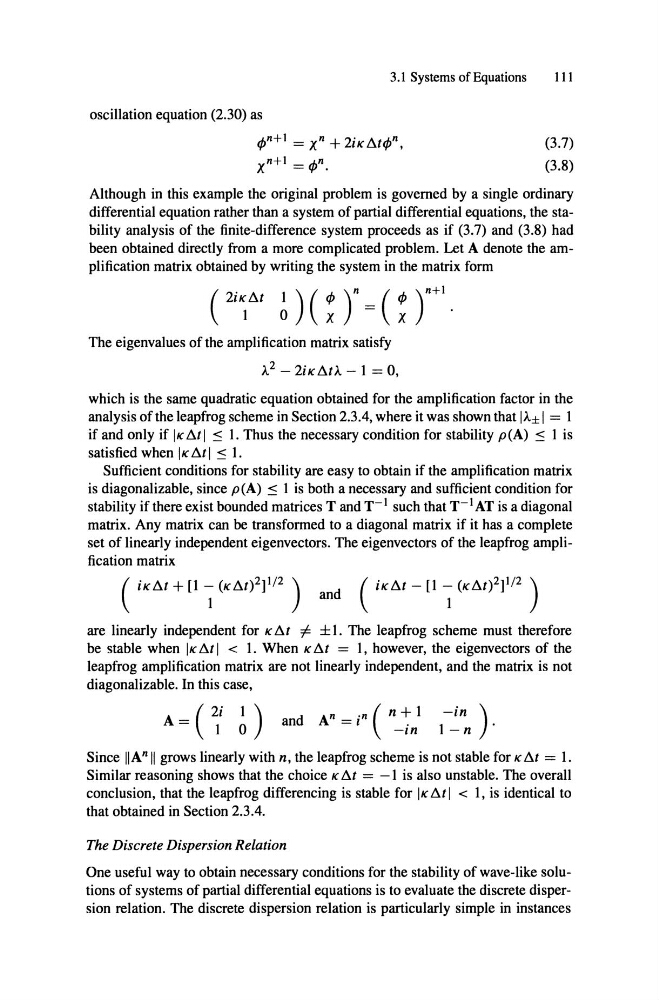
been obtained directIy from a more complicated problem. Let Adenote the amplification matrix obtained by writing the system in the matrix form
The eigenvalues of the amplification matrix satisfy
)..2-2iKßt)"-1=O,
which is the same quadratic equation obtained for the amplification factor in the
analysis of the leapfrog scheme in Section 2.3.4, where it was shown that I)..±I = 1
if and only if IK ßtl ::: 1. Thus the necessary condition for stability p{A) ::: 1 is
satisfied when IK ßt I ::: 1.
Sufficient conditions for stability are easy to obtain if the amplification matrix
is diagonalizable, since p{A) ::: 1 is both a necessary and sufficient condition for
stability if there exist bounded matrices T and T- 1 such that T- 1 ATis a diagonal
matrix. Any matrix can be transformed to a diagonal matrix if it has a complete
set of linearly independent eigenvectors. The eigenvectors of the leapfrog amplification matrix
( itcS: + [1 (K/).t)2] 1/2 ) and ( iK/).t - [1 (K/).t)2]1 /2 )
are 1inearly independent for K /).t f= ± I . The leapfrog scheme must therefore
be stable when IK/).t I < 1. When K /).t = I, however, the eigenvectors of the
leapfrog amplification matrix are not linearly independent, and the matrix is not
diagonalizable. In this case,
A_(2i 1 1)
0
-
·n ( n + 1
.
-in)
1-n .
and A
n =1
-zn
Since 11 An 11 grows linearly with n, the leapfrog scheme is not stable for K /).t = 1.
Similar reasoning shows that the choice K /).t = -1 is also unstab1e. The overall
conclusion, that the leapfrog differencing is stable for IK /).t I < I, is identical to
that obtained in Section 2.3.4.
The Discrete Dispersion Relation
One useful way to obtain necessary conditions fOT the stability of wave-like solutions of systems of partial differential equations is to evaluate the discrete dispersion relation. The discrete dispersion relation is particularly simple in instances
111
oscillation equation (2.30) as
cP n + 1 = x" + 2iK ßtcPn,
X n +
1 = cP n.
(3.7)
(3.8)
Although in this example the original problem is govemed by a single ordinary
differential equation rather than a system of partial differential equations, the stability analysis of the finite-difference system proceeds as if (3.7) and (3.8) had
been obtained directIy from a more complicated problem. Let Adenote the amplification matrix obtained by writing the system in the matrix form
The eigenvalues of the amplification matrix satisfy
)..2-2iKßt)"-1=O,
which is the same quadratic equation obtained for the amplification factor in the
analysis of the leapfrog scheme in Section 2.3.4, where it was shown that I)..±I = 1
if and only if IK ßtl ::: 1. Thus the necessary condition for stability p{A) ::: 1 is
satisfied when IK ßt I ::: 1.
Sufficient conditions for stability are easy to obtain if the amplification matrix
is diagonalizable, since p{A) ::: 1 is both a necessary and sufficient condition for
stability if there exist bounded matrices T and T- 1 such that T- 1 ATis a diagonal
matrix. Any matrix can be transformed to a diagonal matrix if it has a complete
set of linearly independent eigenvectors. The eigenvectors of the leapfrog amplification matrix
( itcS: + [1 (K/).t)2] 1/2 ) and ( iK/).t - [1 (K/).t)2]1 /2 )
are 1inearly independent for K /).t f= ± I . The leapfrog scheme must therefore
be stable when IK/).t I < 1. When K /).t = I, however, the eigenvectors of the
leapfrog amplification matrix are not linearly independent, and the matrix is not
diagonalizable. In this case,
A_(2i 1 1)
0
-
·n ( n + 1
.
-in)
1-n .
and A
n =1
-zn
Since 11 An 11 grows linearly with n, the leapfrog scheme is not stable for K /).t = 1.
Similar reasoning shows that the choice K /).t = -1 is also unstab1e. The overall
conclusion, that the leapfrog differencing is stable for IK /).t I < I, is identical to
that obtained in Section 2.3.4.
The Discrete Dispersion Relation
One useful way to obtain necessary conditions fOT the stability of wave-like solutions of systems of partial differential equations is to evaluate the discrete dispersion relation. The discrete dispersion relation is particularly simple in instances