

for which p (F) = I, but
Fn=(1 n)
o I '
110
3. Beyond the One-Way Wave Equation
The precise necessary and sufficient conditions for an arbitrary matrix to be
power bounded are given by the Kreiss matrix theorem (Kreiss 1962; Strikwerda
1989, p. 188) and are relatively complicated. Necessary conditions for the boundedness of IIAk 11 can, however, be expressed quite simply. In order to have IIAk11
I, i.e., to have a nongrowing numerical solution, it is necessary that
(3.5)
In order to satisfy the bound on the amplification matrix for growing solutions
(3.4) it is necessary that
(3.6)
where y is a constant independent of /).x and /).1. The fact that the preceding are
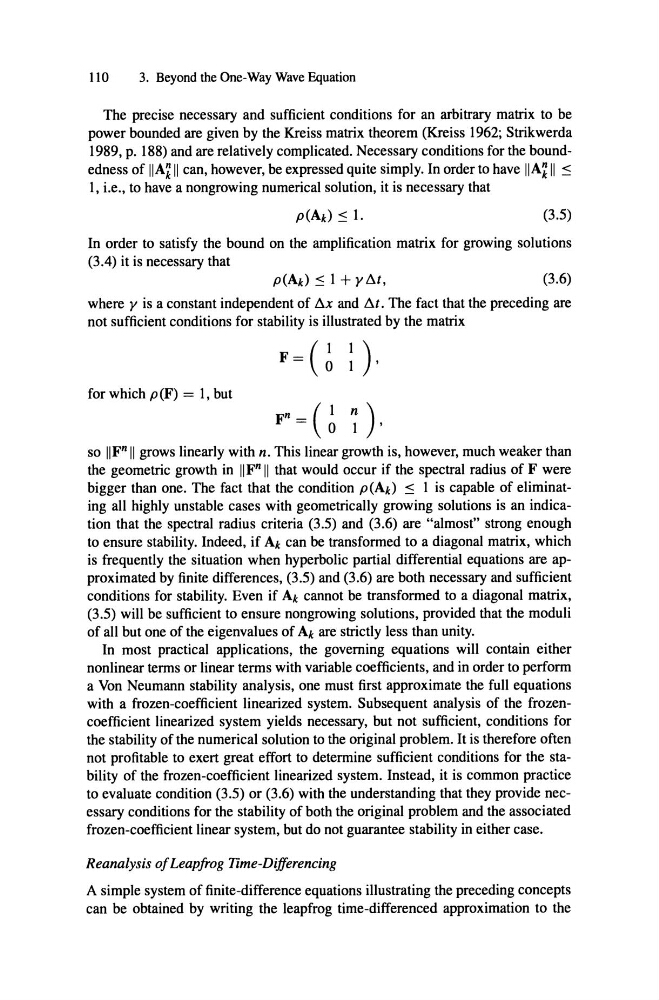
not sufficient conditions for stability is illustrated by the matrix
F=(b
so IIF
n
11 grows linearly with n. This linear growth is, however, much weaker than
the geometrie growth in IIF
n
11 that would occur if the spectral radius of F were
bigger than one. The fact that the condition p(Ak) :::: I is capable of eliminating all highly unstable cases with geometrically growing solutions is an indication that the spectral radius criteria (3.5) and (3.6) are "almost" strong enough
to ensure stability. Indeed, if Ak can be transformed to a diagonal matrix, which
is frequently the situation when hyperbolic partial differential equations are approximated by finite differences , (3.5) and (3.6) are both necessary and sufficient
conditions for stability. Even if Ak cannot be transformed to a diagonal matrix,
(3.5) will be sufficient to ensure nongrowing solutions, provided that the moduli
of all but one of the eigenvalues of Ak are strictly less than unity.
In most practical applications, the goveming equations will contain either
nonlinear terms or linear terms with variable coefficients, and in order to perform
a Von Neumann stability analysis , one must first approximate the full equations
with a frozen-coefficient linearized system. Subsequent analysis of the frozencoefficient linearized system yields necessary, but not sufficient, conditions for
the stability of the numerical solution to the original problem. It is therefore often
not profitable to exert great effort to determine sufficient conditions for the stability of the frozen-coefficient linearized system. Instead, it is common practice
to evaluate condition (3.5) or (3.6) with the understanding that they provide necessary conditions for the stability of both the original problem and the associated
frozen-coefficient linear system, but do not guarantee stability in either case.
Reanalysis 0/Leapfrog Time-Differen cing
A simple system of finite-difference equations iIIustrating the preceding concepts
can be obtained by writing the leapfrog time-differenced approximation to the
Fn=(1 n)
o I '
110
3. Beyond the One-Way Wave Equation
The precise necessary and sufficient conditions for an arbitrary matrix to be
power bounded are given by the Kreiss matrix theorem (Kreiss 1962; Strikwerda
1989, p. 188) and are relatively complicated. Necessary conditions for the boundedness of IIAk 11 can, however, be expressed quite simply. In order to have IIAk11
I, i.e., to have a nongrowing numerical solution, it is necessary that
(3.5)
In order to satisfy the bound on the amplification matrix for growing solutions
(3.4) it is necessary that
(3.6)
where y is a constant independent of /).x and /).1. The fact that the preceding are
not sufficient conditions for stability is illustrated by the matrix
F=(b
so IIF
n
11 grows linearly with n. This linear growth is, however, much weaker than
the geometrie growth in IIF
n
11 that would occur if the spectral radius of F were
bigger than one. The fact that the condition p(Ak) :::: I is capable of eliminating all highly unstable cases with geometrically growing solutions is an indication that the spectral radius criteria (3.5) and (3.6) are "almost" strong enough
to ensure stability. Indeed, if Ak can be transformed to a diagonal matrix, which
is frequently the situation when hyperbolic partial differential equations are approximated by finite differences , (3.5) and (3.6) are both necessary and sufficient
conditions for stability. Even if Ak cannot be transformed to a diagonal matrix,
(3.5) will be sufficient to ensure nongrowing solutions, provided that the moduli
of all but one of the eigenvalues of Ak are strictly less than unity.
In most practical applications, the goveming equations will contain either
nonlinear terms or linear terms with variable coefficients, and in order to perform
a Von Neumann stability analysis , one must first approximate the full equations
with a frozen-coefficient linearized system. Subsequent analysis of the frozencoefficient linearized system yields necessary, but not sufficient, conditions for
the stability of the numerical solution to the original problem. It is therefore often
not profitable to exert great effort to determine sufficient conditions for the stability of the frozen-coefficient linearized system. Instead, it is common practice
to evaluate condition (3.5) or (3.6) with the understanding that they provide necessary conditions for the stability of both the original problem and the associated
frozen-coefficient linear system, but do not guarantee stability in either case.
Reanalysis 0/Leapfrog Time-Differen cing
A simple system of finite-difference equations iIIustrating the preceding concepts
can be obtained by writing the leapfrog time-differenced approximation to the