

3
Beyond the One-Way Wave Equation
The basic properties of finite-difference methods were explored in Chapter 2 by
applying each scheme to a simple prototype problem: the one-way wave equation (or, equivalently, the one-dimensional constant-wind-speed advection equation). The equations goveming wave-like geophysical flows include additional
complexities. In particular, the flow may depend on several unknown functions
that are related by a system of partial differential equations, the unknowns may
be functions of more than two independent variables, and the equations may be
nonlinear. It mayaiso be necessary to account for weak dissipation , sourees, and
sinks. In this chapter we will examine some of the additional considerations that
arise in the design and analysis of finite-difference schemes for the approximation
of these more general problems.
3.1 Systems of Equations
Suppose that the problem of interest involves several unknown functions of x
and t and that the goveming equations for the system are linear with constant
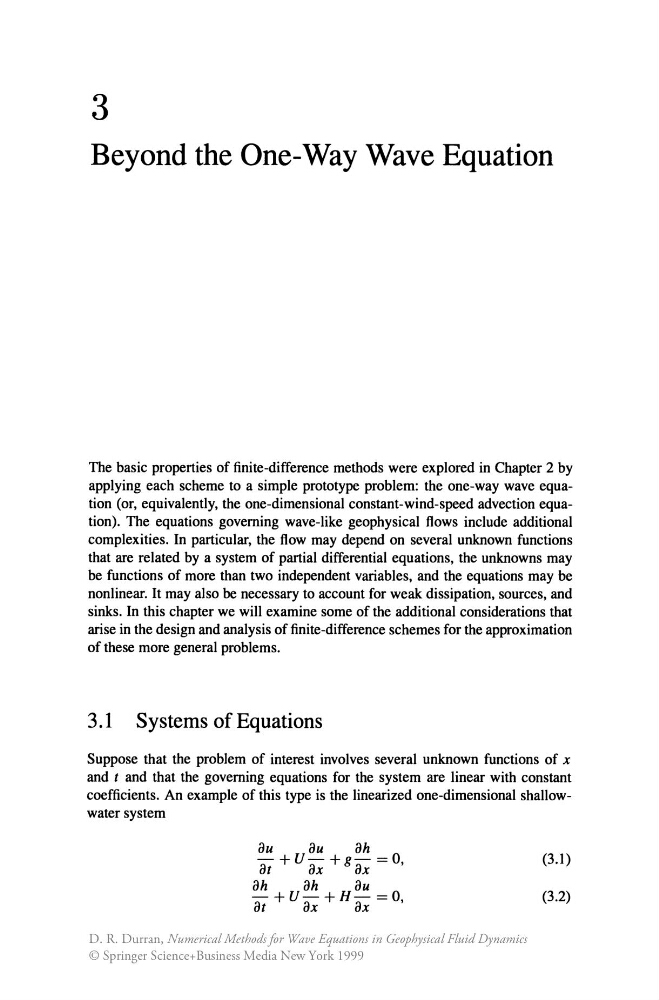
coefficients. An example of this type is the linearized one-dimensional shallowwater system
OU
OU
oh
- + U - + g - =0,
ot
OX
OX
oh
oh
OU
+U-+H- =0,
-
ot
OX
OX
(3.1)
(3.2)
D. R. Durran, Numerical Methods for Wave Equations in Geophysical Fluid Dynamics
© Springer Science+Business Media New York 1999
Beyond the One-Way Wave Equation
The basic properties of finite-difference methods were explored in Chapter 2 by
applying each scheme to a simple prototype problem: the one-way wave equation (or, equivalently, the one-dimensional constant-wind-speed advection equation). The equations goveming wave-like geophysical flows include additional
complexities. In particular, the flow may depend on several unknown functions
that are related by a system of partial differential equations, the unknowns may
be functions of more than two independent variables, and the equations may be
nonlinear. It mayaiso be necessary to account for weak dissipation , sourees, and
sinks. In this chapter we will examine some of the additional considerations that
arise in the design and analysis of finite-difference schemes for the approximation
of these more general problems.
3.1 Systems of Equations
Suppose that the problem of interest involves several unknown functions of x
and t and that the goveming equations for the system are linear with constant
coefficients. An example of this type is the linearized one-dimensional shallowwater system
OU
OU
oh
- + U - + g - =0,
ot
OX
OX
oh
oh
OU
+U-+H- =0,
-
ot
OX
OX
(3.1)
(3.2)
D. R. Durran, Numerical Methods for Wave Equations in Geophysical Fluid Dynamics
© Springer Science+Business Media New York 1999