

2.5 CombinedTime- and Space-Differencing
95
more accurately than the original partial differential equation (Warming and Hyett
1974). The upstream method (2.99) provides a first-order approximation to the
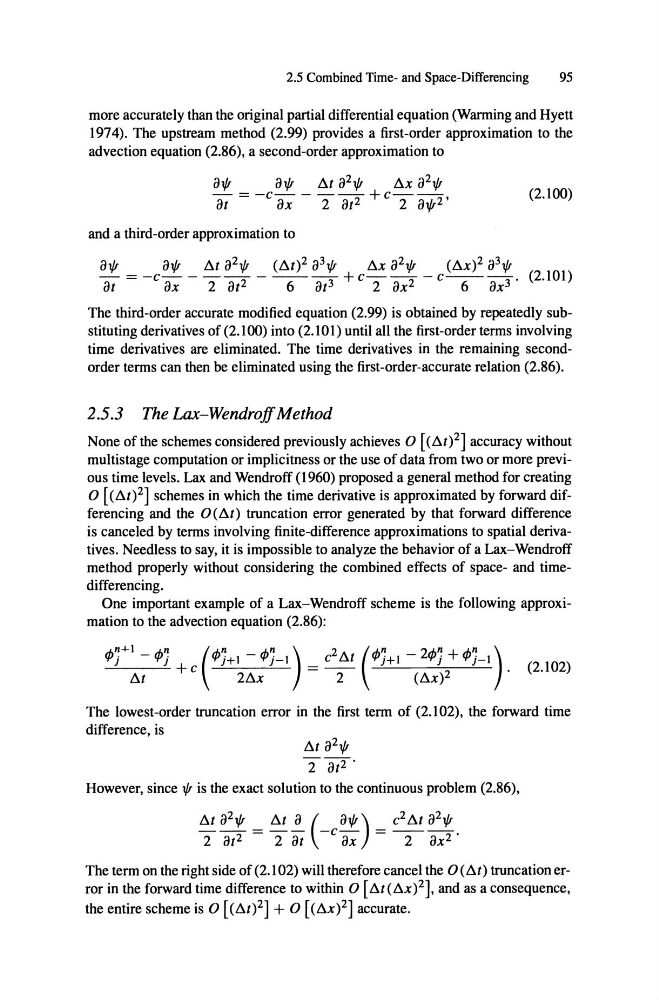
advection equation (2.86), a second-order approximation to
(2.100)
and a third-order approximation to
aljJ
aljJ
I:1t a 2ljJ
(l:1t)2 a 3ljJ
I:1x a 2ljJ
(l:1x)28 3 ljJ
at = -ca; - T 8t 2 - -6- 8t 3 + cT 8x2 - c- 6 - 8x 3 • (2.101)
The third-order accurate modified equation (2.99) is obtained by repeatedly substituting derivatives of (2.100) into (2.101) until all the first-order terms involving
time derivatives are eliminated. The time derivatives in the remaining secondorder terms can then be eliminated using the first-order-accurate relation (2.86).
2.5.3 The Lax-WendroffMethod
None of the schemes considered previously achieves 0 [(1:1t)2] accuracy without
multistage computation or implicitness or the use of data from two or more previous time levels. Lax and Wendroff (1960) proposed a general method for creating
o [(l:1t)2] schemes in which the time derivative is approximated by forward differencing and the 0 (l:1t) truncation error generated by that forward difference
is canceled by terms involving finite-difference approximations to spatial derivatives. Needless to say, it is impossible to analyze the behavior of a Lax-Wendroff
method properly without considering the combined effects of space- and timedifferencing.
One important example of a Lax-Wendroff scheme is the following approximation to the advection equation (2.86):
cPt
l
- cP' J + C (cP' J+ 1 - cP' J- 1 ) = c
2
1:1t (cP' J+ 1 - 2cP'J + cP'J- 1 ) . (2.102)
I:1t
21:1x
2
(l:1x)2
The lowest-order truncation error in the first term of (2.102), the forward time
difference, is
I:1t a 2ljJ
T 8t 2 ·
However, since ljJ is the exact solution to the continuous problem (2.86),
The term on the right side of (2.102) will therefore cancel the 0 (l:1t) truncation error in the forward time difference to within 0 [ßt(l:1x)2], and as a consequence,
the entire scheme is 0 [(l:1t)2] + 0 [(l:1x)2] accurate.
95
more accurately than the original partial differential equation (Warming and Hyett
1974). The upstream method (2.99) provides a first-order approximation to the
advection equation (2.86), a second-order approximation to
(2.100)
and a third-order approximation to
aljJ
aljJ
I:1t a 2ljJ
(l:1t)2 a 3ljJ
I:1x a 2ljJ
(l:1x)28 3 ljJ
at = -ca; - T 8t 2 - -6- 8t 3 + cT 8x2 - c- 6 - 8x 3 • (2.101)
The third-order accurate modified equation (2.99) is obtained by repeatedly substituting derivatives of (2.100) into (2.101) until all the first-order terms involving
time derivatives are eliminated. The time derivatives in the remaining secondorder terms can then be eliminated using the first-order-accurate relation (2.86).
2.5.3 The Lax-WendroffMethod
None of the schemes considered previously achieves 0 [(1:1t)2] accuracy without
multistage computation or implicitness or the use of data from two or more previous time levels. Lax and Wendroff (1960) proposed a general method for creating
o [(l:1t)2] schemes in which the time derivative is approximated by forward differencing and the 0 (l:1t) truncation error generated by that forward difference
is canceled by terms involving finite-difference approximations to spatial derivatives. Needless to say, it is impossible to analyze the behavior of a Lax-Wendroff
method properly without considering the combined effects of space- and timedifferencing.
One important example of a Lax-Wendroff scheme is the following approximation to the advection equation (2.86):
cPt
l
- cP' J + C (cP' J+ 1 - cP' J- 1 ) = c
2
1:1t (cP' J+ 1 - 2cP'J + cP'J- 1 ) . (2.102)
I:1t
21:1x
2
(l:1x)2
The lowest-order truncation error in the first term of (2.102), the forward time
difference, is
I:1t a 2ljJ
T 8t 2 ·
However, since ljJ is the exact solution to the continuous problem (2.86),
The term on the right side of (2.102) will therefore cancel the 0 (l:1t) truncation error in the forward time difference to within 0 [ßt(l:1x)2], and as a consequence,
the entire scheme is 0 [(l:1t)2] + 0 [(l:1x)2] accurate.