

2.5 Combined Time- and Space-Differencing
89
(a)
I"
" '"
' " " , ,, ,
(b)
, ! , I
,
,
"
,
!
!
!
,
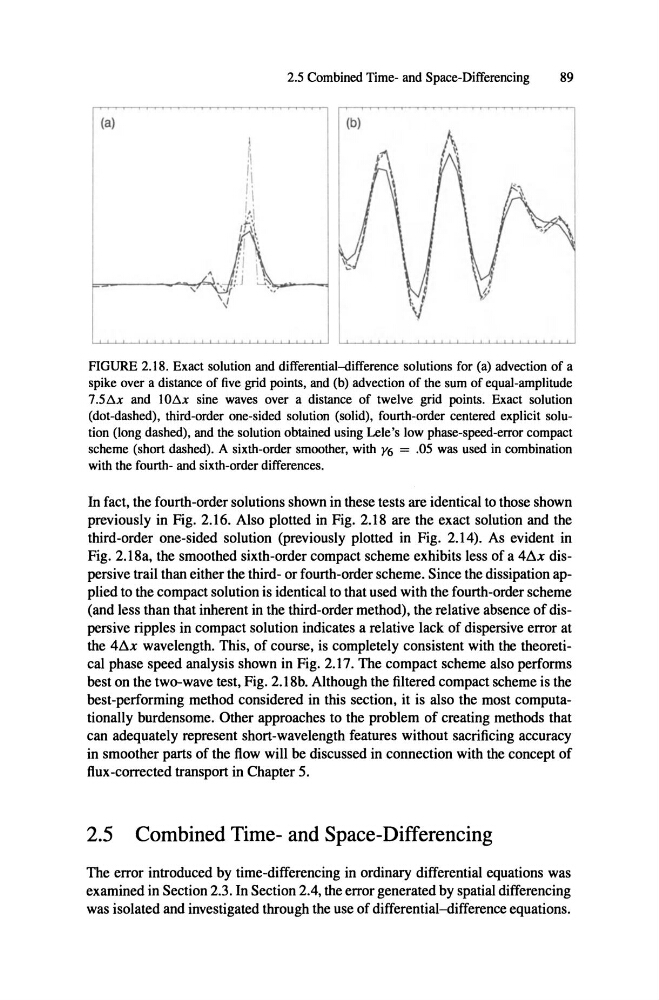
FIGURE 2.18. Exact solution and differential-difference solutions for (a) advection of a
spike over a distance of five grid points, and (b) advection of the sum of equal-amplitude
7.5Ax and lOAx sine waves over a distance of twelve grid points. Exact solution
(dot-dashed), third-order one-sided solution (solid), fourth-order centered explicit solution (long dashed) , and the solution obtained using Lele's low phase-speed-error compact
scheme (short dashed). A sixth-order smoother, with Y6 = .05 was used in combination
with the fourth- and sixth-order differences .
In fact, the fourth-order solutions shown in these tests are identical to those shown
previously in Fig. 2.16. Also plotted in Fig. 2.18 are the exact solution and the
third-order one-sided solution (previously plotted in Fig. 2.14). As evident in
Fig. 2.18a , the smoothed sixth-order compact scheme exhibits less of a 4th dispersive trail than either the third- or fourth-order scheme. Since the dissipation applied to the compact solution is identical to that used with the fourth-order scheme
(and less than that inherent in the third-order method), the relative absence of dispersive ripples in compact solution indicates a relative lack of dispersive error at
the 4ßx wavelength . This, of course, is completely consistent with the theoretical phase speed analysis shown in Fig. 2.17. The compact scheme also performs
best on the two-wave test, Fig. 2.18b. Although the filtered compact scheme is the
best-perforrning method considered in this section, it is also the most computationally burdensome. Other approaches to the problem of creating methods that
can adequately represent short-wavelength features without sacrificing accuracy
in smoother parts of the flow will be discussed in connection with the concept of
flux-corrected transport in Chapter 5.
2.5 Combined Time- and Space-Differencing
The error introduced by time-differencing in ordinary differential equations was
examined in Section 2.3. In Section 2.4, the error generated by spatial differencing
was isolated and investigated through the use of differential-difference equations.
89
(a)
I"
" '"
' " " , ,, ,
(b)
, ! , I
,
,
"
,
!
!
!
,
FIGURE 2.18. Exact solution and differential-difference solutions for (a) advection of a
spike over a distance of five grid points, and (b) advection of the sum of equal-amplitude
7.5Ax and lOAx sine waves over a distance of twelve grid points. Exact solution
(dot-dashed), third-order one-sided solution (solid), fourth-order centered explicit solution (long dashed) , and the solution obtained using Lele's low phase-speed-error compact
scheme (short dashed). A sixth-order smoother, with Y6 = .05 was used in combination
with the fourth- and sixth-order differences .
In fact, the fourth-order solutions shown in these tests are identical to those shown
previously in Fig. 2.16. Also plotted in Fig. 2.18 are the exact solution and the
third-order one-sided solution (previously plotted in Fig. 2.14). As evident in
Fig. 2.18a , the smoothed sixth-order compact scheme exhibits less of a 4th dispersive trail than either the third- or fourth-order scheme. Since the dissipation applied to the compact solution is identical to that used with the fourth-order scheme
(and less than that inherent in the third-order method), the relative absence of dispersive ripples in compact solution indicates a relative lack of dispersive error at
the 4ßx wavelength . This, of course, is completely consistent with the theoretical phase speed analysis shown in Fig. 2.17. The compact scheme also performs
best on the two-wave test, Fig. 2.18b. Although the filtered compact scheme is the
best-perforrning method considered in this section, it is also the most computationally burdensome. Other approaches to the problem of creating methods that
can adequately represent short-wavelength features without sacrificing accuracy
in smoother parts of the flow will be discussed in connection with the concept of
flux-corrected transport in Chapter 5.
2.5 Combined Time- and Space-Differencing
The error introduced by time-differencing in ordinary differential equations was
examined in Section 2.3. In Section 2.4, the error generated by spatial differencing
was isolated and investigated through the use of differential-difference equations.