

88
2. Basic Finite-Difference Methods
50...
WAVELE NGTH
4...
1Ot.
l...ltI2A
WAVE NUMBER
c
--'-1tI4...
o w
W
Q.
:I:
Q.
o'---'
o
- - ' -
31t14...
3'"
.!--J
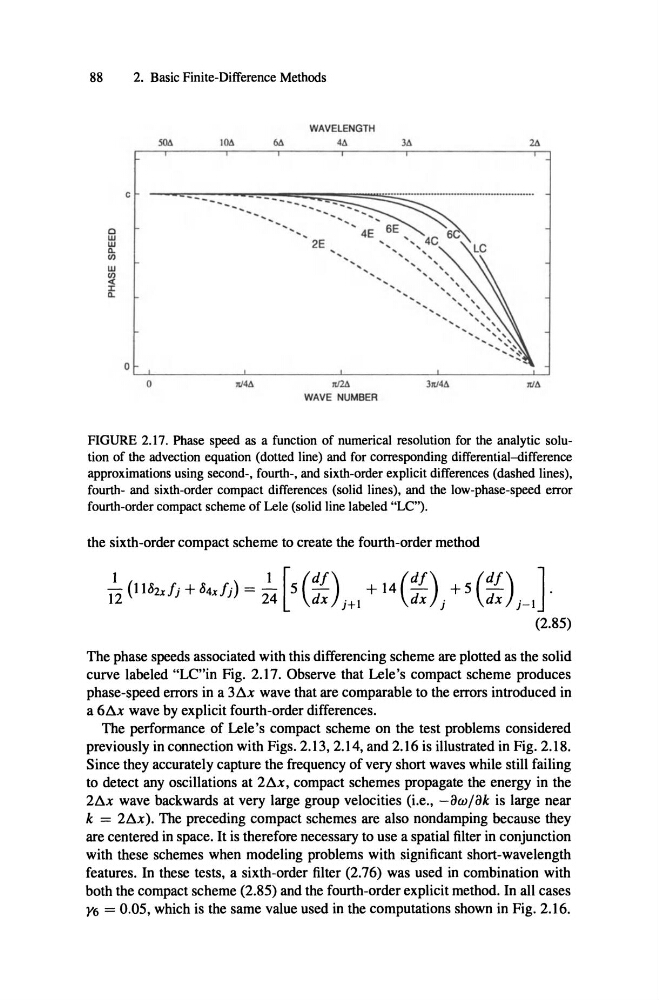
FIGURE 2.17. Phase speed as a function of numerical resolution for the analytic solution of the advection equation (dotted line) and for corresponding differential-difference
approximations using second-, fourth-, and sixth-order explicit differences (dashed lines),
fourth- and sixth-order compact differences (solid lines), and the low-phase-speed error
fourth-order compact scheme of Lele (solid line labeled "Le").
the sixth-order compact scheme to create the fourth-order method
/2 ( 118 2x l j + 84x/j) = ;4 [5 j+\ + 14 j + 5 j-J.
(2.85)
The phase speeds associated with this differencing scheme are plotted as the solid
curve labeled "LC"in Fig. 2.17. Observe that Lele's compact scheme produces
phase-speed errors in a 3ßx wave that are comparable to the errors introduced in
a 6ßx wave by explicit fourth-order differences.
The performance of Lele 's compact scheme on the test problems considered
previously in connection with Figs. 2.13, 2.14, and 2.16 is illustrated in Fig. 2.18.
Since they accurately capture the frequency of very short waves while still failing
to detect any oscillations at 2ßx, compact schemes propagate the energy in the
2ßx wave backwards at very large group velocities (i.e., -aw/ak is large near
k = 2ßx). The preceding compact schemes are also nondamping because they
are centered in space. It is therefore necessary to use a spatial filter in conjunction
with these schemes when modeling problems with significant short-wavelength
features. In these tests, a sixth-order filter (2.76) was used in combination with
both the compact scheme (2.85) and the fourth-order explicit method. In all cases
Y6 = 0.05, which is the same value used in the computations shown in Fig. 2.16.
2. Basic Finite-Difference Methods
50...
WAVELE NGTH
4...
1Ot.
l...ltI2A
WAVE NUMBER
c
--'-1tI4...
o w
W
Q.
:I:
Q.
o'---'
o
- - ' -
31t14...
3'"
.!--J
FIGURE 2.17. Phase speed as a function of numerical resolution for the analytic solution of the advection equation (dotted line) and for corresponding differential-difference
approximations using second-, fourth-, and sixth-order explicit differences (dashed lines),
fourth- and sixth-order compact differences (solid lines), and the low-phase-speed error
fourth-order compact scheme of Lele (solid line labeled "Le").
the sixth-order compact scheme to create the fourth-order method
/2 ( 118 2x l j + 84x/j) = ;4 [5 j+\ + 14 j + 5 j-J.
(2.85)
The phase speeds associated with this differencing scheme are plotted as the solid
curve labeled "LC"in Fig. 2.17. Observe that Lele's compact scheme produces
phase-speed errors in a 3ßx wave that are comparable to the errors introduced in
a 6ßx wave by explicit fourth-order differences.
The performance of Lele 's compact scheme on the test problems considered
previously in connection with Figs. 2.13, 2.14, and 2.16 is illustrated in Fig. 2.18.
Since they accurately capture the frequency of very short waves while still failing
to detect any oscillations at 2ßx, compact schemes propagate the energy in the
2ßx wave backwards at very large group velocities (i.e., -aw/ak is large near
k = 2ßx). The preceding compact schemes are also nondamping because they
are centered in space. It is therefore necessary to use a spatial filter in conjunction
with these schemes when modeling problems with significant short-wavelength
features. In these tests, a sixth-order filter (2.76) was used in combination with
both the compact scheme (2.85) and the fourth-order explicit method. In all cases
Y6 = 0.05, which is the same value used in the computations shown in Fig. 2.16.