

250
The Biology of Sea Turtles, Vol. II
ancestors committed fully to the sea, a completely neritic developmental and adult
life history (Type 1) would be the expected pattern because they would probably
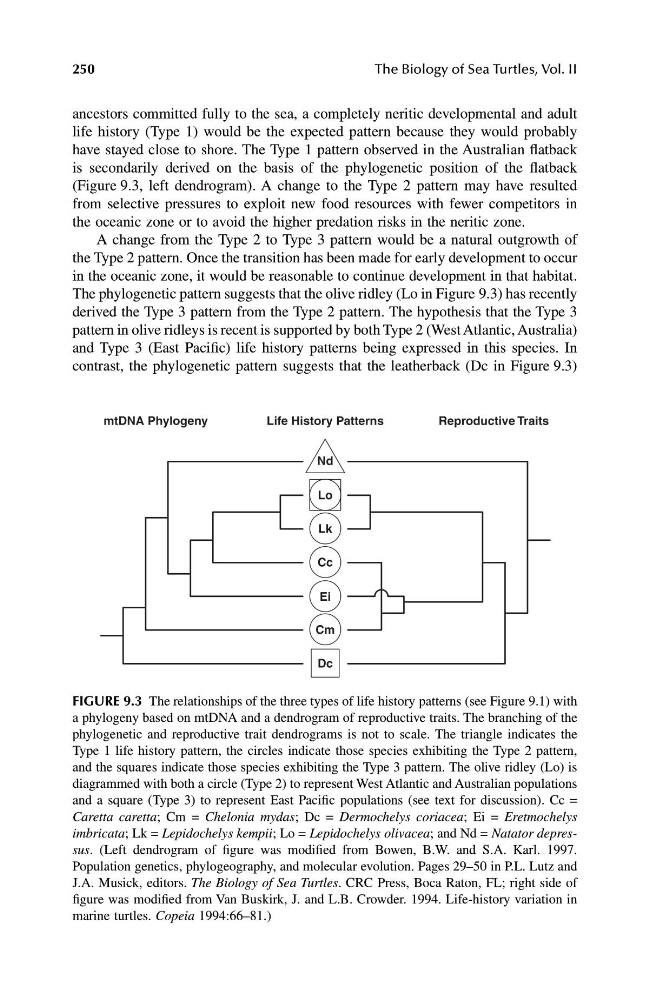
have stayed close to shore. The Type 1 pattern observed in the Australian flatback
is secondarily derived on the basis of the phylogenetic position of the flatback
(Figure 9.3, left dendrogram). A change to the Type 2 pattern may have resulted
from selective pressures to exploit new food resources with fewer competitors in
the oceanic zone or to avoid the higher predation risks in the neritic zone.
A change from the Type 2 to Type 3 pattern would be a natural outgrowth of
the Type 2 pattern. Once the transition has been made for early development to occur
in the oceanic zone, it would be reasonable to continue development in that habitat.
The phylogenetic pattern suggests that the olive ridley (Lo in Figure 9.3) has recently
derived the Type 3 pattern from the Type 2 pattern. The hypothesis that the Type 3
pattern in olive ridleys is recent is supported by both Type 2 (West Atlantic, Australia)
and Type 3 (East Pacific) life history patterns being expressed in this species. In
contrast, the phylogenetic pattern suggests that the leatherback (Dc in Figure 9.3)
FIGURE 9.3 The relationships of the three types of life history patterns (see Figure 9.1) with
a phylogeny based on mtDNA and a dendrogram of reproductive traits. The branching of the
phylogenetic and reproductive trait dendrograms is not to scale. The triangle indicates the
Type 1 life history pattern, the circles indicate those species exhibiting the Type 2 pattern,
and the squares indicate those species exhibiting the Type 3 pattern. The olive ridley (Lo) is
diagrammed with both a circle (Type 2) to represent West Atlantic and Australian populations
and a square (Type 3) to represent East Pacific populations (see text for discussion). Cc =
Caretta caretta ; Cm = Chelonia mydas ; Dc = Dermochelys coriacea ; Ei = Eretmochelys
imbricata ; Lk = Lepidochelys kempii ; Lo = Lepidochelys olivacea ; and Nd = Natator depressus . (Left dendrogram of figure was modified from Bowen, B.W. and S.A. Karl. 1997.
Population genetics, phylogeography, and molecular evolution. Pages 29–50 in P.L. Lutz and
J.A. Musick, editors. The Biology of Sea Turtles . CRC Press, Boca Raton, FL; right side of
figure was modified from Van Buskirk, J. and L.B. Crowder. 1994. Life-history variation in
marine turtles. Copeia 1994:66–81.)
mtDNA Phylogeny
Reproductive Traits
Life History Patterns
Lo
Lk
Cc
Ei
Cm
Dc
Nd
1123 book.book Page 250 Monday, November 11, 2002 11:11 AM
The Biology of Sea Turtles, Vol. II
ancestors committed fully to the sea, a completely neritic developmental and adult
life history (Type 1) would be the expected pattern because they would probably
have stayed close to shore. The Type 1 pattern observed in the Australian flatback
is secondarily derived on the basis of the phylogenetic position of the flatback
(Figure 9.3, left dendrogram). A change to the Type 2 pattern may have resulted
from selective pressures to exploit new food resources with fewer competitors in
the oceanic zone or to avoid the higher predation risks in the neritic zone.
A change from the Type 2 to Type 3 pattern would be a natural outgrowth of
the Type 2 pattern. Once the transition has been made for early development to occur
in the oceanic zone, it would be reasonable to continue development in that habitat.
The phylogenetic pattern suggests that the olive ridley (Lo in Figure 9.3) has recently
derived the Type 3 pattern from the Type 2 pattern. The hypothesis that the Type 3
pattern in olive ridleys is recent is supported by both Type 2 (West Atlantic, Australia)
and Type 3 (East Pacific) life history patterns being expressed in this species. In
contrast, the phylogenetic pattern suggests that the leatherback (Dc in Figure 9.3)
FIGURE 9.3 The relationships of the three types of life history patterns (see Figure 9.1) with
a phylogeny based on mtDNA and a dendrogram of reproductive traits. The branching of the
phylogenetic and reproductive trait dendrograms is not to scale. The triangle indicates the
Type 1 life history pattern, the circles indicate those species exhibiting the Type 2 pattern,
and the squares indicate those species exhibiting the Type 3 pattern. The olive ridley (Lo) is
diagrammed with both a circle (Type 2) to represent West Atlantic and Australian populations
and a square (Type 3) to represent East Pacific populations (see text for discussion). Cc =
Caretta caretta ; Cm = Chelonia mydas ; Dc = Dermochelys coriacea ; Ei = Eretmochelys
imbricata ; Lk = Lepidochelys kempii ; Lo = Lepidochelys olivacea ; and Nd = Natator depressus . (Left dendrogram of figure was modified from Bowen, B.W. and S.A. Karl. 1997.
Population genetics, phylogeography, and molecular evolution. Pages 29–50 in P.L. Lutz and
J.A. Musick, editors. The Biology of Sea Turtles . CRC Press, Boca Raton, FL; right side of
figure was modified from Van Buskirk, J. and L.B. Crowder. 1994. Life-history variation in
marine turtles. Copeia 1994:66–81.)
mtDNA Phylogeny
Reproductive Traits
Life History Patterns
Lo
Lk
Cc
Ei
Cm
Dc
Nd
1123 book.book Page 250 Monday, November 11, 2002 11:11 AM