

216
The Biology of Sea Turtles, Vol. II
1968). In addition to being involved in hormone regulation, Sertoli’s cells have a
phagocytic role, eliminating sperm after spermatogenesis is finished (Fox, 1952).
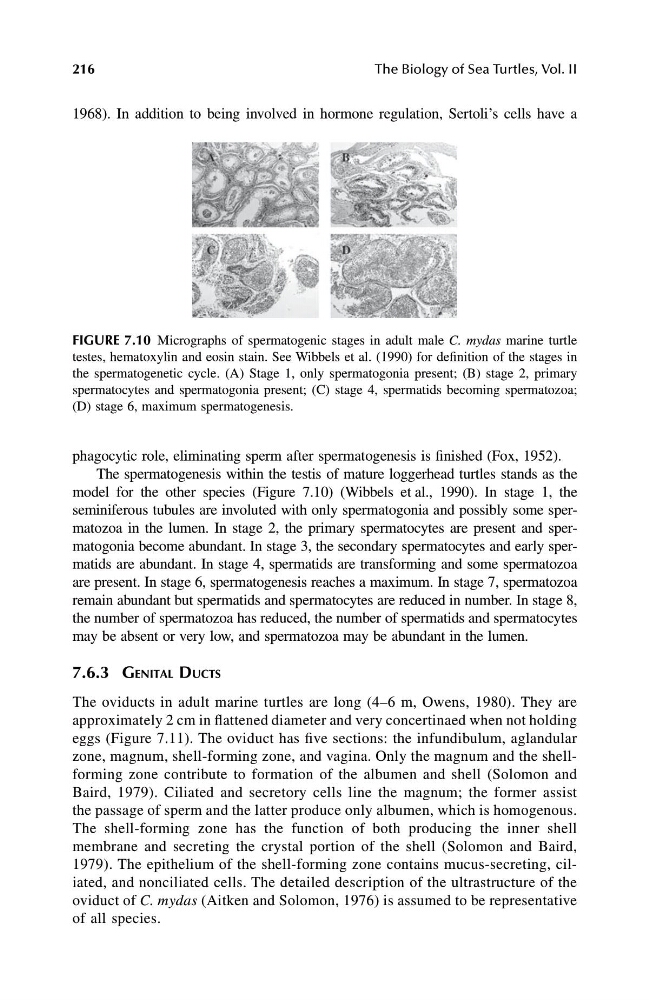
The spermatogenesis within the testis of mature loggerhead turtles stands as the
model for the other species (Figure 7.10) (Wibbels et al., 1990). In stage 1, the
seminiferous tubules are involuted with only spermatogonia and possibly some spermatozoa in the lumen. In stage 2, the primary spermatocytes are present and spermatogonia become abundant. In stage 3, the secondary spermatocytes and early spermatids are abundant. In stage 4, spermatids are transforming and some spermatozoa
are present. In stage 6, spermatogenesis reaches a maximum. In stage 7, spermatozoa
remain abundant but spermatids and spermatocytes are reduced in number. In stage 8,
the number of spermatozoa has reduced, the number of spermatids and spermatocytes
may be absent or very low, and spermatozoa may be abundant in the lumen.
7.6.3 GENITAL DUCTS
The oviducts in adult marine turtles are long (4–6 m, Owens, 1980). They are
approximately 2 cm in flattened diameter and very concertinaed when not holding
eggs (Figure 7.11). The oviduct has five sections: the infundibulum, aglandular
zone, magnum, shell-forming zone, and vagina. Only the magnum and the shellforming zone contribute to formation of the albumen and shell (Solomon and
Baird, 1979). Ciliated and secretory cells line the magnum; the former assist
the passage of sperm and the latter produce only albumen, which is homogenous.
The shell-forming zone has the function of both producing the inner shell
membrane and secreting the crystal portion of the shell (Solomon and Baird,
1979). The epithelium of the shell-forming zone contains mucus-secreting, ciliated, and nonciliated cells. The detailed description of the ultrastructure of the
oviduct of C. mydas (Aitken and Solomon, 1976) is assumed to be representative
of all species.
FIGURE 7.10 Micrographs of spermatogenic stages in adult male C. mydas marine turtle
testes, hematoxylin and eosin stain. See Wibbels et al. (1990) for definition of the stages in
the spermatogenetic cycle. (A) Stage 1, only spermatogonia present; (B) stage 2, primary
spermatocytes and spermatogonia present; (C) stage 4, spermatids becoming spermatozoa;
(D) stage 6, maximum spermatogenesis.
1123 book.book Page 216 Monday, November 11, 2002 11:11 AM
The Biology of Sea Turtles, Vol. II
1968). In addition to being involved in hormone regulation, Sertoli’s cells have a
phagocytic role, eliminating sperm after spermatogenesis is finished (Fox, 1952).
The spermatogenesis within the testis of mature loggerhead turtles stands as the
model for the other species (Figure 7.10) (Wibbels et al., 1990). In stage 1, the
seminiferous tubules are involuted with only spermatogonia and possibly some spermatozoa in the lumen. In stage 2, the primary spermatocytes are present and spermatogonia become abundant. In stage 3, the secondary spermatocytes and early spermatids are abundant. In stage 4, spermatids are transforming and some spermatozoa
are present. In stage 6, spermatogenesis reaches a maximum. In stage 7, spermatozoa
remain abundant but spermatids and spermatocytes are reduced in number. In stage 8,
the number of spermatozoa has reduced, the number of spermatids and spermatocytes
may be absent or very low, and spermatozoa may be abundant in the lumen.
7.6.3 GENITAL DUCTS
The oviducts in adult marine turtles are long (4–6 m, Owens, 1980). They are
approximately 2 cm in flattened diameter and very concertinaed when not holding
eggs (Figure 7.11). The oviduct has five sections: the infundibulum, aglandular
zone, magnum, shell-forming zone, and vagina. Only the magnum and the shellforming zone contribute to formation of the albumen and shell (Solomon and
Baird, 1979). Ciliated and secretory cells line the magnum; the former assist
the passage of sperm and the latter produce only albumen, which is homogenous.
The shell-forming zone has the function of both producing the inner shell
membrane and secreting the crystal portion of the shell (Solomon and Baird,
1979). The epithelium of the shell-forming zone contains mucus-secreting, ciliated, and nonciliated cells. The detailed description of the ultrastructure of the
oviduct of C. mydas (Aitken and Solomon, 1976) is assumed to be representative
of all species.
FIGURE 7.10 Micrographs of spermatogenic stages in adult male C. mydas marine turtle
testes, hematoxylin and eosin stain. See Wibbels et al. (1990) for definition of the stages in
the spermatogenetic cycle. (A) Stage 1, only spermatogonia present; (B) stage 2, primary
spermatocytes and spermatogonia present; (C) stage 4, spermatids becoming spermatozoa;
(D) stage 6, maximum spermatogenesis.
1123 book.book Page 216 Monday, November 11, 2002 11:11 AM