

Sensory Biology of Sea Turtles
97
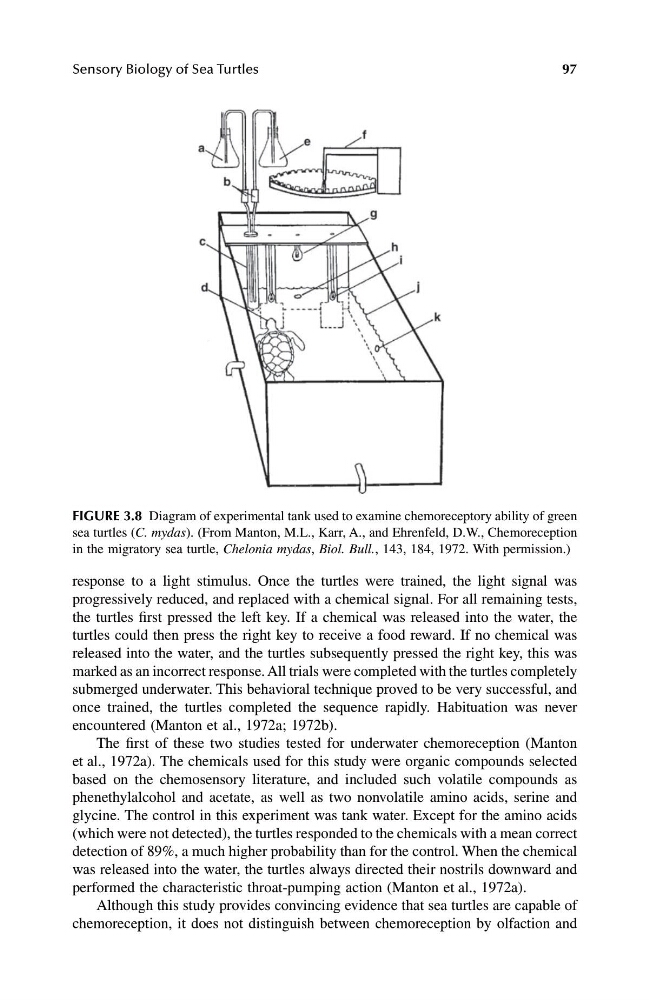
response to a light stimulus. Once the turtles were trained, the light signal was
progressively reduced, and replaced with a chemical signal. For all remaining tests,
the turtles first pressed the left key. If a chemical was released into the water, the
turtles could then press the right key to receive a food reward. If no chemical was
released into the water, and the turtles subsequently pressed the right key, this was
marked as an incorrect response. All trials were completed with the turtles completely
submerged underwater. This behavioral technique proved to be very successful, and
once trained, the turtles completed the sequence rapidly. Habituation was never
encountered (Manton et al., 1972a; 1972b).
The first of these two studies tested for underwater chemoreception (Manton
et al., 1972a). The chemicals used for this study were organic compounds selected
based on the chemosensory literature, and included such volatile compounds as
phenethylalcohol and acetate, as well as two nonvolatile amino acids, serine and
glycine. The control in this experiment was tank water. Except for the amino acids
(which were not detected), the turtles responded to the chemicals with a mean correct
detection of 89%, a much higher probability than for the control. When the chemical
was released into the water, the turtles always directed their nostrils downward and
performed the characteristic throat-pumping action (Manton et al., 1972a).
Although this study provides convincing evidence that sea turtles are capable of
chemoreception, it does not distinguish between chemoreception by olfaction and
FIGURE 3.8 Diagram of experimental tank used to examine chemoreceptory ability of green
sea turtles (C. mydas). (From Manton, M.L., Karr, A., and Ehrenfeld, D.W., Chemoreception
in the migratory sea turtle, Chelonia mydas, Biol. Bull., 143, 184, 1972. With permission.)
1123 book.book Page 97 Monday, November 11, 2002 11:11 AM
97
response to a light stimulus. Once the turtles were trained, the light signal was
progressively reduced, and replaced with a chemical signal. For all remaining tests,
the turtles first pressed the left key. If a chemical was released into the water, the
turtles could then press the right key to receive a food reward. If no chemical was
released into the water, and the turtles subsequently pressed the right key, this was
marked as an incorrect response. All trials were completed with the turtles completely
submerged underwater. This behavioral technique proved to be very successful, and
once trained, the turtles completed the sequence rapidly. Habituation was never
encountered (Manton et al., 1972a; 1972b).
The first of these two studies tested for underwater chemoreception (Manton
et al., 1972a). The chemicals used for this study were organic compounds selected
based on the chemosensory literature, and included such volatile compounds as
phenethylalcohol and acetate, as well as two nonvolatile amino acids, serine and
glycine. The control in this experiment was tank water. Except for the amino acids
(which were not detected), the turtles responded to the chemicals with a mean correct
detection of 89%, a much higher probability than for the control. When the chemical
was released into the water, the turtles always directed their nostrils downward and
performed the characteristic throat-pumping action (Manton et al., 1972a).
Although this study provides convincing evidence that sea turtles are capable of
chemoreception, it does not distinguish between chemoreception by olfaction and
FIGURE 3.8 Diagram of experimental tank used to examine chemoreceptory ability of green
sea turtles (C. mydas). (From Manton, M.L., Karr, A., and Ehrenfeld, D.W., Chemoreception
in the migratory sea turtle, Chelonia mydas, Biol. Bull., 143, 184, 1972. With permission.)
1123 book.book Page 97 Monday, November 11, 2002 11:11 AM