

96
The Biology of Sea Turtles, Vol. II
3.4.2 BEHAVIOR
3.4.2.1 General Behavioral Observations
In a study that generally documented the sea turtle’s natural behavior, Walker (1959)
reported that sea turtles open their nostrils and move their mouths slowly open and
closed while underwater. Walker postulated that this throat-pumping behavior moves
water over the nostrils for olfaction, as had been suggested for many freshwater
turtles (McCutcheon, 1943; Root, 1949). Throat-pumping has not been observed
when sea turtles are resting or when they are breathing at the surface. This repetitive
blowing of water out of the external nares while underwater occurs only while the
animal is awake and active, and is postulated to be a mechanism for moving water
over the chemoreceptor organs (Manton, 1979).
3.4.2.2 Odor Discrimination
Two operant conditioning studies examining underwater chemosensory behavior in
green sea turtles (C. mydas) have been performed (Manton et al., 1972a; 1972b).
Both studies used similar procedures. A tank was set up with two response keys
suspended underwater; a light was mounted over each key (Figure 3.8). The turtles
were able to swim freely within the tank environment. Turtles were first trained
(using a food reward as reinforcement) to press either the right or the left key in
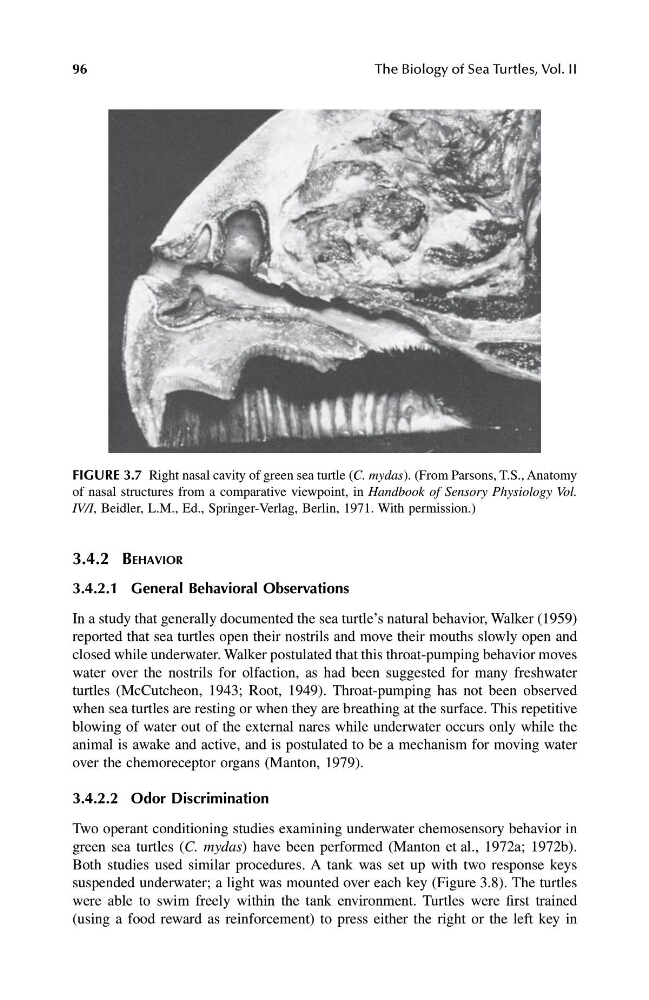
FIGURE 3.7 Right nasal cavity of green sea turtle (C. mydas). (From Parsons, T.S., Anatomy
of nasal structures from a comparative viewpoint, in Handbook of Sensory Physiology Vol.
IV/I, Beidler, L.M., Ed., Springer-Verlag, Berlin, 1971. With permission.)
1123 book.book Page 96 Monday, November 11, 2002 11:11 AM
The Biology of Sea Turtles, Vol. II
3.4.2 BEHAVIOR
3.4.2.1 General Behavioral Observations
In a study that generally documented the sea turtle’s natural behavior, Walker (1959)
reported that sea turtles open their nostrils and move their mouths slowly open and
closed while underwater. Walker postulated that this throat-pumping behavior moves
water over the nostrils for olfaction, as had been suggested for many freshwater
turtles (McCutcheon, 1943; Root, 1949). Throat-pumping has not been observed
when sea turtles are resting or when they are breathing at the surface. This repetitive
blowing of water out of the external nares while underwater occurs only while the
animal is awake and active, and is postulated to be a mechanism for moving water
over the chemoreceptor organs (Manton, 1979).
3.4.2.2 Odor Discrimination
Two operant conditioning studies examining underwater chemosensory behavior in
green sea turtles (C. mydas) have been performed (Manton et al., 1972a; 1972b).
Both studies used similar procedures. A tank was set up with two response keys
suspended underwater; a light was mounted over each key (Figure 3.8). The turtles
were able to swim freely within the tank environment. Turtles were first trained
(using a food reward as reinforcement) to press either the right or the left key in
FIGURE 3.7 Right nasal cavity of green sea turtle (C. mydas). (From Parsons, T.S., Anatomy
of nasal structures from a comparative viewpoint, in Handbook of Sensory Physiology Vol.
IV/I, Beidler, L.M., Ed., Springer-Verlag, Berlin, 1971. With permission.)
1123 book.book Page 96 Monday, November 11, 2002 11:11 AM