

58
Biology of Sea Turtles, Vol. II
anterior carapace, involved in flipper movements and, in a few cases, breathing.
Posterior muscles are the large postaxial muscles of the hip, thigh, and lower leg.
2.4.1 MUSCLES OF THE HEAD AND NECK
The major head muscles function in jaw opening and closing. They can be divided
into jaw opening muscles innervated by the trigeminal nerve, and the jaw closing
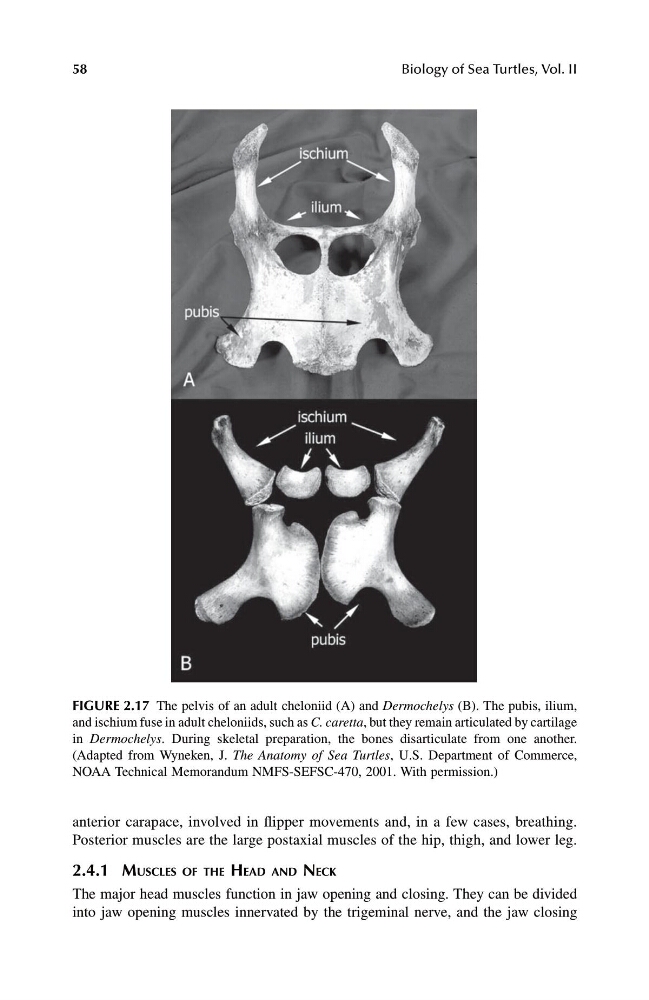
FIGURE 2.17 The pelvis of an adult cheloniid (A) and Dermochelys (B). The pubis, ilium,
and ischium fuse in adult cheloniids, such as C. caretta, but they remain articulated by cartilage
in Dermochelys. During skeletal preparation, the bones disarticulate from one another.
(Adapted from Wyneken, J. The Anatomy of Sea Turtles, U.S. Department of Commerce,
NOAA Technical Memorandum NMFS-SEFSC-470, 2001. With permission.)
1123_C02.fm Page 58 Friday, November 15, 2002 11:16 AM
Biology of Sea Turtles, Vol. II
anterior carapace, involved in flipper movements and, in a few cases, breathing.
Posterior muscles are the large postaxial muscles of the hip, thigh, and lower leg.
2.4.1 MUSCLES OF THE HEAD AND NECK
The major head muscles function in jaw opening and closing. They can be divided
into jaw opening muscles innervated by the trigeminal nerve, and the jaw closing
FIGURE 2.17 The pelvis of an adult cheloniid (A) and Dermochelys (B). The pubis, ilium,
and ischium fuse in adult cheloniids, such as C. caretta, but they remain articulated by cartilage
in Dermochelys. During skeletal preparation, the bones disarticulate from one another.
(Adapted from Wyneken, J. The Anatomy of Sea Turtles, U.S. Department of Commerce,
NOAA Technical Memorandum NMFS-SEFSC-470, 2001. With permission.)
1123_C02.fm Page 58 Friday, November 15, 2002 11:16 AM