

90 3 Non-geometry standards
The current version of the ISO 19115 refers primarily to vector data. An amendment for imagery type data (raster) will follow (ISO 19115-2).
Content ofl50 19115
The metadata elements in ISO 19115 are grouped in two levels: the core metadata
elements and the fulliist (also called "comprehensive metadata elements").
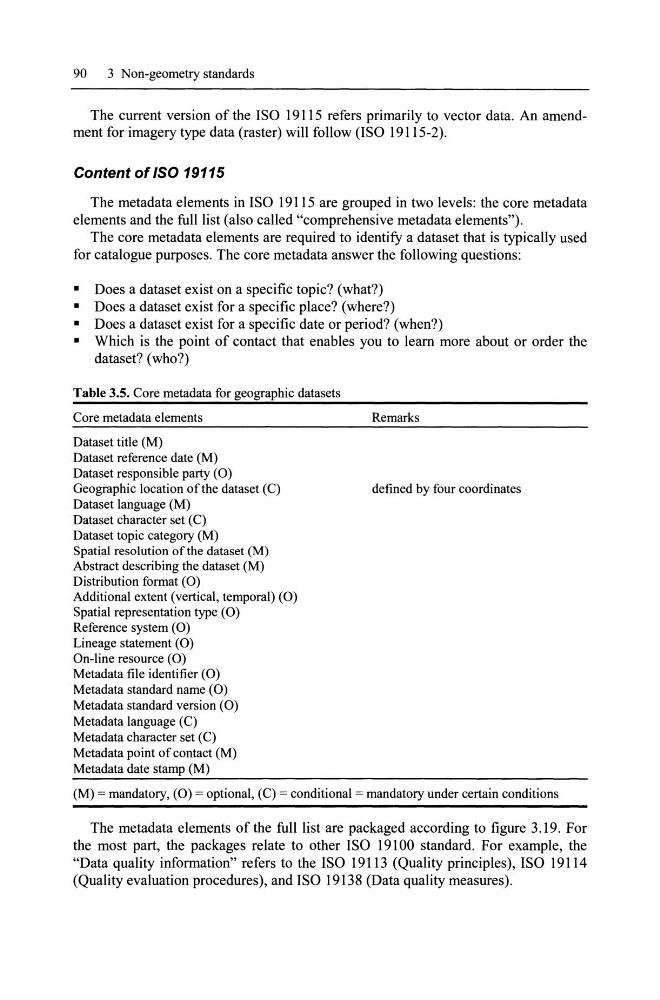
The core metadata elements are required to identify a dataset that is typically used
for catalogue purposes. The core metadata answer the following questions:
• Does a dataset exist on a specific topic? (what?)
• Does a dataset exist for a specific place? (where?)
• Does a dataset exist for a specific date or period? (when?)
• Which is the point of contact that enables you to leam more about or order the
dataset? (who?)
Table 3.5. Core metadata for geographie datasets
Core metadata elements
Dataset tide (M)
Dataset referenee date (M)
Dataset responsible party (0)
Geographie loeation ofthe dataset (C)
Dataset language (M)
Dataset eharaeter set (C)
Dataset topie eategory (M)
Spatial resolution ofthe dataset (M)
Abstract deseribing the dataset (M)
Distribution format (0)
Additional extent (vertieal, temporal) (0)
Spatial representation type (0)
Referenee system (0)
Lineage statement (0)
On-line resouree (0)
Metadata file identifier (0)
Metadata standard name (0)
Metadata standard version (0)
Metadata language (C)
Metadata eharacter set (C)
Metadata point of eontaet (M)
Metadata date stamp (M)
Remarks
defined by four coordinates
(M) = mandatory, (0) = optional, (C) = eonditional = mandatory under certain eonditions
The metadata elements ofthe fulllist are packaged according to figure 3.19. For
the most part, the packages relate to other ISO 19100 standard. For example, the
"Data quality information" refers to the ISO 19113 (Quality principles), ISO 19114
(Quality evaluation procedures), and ISO 19138 (Data quality measures).
The current version of the ISO 19115 refers primarily to vector data. An amendment for imagery type data (raster) will follow (ISO 19115-2).
Content ofl50 19115
The metadata elements in ISO 19115 are grouped in two levels: the core metadata
elements and the fulliist (also called "comprehensive metadata elements").
The core metadata elements are required to identify a dataset that is typically used
for catalogue purposes. The core metadata answer the following questions:
• Does a dataset exist on a specific topic? (what?)
• Does a dataset exist for a specific place? (where?)
• Does a dataset exist for a specific date or period? (when?)
• Which is the point of contact that enables you to leam more about or order the
dataset? (who?)
Table 3.5. Core metadata for geographie datasets
Core metadata elements
Dataset tide (M)
Dataset referenee date (M)
Dataset responsible party (0)
Geographie loeation ofthe dataset (C)
Dataset language (M)
Dataset eharaeter set (C)
Dataset topie eategory (M)
Spatial resolution ofthe dataset (M)
Abstract deseribing the dataset (M)
Distribution format (0)
Additional extent (vertieal, temporal) (0)
Spatial representation type (0)
Referenee system (0)
Lineage statement (0)
On-line resouree (0)
Metadata file identifier (0)
Metadata standard name (0)
Metadata standard version (0)
Metadata language (C)
Metadata eharacter set (C)
Metadata point of eontaet (M)
Metadata date stamp (M)
Remarks
defined by four coordinates
(M) = mandatory, (0) = optional, (C) = eonditional = mandatory under certain eonditions
The metadata elements ofthe fulllist are packaged according to figure 3.19. For
the most part, the packages relate to other ISO 19100 standard. For example, the
"Data quality information" refers to the ISO 19113 (Quality principles), ISO 19114
(Quality evaluation procedures), and ISO 19138 (Data quality measures).