

3.2 Basic standards
89
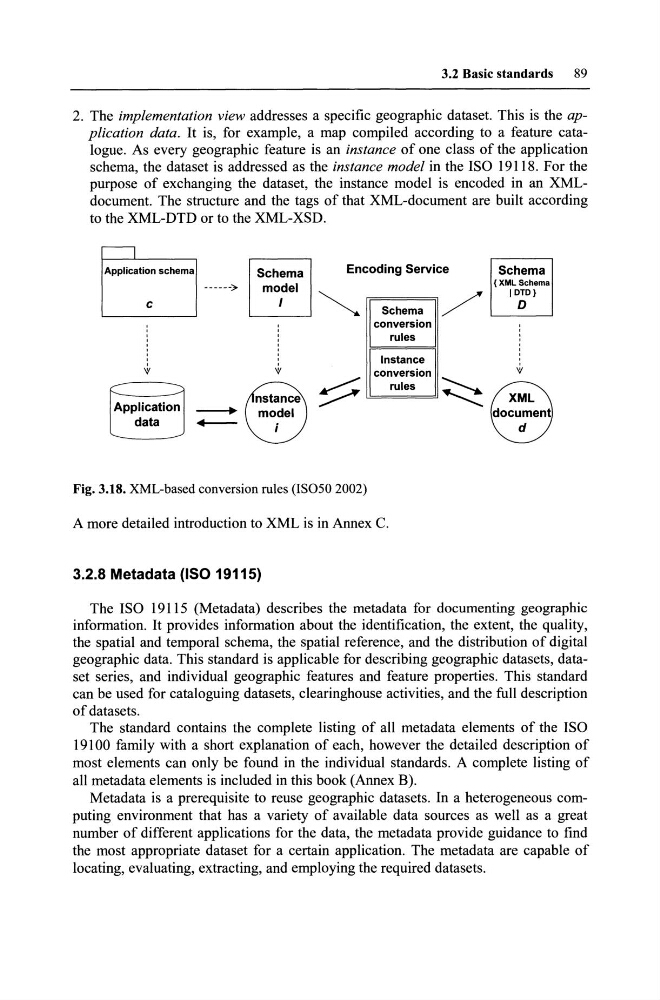
2. The implementation view addresses a speeifie geographie dataset. This is the application data. It is, for example, a map eompiled aeeording to a feature eatalogue. As every geographie feature is an instance of one class of the applieation
seherna, the dataset is addressed as the instance model in the ISO 19118. For the
purpose of exehanging the dataset, the instanee model is eneoded in an XMLdoeument. The strueture and the tags of that XML-doeument are built aeeording
to the XML-DTD or to the XML-XSD.
r--=l
Application schema
Schema
Encoding Service
Schema
------>
model
{XML Schema
~
/
IDTD}
C
I
Schema
D
conversion
rules
Instance
':t
conversion
~
rules
~
Application ----+
data
+-Fig. 3.18. XML-based conversion mies (lS050 2002)
A more detailed introduction to XML is in Annex C.
3.2.8 Metadata (ISO 19115)
The ISO 19115 (Metadata) deseribes the metadata for doeumenting geographie
information. It provides information about the identifieation, the extent, the qua1ity,
the spatial and temporal schema, the spatial referenee, and the distribution of digital
geographie data. This standard is app1ieable for deseribing geographie datasets, dataset series, and individual geographie features and feature properties. This standard
ean be used for eata10guing datasets, clearinghouse aetivities, and the fuIl deseription
of datasets.
The standard eontains the eomp1ete 1isting of aIl metadata elements of the ISO
19100 family with a short explanation of eaeh, however the detailed deseription of
most elements ean only be found in the individual standards. A eomplete listing of
aIl metadata elements is included in this book (Annex B).
Metadata is aprerequisite to reuse geographie datasets. In a heterogeneous eomputing environment that has a variety of available data sourees as weIl as a great
number of different applieations for the data, the metadata provide guidanee to find
the most appropriate dataset for a eertain applieation. The metadata are eapable of
10eating, eva1uating, extraeting, and employing the required datasets.
89
2. The implementation view addresses a speeifie geographie dataset. This is the application data. It is, for example, a map eompiled aeeording to a feature eatalogue. As every geographie feature is an instance of one class of the applieation
seherna, the dataset is addressed as the instance model in the ISO 19118. For the
purpose of exehanging the dataset, the instanee model is eneoded in an XMLdoeument. The strueture and the tags of that XML-doeument are built aeeording
to the XML-DTD or to the XML-XSD.
r--=l
Application schema
Schema
Encoding Service
Schema
------>
model
{XML Schema
~
/
IDTD}
C
I
Schema
D
conversion
rules
Instance
':t
conversion
~
rules
~
Application ----+
data
+-Fig. 3.18. XML-based conversion mies (lS050 2002)
A more detailed introduction to XML is in Annex C.
3.2.8 Metadata (ISO 19115)
The ISO 19115 (Metadata) deseribes the metadata for doeumenting geographie
information. It provides information about the identifieation, the extent, the qua1ity,
the spatial and temporal schema, the spatial referenee, and the distribution of digital
geographie data. This standard is app1ieable for deseribing geographie datasets, dataset series, and individual geographie features and feature properties. This standard
ean be used for eata10guing datasets, clearinghouse aetivities, and the fuIl deseription
of datasets.
The standard eontains the eomp1ete 1isting of aIl metadata elements of the ISO
19100 family with a short explanation of eaeh, however the detailed deseription of
most elements ean only be found in the individual standards. A eomplete listing of
aIl metadata elements is included in this book (Annex B).
Metadata is aprerequisite to reuse geographie datasets. In a heterogeneous eomputing environment that has a variety of available data sourees as weIl as a great
number of different applieations for the data, the metadata provide guidanee to find
the most appropriate dataset for a eertain applieation. The metadata are eapable of
10eating, eva1uating, extraeting, and employing the required datasets.