

3.1 Infrastructure standards
57
rectly implemented. For each class defined according to the ISO 19100 family, its set
of defined attributes together with the sets of attributes of other classes (that are accessible either directly or indirectly via associations), shall be sufficient to fully support the implementation of each operation defined for this particular class.
Attributes
All attributes must be typed, and the type must exist among the set of legal base
types. A type must always be specified; there is no default type.
Data types
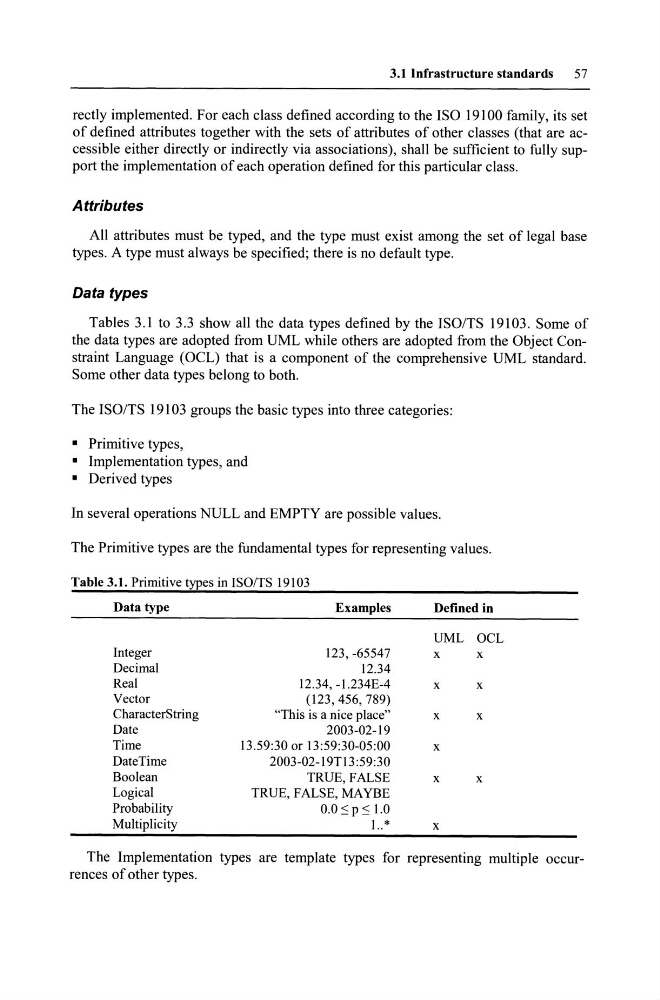
Tables 3.1 to 3.3 show all the data types defined by the ISO/TS 19103. Some of
the data types are adopted from UML while others are adopted from the Object Constraint Language (OCL) that is a component of the comprehensive UML standard.
Some other data types belong to both.
The ISO/TS 19103 groups the basic types into three categories:
• Primitive types,
• Implementation types, and
• Derived types
In several operations NULL and EMPTY are possible values.
The Primitive types are the fundamental types for representing values.
Table 3.1. Primitive types in ISO/TS 19103
Data type
Integer
Decimal
Real
Vector
CharacterString
Date
Time
DateTime
Boolean
Logical
Probability
Multiplicity
Examples
123, -65547
12.34
12.34, -1.234E-4
(123,456,789)
"This is a nice place"
2003-02-19
13.59:30 or 13:59:30-05:00
2003-02-19Tl3:59:30
TRUE,FALSE
TRUE, F ALSE, MA YBE
0.0::; p::; 1.0
1..*
Defined in
UML OCL
x
x
x
x
x
x
x
x
x
x
The Implementation types are template types for representing multiple OCCUfrences of other types.
57
rectly implemented. For each class defined according to the ISO 19100 family, its set
of defined attributes together with the sets of attributes of other classes (that are accessible either directly or indirectly via associations), shall be sufficient to fully support the implementation of each operation defined for this particular class.
Attributes
All attributes must be typed, and the type must exist among the set of legal base
types. A type must always be specified; there is no default type.
Data types
Tables 3.1 to 3.3 show all the data types defined by the ISO/TS 19103. Some of
the data types are adopted from UML while others are adopted from the Object Constraint Language (OCL) that is a component of the comprehensive UML standard.
Some other data types belong to both.
The ISO/TS 19103 groups the basic types into three categories:
• Primitive types,
• Implementation types, and
• Derived types
In several operations NULL and EMPTY are possible values.
The Primitive types are the fundamental types for representing values.
Table 3.1. Primitive types in ISO/TS 19103
Data type
Integer
Decimal
Real
Vector
CharacterString
Date
Time
DateTime
Boolean
Logical
Probability
Multiplicity
Examples
123, -65547
12.34
12.34, -1.234E-4
(123,456,789)
"This is a nice place"
2003-02-19
13.59:30 or 13:59:30-05:00
2003-02-19Tl3:59:30
TRUE,FALSE
TRUE, F ALSE, MA YBE
0.0::; p::; 1.0
1..*
Defined in
UML OCL
x
x
x
x
x
x
x
x
x
x
The Implementation types are template types for representing multiple OCCUfrences of other types.