

2.2ISO/TC211
33
The ISO/TC211 is presently undergoing significant changes in order to meet the
challenges of the future.
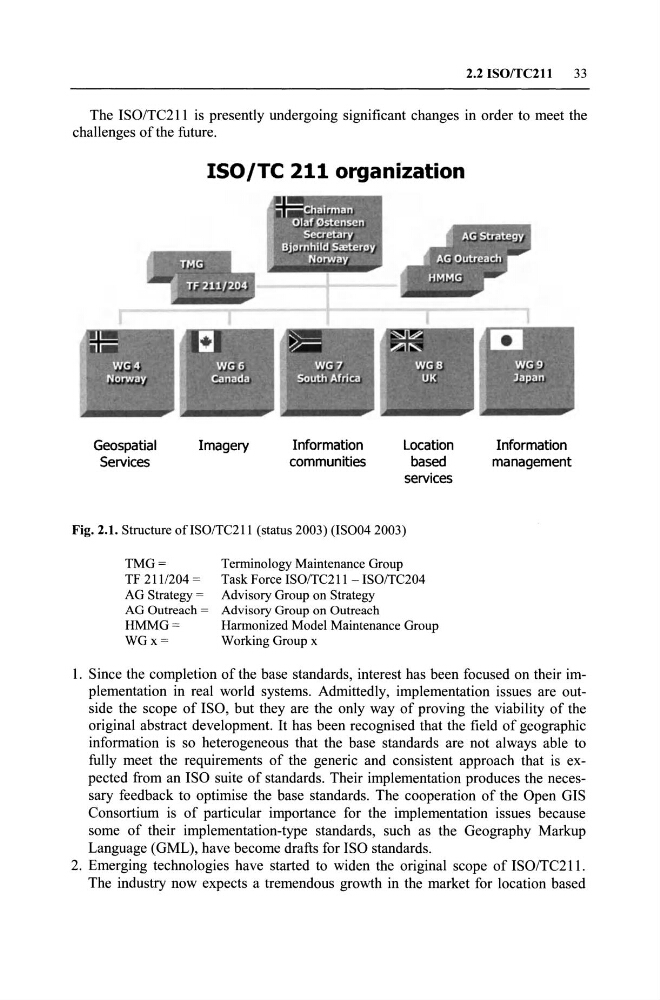
ISO/TC 211 organization
Geospatial
Services
Imagery
Information
communities
Location
based
services
Fig. 2.1. Structure ofISO/TC211 (status 2003) (lS004 2003)
TMG=
TF 2111204 =
AG Strategy =
AG Outreach =
HMMG=
WGx=
Terminology Maintenance Group
Task Force ISOITC211 - ISO/TC204
Advisory Group on Strategy
Advisory Group on Outreach
Harmonized Model Maintenance Group
Working Group x
Information
management
1. Since the completion of the base standards, interest has been focused on their implementation in real world systems. Admittedly, implementation issues are outside the scope of ISO, but they are the only way of proving the viability of the
original abstract development. It has been recognised that the field of geographie
information is so heterogeneous that the base standards are not always able to
fully meet the requirements of the generic and consistent approach that is expected from an ISO suite of standards. Their implementation produces the necessary feedback to optimise the base standards. The cooperation of the Open GIS
Consortium is of particular importance for the implementation issues because
some of their implementation-type standards, such as the Geography Markup
Language (GML), have become drafts for ISO standards.
2. Emerging technologies have started to widen the original scope of ISO/Te211.
The industry now expects a tremendous growth in the market for location based
33
The ISO/TC211 is presently undergoing significant changes in order to meet the
challenges of the future.
ISO/TC 211 organization
Geospatial
Services
Imagery
Information
communities
Location
based
services
Fig. 2.1. Structure ofISO/TC211 (status 2003) (lS004 2003)
TMG=
TF 2111204 =
AG Strategy =
AG Outreach =
HMMG=
WGx=
Terminology Maintenance Group
Task Force ISOITC211 - ISO/TC204
Advisory Group on Strategy
Advisory Group on Outreach
Harmonized Model Maintenance Group
Working Group x
Information
management
1. Since the completion of the base standards, interest has been focused on their implementation in real world systems. Admittedly, implementation issues are outside the scope of ISO, but they are the only way of proving the viability of the
original abstract development. It has been recognised that the field of geographie
information is so heterogeneous that the base standards are not always able to
fully meet the requirements of the generic and consistent approach that is expected from an ISO suite of standards. Their implementation produces the necessary feedback to optimise the base standards. The cooperation of the Open GIS
Consortium is of particular importance for the implementation issues because
some of their implementation-type standards, such as the Geography Markup
Language (GML), have become drafts for ISO standards.
2. Emerging technologies have started to widen the original scope of ISO/Te211.
The industry now expects a tremendous growth in the market for location based