

Annex C: Extensible Markup Language (XML)
293
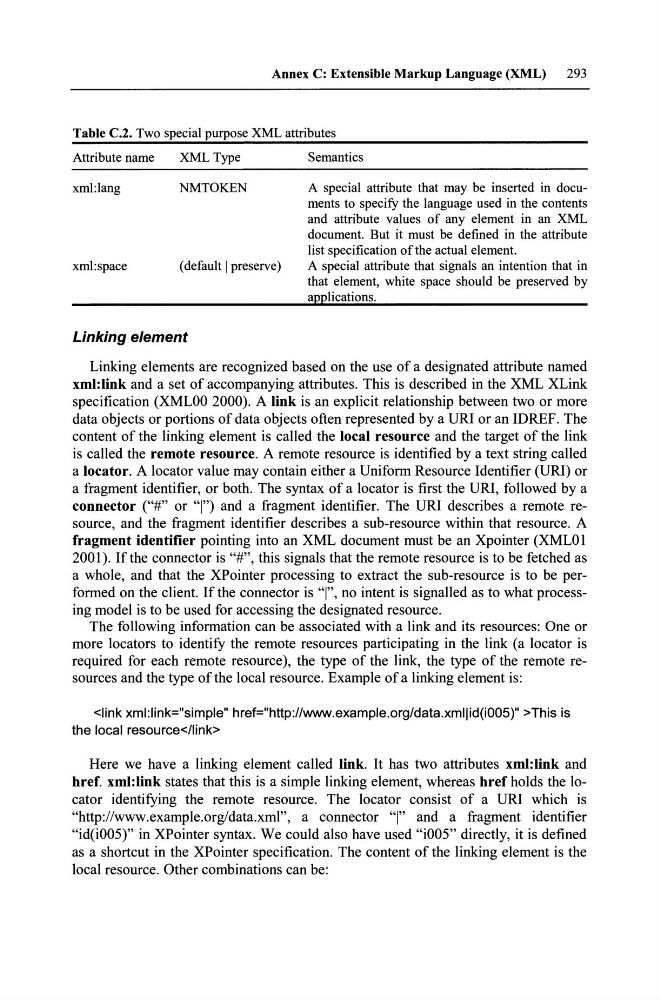
Table C.2. Two special purpose XML attributes
Attribute name
XMLType
xml:lang
NMTOKEN
xml:space
(default I preserve)
Linking element
Semantics
A special attribute that may be inserted in documents to specify the language used in the contents
and attribute values of any element in an XML
document. But it must be defined in the attribute
list specification ofthe actual element.
A special attribute that signals an intention that in
that element, white space should be preserved by
applications.
Linking elements are reeognized based on the use of adesignated attribute named
xml:link and a set of aeeompanying attributes. This is deseribed in the XML XLink
speeifieation (XMLOO 2000). A link is an explicit relationship between two or more
data objeets or portions of data objeets often represented by a URI or an IDREF. The
eontent of the linking element is ealled the local resource and the target of the link
is ealled the remote resource. A remote resouree is identified by a text string ealled
a locator. A loeator value may eontain either a Uniform Resouree Identifier (URI) or
a fragment identifier, or both. The syntax of a loeator is first the URI, followed by a
connector ("#" or "I") and a fragment identifier. The URI deseribes a remote resouree, and the fragment identifier deseribes a sub-resouree within that resouree. A
fragment identifier pointing into an XML doeument must be an Xpointer (XMLO 1
2001). Ifthe eonneetor is "#", this signals that the remote resouree is to be fetehed as
a whole, and that the XPointer proeessing to extraet the sub-resouree is to be performed on the dient. If the eonneetor is "I", no intent is signalled as to what proeessing model is to be used for aeeessing the designated resouree.
The following information ean be associated with a link and its resourees: One or
more loeators to identifY the remote resourees partieipating in the link (a loeator is
required for eaeh remote resouree), the type of the link, the type of the remote resourees and the type ofthe loeal resouree. Example ofa linking element is:
This is
the local resource
Here we have a linking element ealled link. It has two attributes xml:link and
href. xml:link states that this is a simple linking element, whereas href holds the 10eator identifYing the remote resouree. The loeator eonsist of a UR! whieh is
''http://www.example.org/data.xml'', a eonneetor "I" and a fragment identifier
"id(i005)" in XPointer syntax. We eould also have used "i005" direetly, it is defined
as a shorteut in the XPointer speeifieation. The eontent of the linking element is the
loeal resouree. Other eombinations ean be:
293
Table C.2. Two special purpose XML attributes
Attribute name
XMLType
xml:lang
NMTOKEN
xml:space
(default I preserve)
Linking element
Semantics
A special attribute that may be inserted in documents to specify the language used in the contents
and attribute values of any element in an XML
document. But it must be defined in the attribute
list specification ofthe actual element.
A special attribute that signals an intention that in
that element, white space should be preserved by
applications.
Linking elements are reeognized based on the use of adesignated attribute named
xml:link and a set of aeeompanying attributes. This is deseribed in the XML XLink
speeifieation (XMLOO 2000). A link is an explicit relationship between two or more
data objeets or portions of data objeets often represented by a URI or an IDREF. The
eontent of the linking element is ealled the local resource and the target of the link
is ealled the remote resource. A remote resouree is identified by a text string ealled
a locator. A loeator value may eontain either a Uniform Resouree Identifier (URI) or
a fragment identifier, or both. The syntax of a loeator is first the URI, followed by a
connector ("#" or "I") and a fragment identifier. The URI deseribes a remote resouree, and the fragment identifier deseribes a sub-resouree within that resouree. A
fragment identifier pointing into an XML doeument must be an Xpointer (XMLO 1
2001). Ifthe eonneetor is "#", this signals that the remote resouree is to be fetehed as
a whole, and that the XPointer proeessing to extraet the sub-resouree is to be performed on the dient. If the eonneetor is "I", no intent is signalled as to what proeessing model is to be used for aeeessing the designated resouree.
The following information ean be associated with a link and its resourees: One or
more loeators to identifY the remote resourees partieipating in the link (a loeator is
required for eaeh remote resouree), the type of the link, the type of the remote resourees and the type ofthe loeal resouree. Example ofa linking element is:
This is
the local resource
Here we have a linking element ealled link. It has two attributes xml:link and
href. xml:link states that this is a simple linking element, whereas href holds the 10eator identifYing the remote resouree. The loeator eonsist of a UR! whieh is
''http://www.example.org/data.xml'', a eonneetor "I" and a fragment identifier
"id(i005)" in XPointer syntax. We eould also have used "i005" direetly, it is defined
as a shorteut in the XPointer speeifieation. The eontent of the linking element is the
loeal resouree. Other eombinations ean be: