

3.5 Implementation standards
119
Tracking
The tracked positions are defined by coordinates or other types of positional descriptions. A tracking service (elass TK _ TrackingService) delivers the positions, either one by one or as a sequentiallist.
The positions may be one of the types coordinate, place name, feature, linear reference, network, address or phone.
A trigger defines the moment or the location for delivering positional information.
The triggers are generally of two types: triggered by an event, or triggered by the
passage of time.
A transitional trigger delivers a new position dependent on the movement of the
vehiele being tracked. Usually, events take place after the completion of a distance,
or after a change of direction. The periodic trigger is used to control location sequences by setting temporal limits on how far apart in time tracking sampies are
taken.
The tracking location metadata inelude the mobile subscriber and the quality of
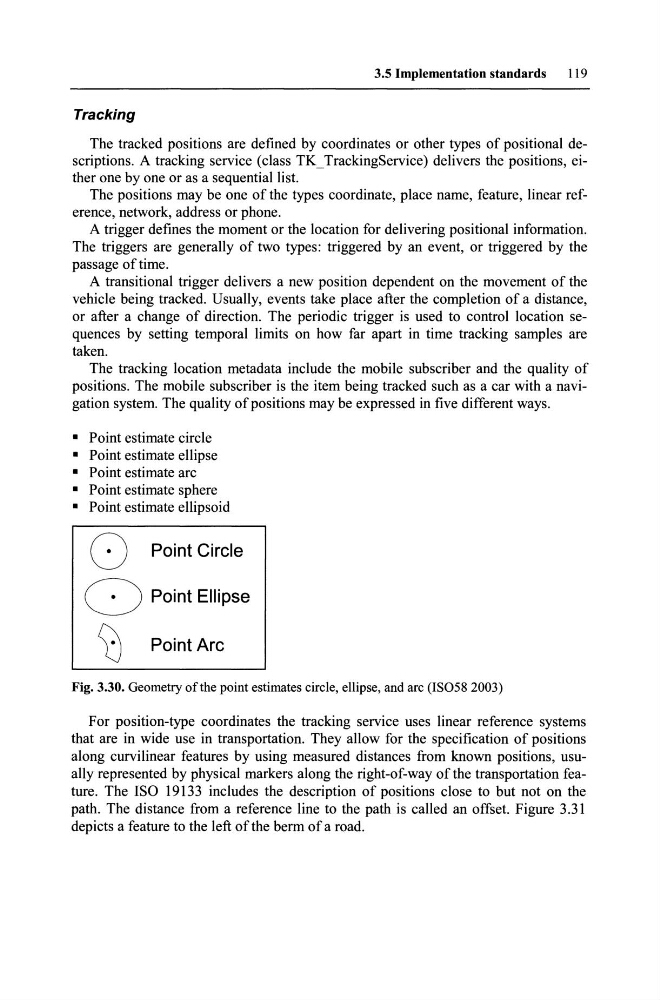
positions. The mobile subscriber is the item being tracked such as a car with a navigation system. The quality of positions may be expressed in five different ways.
• Point estimate cirele
• Point estimate ellipse
• Point estimate arc
• Point estimate sphere
• Point estimate ellipsoid
o Point Cirele
o Point Ellipse
t) Point Are
Fig. 3.30. Geometry ofthe point estimates circle, ellipse, and arc (18058 2003)
For position-type coordinates the tracking service uses linear reference systems
that are in wide use in transportation. They allow for the specification of positions
along curvilinear features by using measured distances from known positions, usually represented by physical markers along the right-of-way of the transportation feature. The ISO 19133 includes the description of positions elose to but not on the
path. The distance from a reference line to the path is called an offset. Figure 3.31
depicts a feature to the left ofthe berm ofa road.
119
Tracking
The tracked positions are defined by coordinates or other types of positional descriptions. A tracking service (elass TK _ TrackingService) delivers the positions, either one by one or as a sequentiallist.
The positions may be one of the types coordinate, place name, feature, linear reference, network, address or phone.
A trigger defines the moment or the location for delivering positional information.
The triggers are generally of two types: triggered by an event, or triggered by the
passage of time.
A transitional trigger delivers a new position dependent on the movement of the
vehiele being tracked. Usually, events take place after the completion of a distance,
or after a change of direction. The periodic trigger is used to control location sequences by setting temporal limits on how far apart in time tracking sampies are
taken.
The tracking location metadata inelude the mobile subscriber and the quality of
positions. The mobile subscriber is the item being tracked such as a car with a navigation system. The quality of positions may be expressed in five different ways.
• Point estimate cirele
• Point estimate ellipse
• Point estimate arc
• Point estimate sphere
• Point estimate ellipsoid
o Point Cirele
o Point Ellipse
t) Point Are
Fig. 3.30. Geometry ofthe point estimates circle, ellipse, and arc (18058 2003)
For position-type coordinates the tracking service uses linear reference systems
that are in wide use in transportation. They allow for the specification of positions
along curvilinear features by using measured distances from known positions, usually represented by physical markers along the right-of-way of the transportation feature. The ISO 19133 includes the description of positions elose to but not on the
path. The distance from a reference line to the path is called an offset. Figure 3.31
depicts a feature to the left ofthe berm ofa road.