

J. Ojeda Zújar et al.
530
Then the values corresponding to the estuarine and coastal waters in a visible band
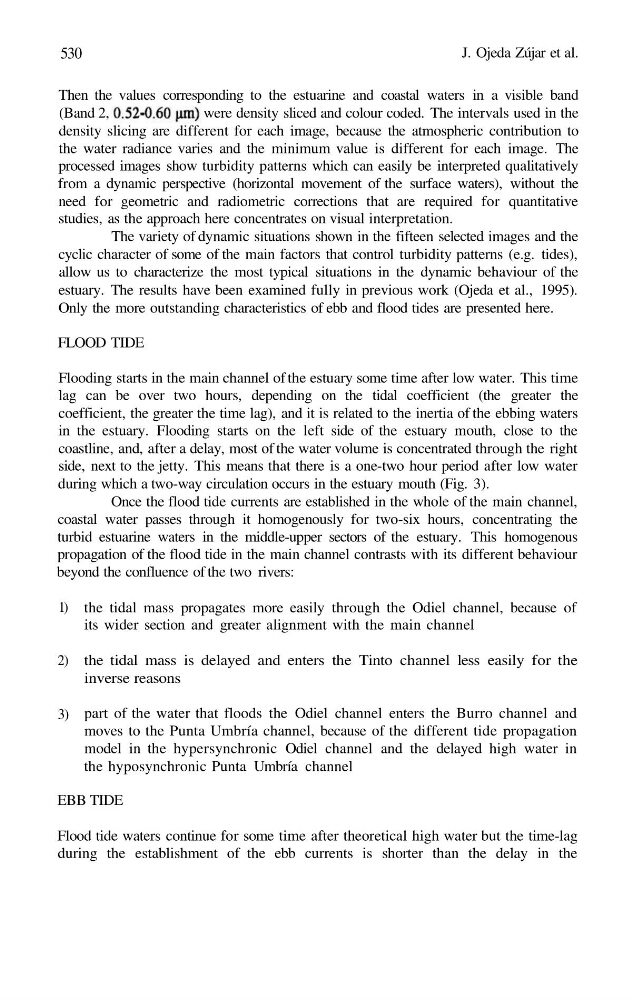
(Band 2,
were density sliced and colour coded. The intervals used in the
density slicing are different for each image, because the atmospheric contribution to
the water radiance varies and the minimum value is different for each image. The
processed images show turbidity patterns which can easily be interpreted qualitatively
from a dynamic perspective (horizontal movement of the surface waters), without the
need for geometric and radiometric corrections that are required for quantitative
studies, as the approach here concentrates on visual interpretation.
The variety of dynamic situations shown in the fifteen selected images and the
cyclic character of some of the main factors that control turbidity patterns (e.g. tides),
allow us to characterize the most typical situations in the dynamic behaviour of the
estuary. The results have been examined fully in previous work (Ojeda et al., 1995).
Only the more outstanding characteristics of ebb and flood tides are presented here.
FLOOD TIDE
Flooding starts in the main channel of the estuary some time after low water. This time
lag can be over two hours, depending on the tidal coefficient (the greater the
coefficient, the greater the time lag), and it is related to the inertia of the ebbing waters
in the estuary. Flooding starts on the left side of the estuary mouth, close to the
coastline, and, after a delay, most of the water volume is concentrated through the right
side, next to the jetty. This means that there is a one-two hour period after low water
during which a two-way circulation occurs in the estuary mouth (Fig. 3).
Once the flood tide currents are established in the whole of the main channel,
coastal water passes through it homogenously for two-six hours, concentrating the
turbid estuarine waters in the middle-upper sectors of the estuary. This homogenous
propagation of the flood tide in the main channel contrasts with its different behaviour
beyond the confluence of the two rivers:
1)
2)
3)
the tidal mass propagates more easily through the Odiel channel, because of
its wider section and greater alignment with the main channel
the tidal mass is delayed and enters the Tinto channel less easily for the
inverse reasons
part of the water that floods the Odiel channel enters the Burro channel and
moves to the Punta Umbría channel, because of the different tide propagation
model in the hypersynchronic Odiel channel and the delayed high water in
the hyposynchronic Punta Umbría channel
EBB TIDE
Flood tide waters continue for some time after theoretical high water but the time-lag
during the establishment of the ebb currents is shorter than the delay in the
530
Then the values corresponding to the estuarine and coastal waters in a visible band
(Band 2,
were density sliced and colour coded. The intervals used in the
density slicing are different for each image, because the atmospheric contribution to
the water radiance varies and the minimum value is different for each image. The
processed images show turbidity patterns which can easily be interpreted qualitatively
from a dynamic perspective (horizontal movement of the surface waters), without the
need for geometric and radiometric corrections that are required for quantitative
studies, as the approach here concentrates on visual interpretation.
The variety of dynamic situations shown in the fifteen selected images and the
cyclic character of some of the main factors that control turbidity patterns (e.g. tides),
allow us to characterize the most typical situations in the dynamic behaviour of the
estuary. The results have been examined fully in previous work (Ojeda et al., 1995).
Only the more outstanding characteristics of ebb and flood tides are presented here.
FLOOD TIDE
Flooding starts in the main channel of the estuary some time after low water. This time
lag can be over two hours, depending on the tidal coefficient (the greater the
coefficient, the greater the time lag), and it is related to the inertia of the ebbing waters
in the estuary. Flooding starts on the left side of the estuary mouth, close to the
coastline, and, after a delay, most of the water volume is concentrated through the right
side, next to the jetty. This means that there is a one-two hour period after low water
during which a two-way circulation occurs in the estuary mouth (Fig. 3).
Once the flood tide currents are established in the whole of the main channel,
coastal water passes through it homogenously for two-six hours, concentrating the
turbid estuarine waters in the middle-upper sectors of the estuary. This homogenous
propagation of the flood tide in the main channel contrasts with its different behaviour
beyond the confluence of the two rivers:
1)
2)
3)
the tidal mass propagates more easily through the Odiel channel, because of
its wider section and greater alignment with the main channel
the tidal mass is delayed and enters the Tinto channel less easily for the
inverse reasons
part of the water that floods the Odiel channel enters the Burro channel and
moves to the Punta Umbría channel, because of the different tide propagation
model in the hypersynchronic Odiel channel and the delayed high water in
the hyposynchronic Punta Umbría channel
EBB TIDE
Flood tide waters continue for some time after theoretical high water but the time-lag
during the establishment of the ebb currents is shorter than the delay in the