

Error Modeling and Management for Data
367
However, the quality of the solution to the point-in-polygon problem has yet to
be addressed properly. A simple computation of the quality of the point-in-polygon
solution could avoid placing buoys on dry land or rivers outside their floodplain
(Chrisman, 1989).
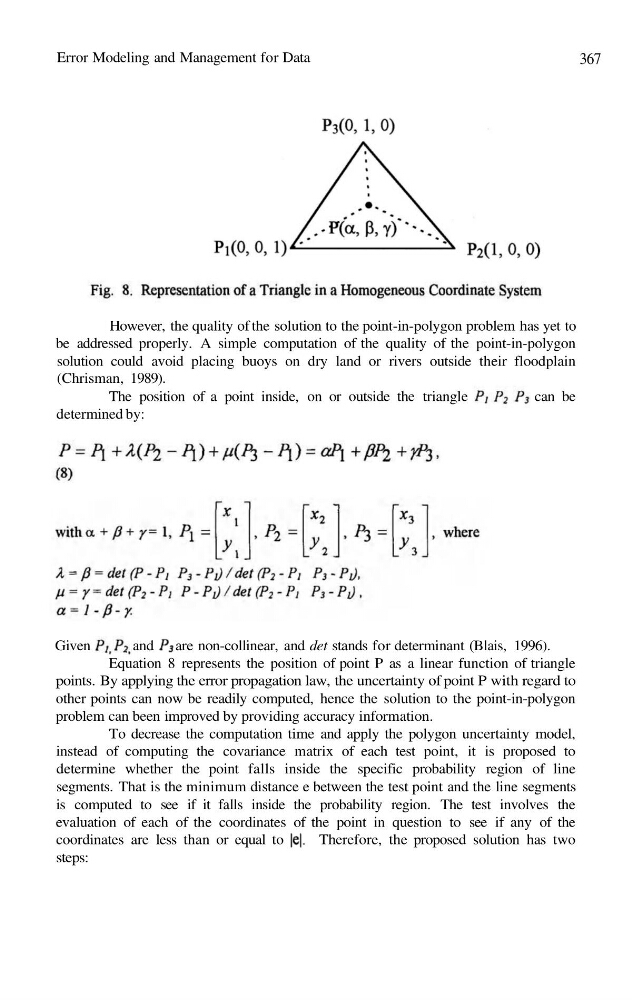
The position of a point inside, on or outside the triangle
can be
determined by:
Given
and are non-collinear, and det stands for determinant (Blais, 1996).
Equation 8 represents the position of point P as a linear function of triangle
points. By applying the error propagation law, the uncertainty of point P with regard to
other points can now be readily computed, hence the solution to the point-in-polygon
problem can been improved by providing accuracy information.
To decrease the computation time and apply the polygon uncertainty model,
instead of computing the covariance matrix of each test point, it is proposed to
determine whether the point falls inside the specific probability region of line
segments. That is the minimum distance e between the test point and the line segments
is computed to see if it falls inside the probability region. The test involves the
evaluation of each of the coordinates of the point in question to see if any of the
coordinates are less than or equal to
Therefore, the proposed solution has two
steps:
367
However, the quality of the solution to the point-in-polygon problem has yet to
be addressed properly. A simple computation of the quality of the point-in-polygon
solution could avoid placing buoys on dry land or rivers outside their floodplain
(Chrisman, 1989).
The position of a point inside, on or outside the triangle
can be
determined by:
Given
and are non-collinear, and det stands for determinant (Blais, 1996).
Equation 8 represents the position of point P as a linear function of triangle
points. By applying the error propagation law, the uncertainty of point P with regard to
other points can now be readily computed, hence the solution to the point-in-polygon
problem can been improved by providing accuracy information.
To decrease the computation time and apply the polygon uncertainty model,
instead of computing the covariance matrix of each test point, it is proposed to
determine whether the point falls inside the specific probability region of line
segments. That is the minimum distance e between the test point and the line segments
is computed to see if it falls inside the probability region. The test involves the
evaluation of each of the coordinates of the point in question to see if any of the
coordinates are less than or equal to
Therefore, the proposed solution has two
steps: