

Error Modeling and Management for Data
361
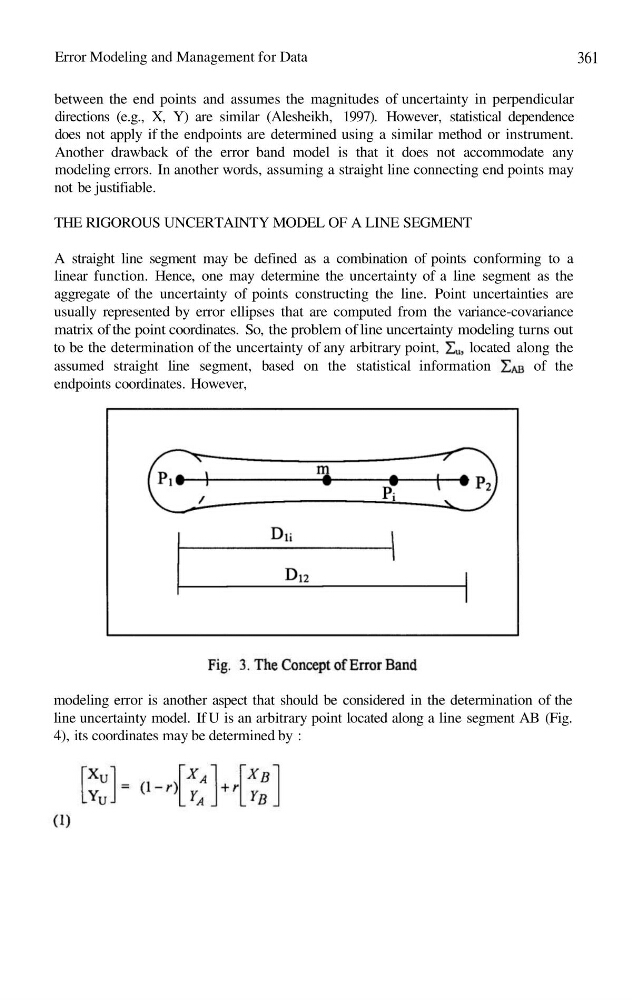
between the end points and assumes the magnitudes of uncertainty in perpendicular
directions (e.g., X, Y) are similar (Alesheikh, 1997). However, statistical dependence
does not apply if the endpoints are determined using a similar method or instrument.
Another drawback of the error band model is that it does not accommodate any
modeling errors. In another words, assuming a straight line connecting end points may
not be justifiable.
THE RIGOROUS UNCERTAINTY MODEL OF A LINE SEGMENT
A straight line segment may be defined as a combination of points conforming to a
linear function. Hence, one may determine the uncertainty of a line segment as the
aggregate of the uncertainty of points constructing the line. Point uncertainties are
usually represented by error ellipses that are computed from the variance-covariance
matrix of the point coordinates. So, the problem of line uncertainty modeling turns out
to be the determination of the uncertainty of any arbitrary point,
located along the
assumed straight line segment, based on the statistical information
of the
endpoints coordinates. However,
modeling error is another aspect that should be considered in the determination of the
line uncertainty model. If U is an arbitrary point located along a line segment AB (Fig.
4), its coordinates may be determined by :
361
between the end points and assumes the magnitudes of uncertainty in perpendicular
directions (e.g., X, Y) are similar (Alesheikh, 1997). However, statistical dependence
does not apply if the endpoints are determined using a similar method or instrument.
Another drawback of the error band model is that it does not accommodate any
modeling errors. In another words, assuming a straight line connecting end points may
not be justifiable.
THE RIGOROUS UNCERTAINTY MODEL OF A LINE SEGMENT
A straight line segment may be defined as a combination of points conforming to a
linear function. Hence, one may determine the uncertainty of a line segment as the
aggregate of the uncertainty of points constructing the line. Point uncertainties are
usually represented by error ellipses that are computed from the variance-covariance
matrix of the point coordinates. So, the problem of line uncertainty modeling turns out
to be the determination of the uncertainty of any arbitrary point,
located along the
assumed straight line segment, based on the statistical information
of the
endpoints coordinates. However,
modeling error is another aspect that should be considered in the determination of the
line uncertainty model. If U is an arbitrary point located along a line segment AB (Fig.
4), its coordinates may be determined by :