

Evaluation of Ecological Effects of the North Sea
305
Water temperature in the North Sea was assumed to be 6°C in quarter 1, 7°C in
quarter 2, 10°C in quarter 3 and 8°C in quarter 4. A digestion coefficient (Q) of 0.2
g/hr was assumed for all prey at a reference temperature of 12°C. For plaice and sole a
similar approach was used, and reference made to the daily consumption rates of
Basimi and Grove (1985). The function to relate water temperature to the
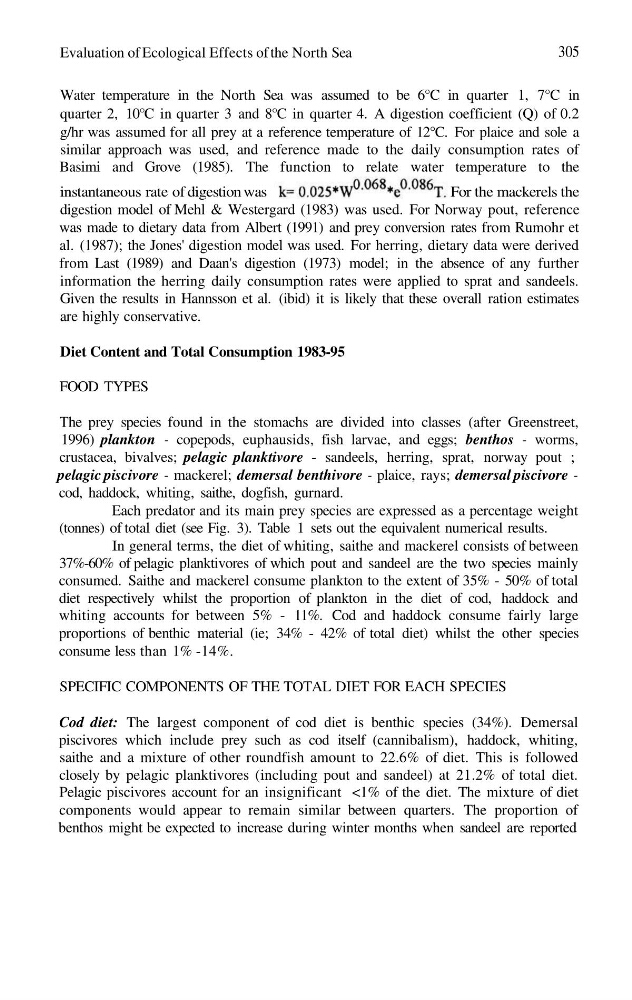
instantaneous rate of digestion was
For the mackerels the
digestion model of Mehl & Westergard (1983) was used. For Norway pout, reference
was made to dietary data from Albert (1991) and prey conversion rates from Rumohr et
al. (1987); the Jones' digestion model was used. For herring, dietary data were derived
from Last (1989) and Daan's digestion (1973) model; in the absence of any further
information the herring daily consumption rates were applied to sprat and sandeels.
Given the results in Hannsson et al. (ibid) it is likely that these overall ration estimates
are highly conservative.
Diet Content and Total Consumption 1983-95
FOOD TYPES
The prey species found in the stomachs are divided into classes (after Greenstreet,
1996) plankton - copepods, euphausids, fish larvae, and eggs; benthos - worms,
crustacea, bivalves; pelagic planktivore - sandeels, herring, sprat, norway pout ;
pelagic piscivore - mackerel; demersal benthivore - plaice, rays; demersal piscivore -
cod, haddock, whiting, saithe, dogfish, gurnard.
Each predator and its main prey species are expressed as a percentage weight
(tonnes) of total diet (see Fig. 3). Table 1 sets out the equivalent numerical results.
In general terms, the diet of whiting, saithe and mackerel consists of between
37%-60% of pelagic planktivores of which pout and sandeel are the two species mainly
consumed. Saithe and mackerel consume plankton to the extent of 35% - 50% of total
diet respectively whilst the proportion of plankton in the diet of cod, haddock and
whiting accounts for between 5% - 11%. Cod and haddock consume fairly large
proportions of benthic material (ie; 34% - 42% of total diet) whilst the other species
consume less than 1% -14%.
SPECIFIC COMPONENTS OF THE TOTAL DIET FOR EACH SPECIES
Cod diet: The largest component of cod diet is benthic species (34%). Demersal
piscivores which include prey such as cod itself (cannibalism), haddock, whiting,
saithe and a mixture of other roundfish amount to 22.6% of diet. This is followed
closely by pelagic planktivores (including pout and sandeel) at 21.2% of total diet.
Pelagic piscivores account for an insignificant <1% of the diet. The mixture of diet
components would appear to remain similar between quarters. The proportion of
benthos might be expected to increase during winter months when sandeel are reported
305
Water temperature in the North Sea was assumed to be 6°C in quarter 1, 7°C in
quarter 2, 10°C in quarter 3 and 8°C in quarter 4. A digestion coefficient (Q) of 0.2
g/hr was assumed for all prey at a reference temperature of 12°C. For plaice and sole a
similar approach was used, and reference made to the daily consumption rates of
Basimi and Grove (1985). The function to relate water temperature to the
instantaneous rate of digestion was
For the mackerels the
digestion model of Mehl & Westergard (1983) was used. For Norway pout, reference
was made to dietary data from Albert (1991) and prey conversion rates from Rumohr et
al. (1987); the Jones' digestion model was used. For herring, dietary data were derived
from Last (1989) and Daan's digestion (1973) model; in the absence of any further
information the herring daily consumption rates were applied to sprat and sandeels.
Given the results in Hannsson et al. (ibid) it is likely that these overall ration estimates
are highly conservative.
Diet Content and Total Consumption 1983-95
FOOD TYPES
The prey species found in the stomachs are divided into classes (after Greenstreet,
1996) plankton - copepods, euphausids, fish larvae, and eggs; benthos - worms,
crustacea, bivalves; pelagic planktivore - sandeels, herring, sprat, norway pout ;
pelagic piscivore - mackerel; demersal benthivore - plaice, rays; demersal piscivore -
cod, haddock, whiting, saithe, dogfish, gurnard.
Each predator and its main prey species are expressed as a percentage weight
(tonnes) of total diet (see Fig. 3). Table 1 sets out the equivalent numerical results.
In general terms, the diet of whiting, saithe and mackerel consists of between
37%-60% of pelagic planktivores of which pout and sandeel are the two species mainly
consumed. Saithe and mackerel consume plankton to the extent of 35% - 50% of total
diet respectively whilst the proportion of plankton in the diet of cod, haddock and
whiting accounts for between 5% - 11%. Cod and haddock consume fairly large
proportions of benthic material (ie; 34% - 42% of total diet) whilst the other species
consume less than 1% -14%.
SPECIFIC COMPONENTS OF THE TOTAL DIET FOR EACH SPECIES
Cod diet: The largest component of cod diet is benthic species (34%). Demersal
piscivores which include prey such as cod itself (cannibalism), haddock, whiting,
saithe and a mixture of other roundfish amount to 22.6% of diet. This is followed
closely by pelagic planktivores (including pout and sandeel) at 21.2% of total diet.
Pelagic piscivores account for an insignificant <1% of the diet. The mixture of diet
components would appear to remain similar between quarters. The proportion of
benthos might be expected to increase during winter months when sandeel are reported