

284
A. Simms
demonstrated that, during excessive freshwater runoff clams may experience 90 percent
mortality in areas where salinities reduced to less than 5 ppt (Newell and Hidu, 1994).
During the runoff event from Sept. 19 to 23, 1995 the salinities at Indian Hole and Little
Barasway dropped below 5 ppt for several days, e.g. salinities ranged from 2 to 30 ppt,
but returned to acceptable levels within 5 days (Fig. 5). The short-term impacts of low
salinities on clam mortality have not been studied in this area. However, calms can
survive low salinities if water temperatures are low (Allen and Garrett, 1971). From
Sept. 19 to Sept. 23, 1995 the water temperature ranged from 11 to 14.5 degrees Celsius
and there were no high clam mortality recorded during this period.
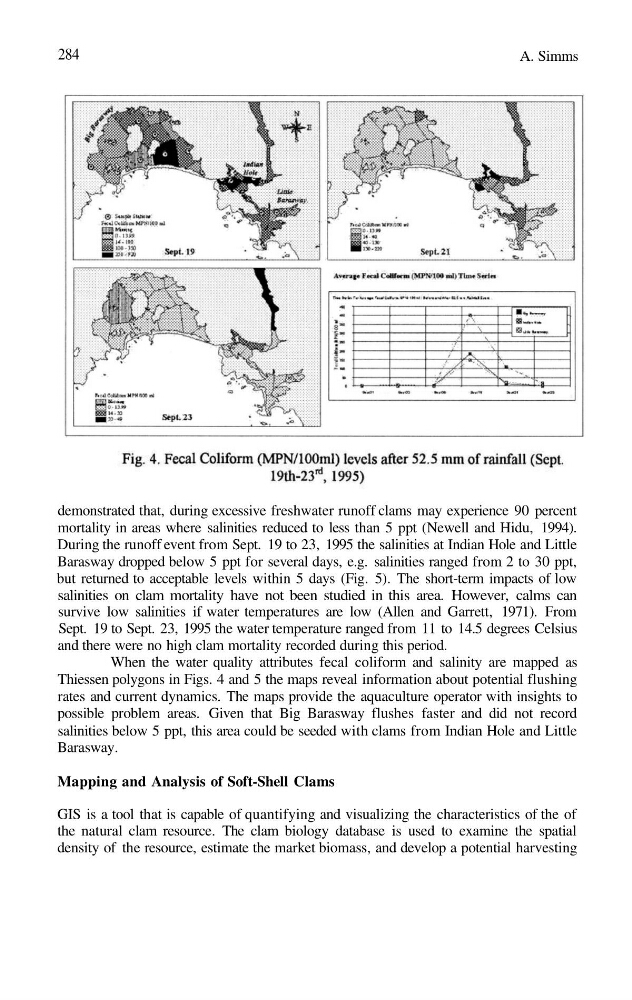
When the water quality attributes fecal coliform and salinity are mapped as
Thiessen polygons in Figs. 4 and 5 the maps reveal information about potential flushing
rates and current dynamics. The maps provide the aquaculture operator with insights to
possible problem areas. Given that Big Barasway flushes faster and did not record
salinities below 5 ppt, this area could be seeded with clams from Indian Hole and Little
Barasway.
Mapping and Analysis of Soft-Shell Clams
GIS is a tool that is capable of quantifying and visualizing the characteristics of the of
the natural clam resource. The clam biology database is used to examine the spatial
density of the resource, estimate the market biomass, and develop a potential harvesting
A. Simms
demonstrated that, during excessive freshwater runoff clams may experience 90 percent
mortality in areas where salinities reduced to less than 5 ppt (Newell and Hidu, 1994).
During the runoff event from Sept. 19 to 23, 1995 the salinities at Indian Hole and Little
Barasway dropped below 5 ppt for several days, e.g. salinities ranged from 2 to 30 ppt,
but returned to acceptable levels within 5 days (Fig. 5). The short-term impacts of low
salinities on clam mortality have not been studied in this area. However, calms can
survive low salinities if water temperatures are low (Allen and Garrett, 1971). From
Sept. 19 to Sept. 23, 1995 the water temperature ranged from 11 to 14.5 degrees Celsius
and there were no high clam mortality recorded during this period.
When the water quality attributes fecal coliform and salinity are mapped as
Thiessen polygons in Figs. 4 and 5 the maps reveal information about potential flushing
rates and current dynamics. The maps provide the aquaculture operator with insights to
possible problem areas. Given that Big Barasway flushes faster and did not record
salinities below 5 ppt, this area could be seeded with clams from Indian Hole and Little
Barasway.
Mapping and Analysis of Soft-Shell Clams
GIS is a tool that is capable of quantifying and visualizing the characteristics of the of
the natural clam resource. The clam biology database is used to examine the spatial
density of the resource, estimate the market biomass, and develop a potential harvesting