

GIS and Aquaculture: Soft-Shell Clam Site Assessment
283
To date the long term impact of fecal coliform contamination on clams is not
known. Studies have demonstrated that clams can rid themselves of contaminates if they
are exposed to clean seawater for approximately 48 hours. This process is only viable
for marginally contaminated clams (Supan and Cake, 1982). On going field surveys are
examining the impacts of these type of runoff events on the clam beds. Furthermore,
this is the first water quality study conducted on the estuaries and the residents were not
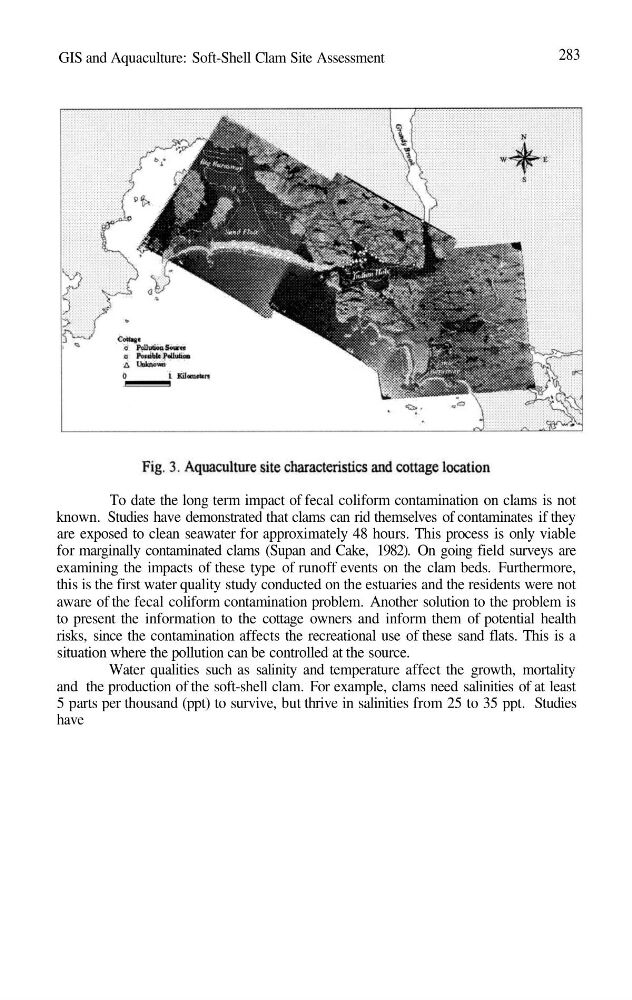
aware of the fecal coliform contamination problem. Another solution to the problem is
to present the information to the cottage owners and inform them of potential health
risks, since the contamination affects the recreational use of these sand flats. This is a
situation where the pollution can be controlled at the source.
Water qualities such as salinity and temperature affect the growth, mortality
and the production of the soft-shell clam. For example, clams need salinities of at least
5 parts per thousand (ppt) to survive, but thrive in salinities from 25 to 35 ppt. Studies
have
283
To date the long term impact of fecal coliform contamination on clams is not
known. Studies have demonstrated that clams can rid themselves of contaminates if they
are exposed to clean seawater for approximately 48 hours. This process is only viable
for marginally contaminated clams (Supan and Cake, 1982). On going field surveys are
examining the impacts of these type of runoff events on the clam beds. Furthermore,
this is the first water quality study conducted on the estuaries and the residents were not
aware of the fecal coliform contamination problem. Another solution to the problem is
to present the information to the cottage owners and inform them of potential health
risks, since the contamination affects the recreational use of these sand flats. This is a
situation where the pollution can be controlled at the source.
Water qualities such as salinity and temperature affect the growth, mortality
and the production of the soft-shell clam. For example, clams need salinities of at least
5 parts per thousand (ppt) to survive, but thrive in salinities from 25 to 35 ppt. Studies
have