

228
Wanless et al.
Indirect Effects of a Notional Oil-Spill
We envisage a notional accident where an oil-spill occurs near Fife Ness (the eastern
promontory between the Firths of Forth and Tay), and is moved along the northern
shore of the Firth of Forth by wind and currents (Fig. 4). We assume that dispersed oil
affecting the sea-bed and its fauna makes the 'slick zone' appreciably less suitable for
shags to feed in during the chick rearing season: we emphasise that this is an
illustrative example only. Current information on the likely effects of oil on coastal
marine fish do show toxic and pathological effects, but are rather unclear about effects
on fish densities (e.g. Exxon Valdez Oil Spill Symposium, 1993). The inset of Fig. 4
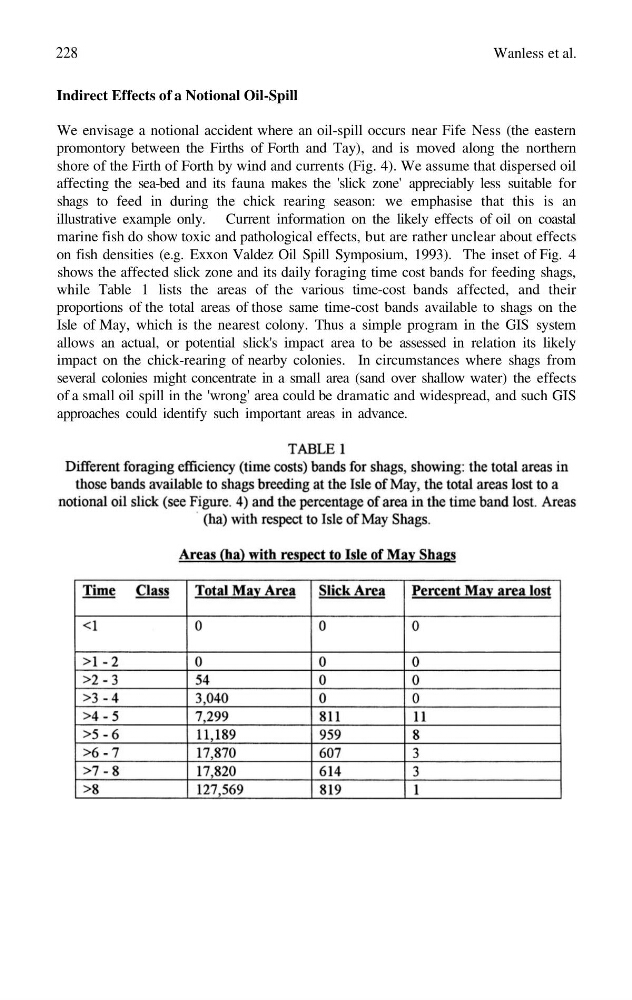
shows the affected slick zone and its daily foraging time cost bands for feeding shags,
while Table 1 lists the areas of the various time-cost bands affected, and their
proportions of the total areas of those same time-cost bands available to shags on the
Isle of May, which is the nearest colony. Thus a simple program in the GIS system
allows an actual, or potential slick's impact area to be assessed in relation its likely
impact on the chick-rearing of nearby colonies. In circumstances where shags from
several colonies might concentrate in a small area (sand over shallow water) the effects
of a small oil spill in the 'wrong' area could be dramatic and widespread, and such GIS
approaches could identify such important areas in advance.
Wanless et al.
Indirect Effects of a Notional Oil-Spill
We envisage a notional accident where an oil-spill occurs near Fife Ness (the eastern
promontory between the Firths of Forth and Tay), and is moved along the northern
shore of the Firth of Forth by wind and currents (Fig. 4). We assume that dispersed oil
affecting the sea-bed and its fauna makes the 'slick zone' appreciably less suitable for
shags to feed in during the chick rearing season: we emphasise that this is an
illustrative example only. Current information on the likely effects of oil on coastal
marine fish do show toxic and pathological effects, but are rather unclear about effects
on fish densities (e.g. Exxon Valdez Oil Spill Symposium, 1993). The inset of Fig. 4
shows the affected slick zone and its daily foraging time cost bands for feeding shags,
while Table 1 lists the areas of the various time-cost bands affected, and their
proportions of the total areas of those same time-cost bands available to shags on the
Isle of May, which is the nearest colony. Thus a simple program in the GIS system
allows an actual, or potential slick's impact area to be assessed in relation its likely
impact on the chick-rearing of nearby colonies. In circumstances where shags from
several colonies might concentrate in a small area (sand over shallow water) the effects
of a small oil spill in the 'wrong' area could be dramatic and widespread, and such GIS
approaches could identify such important areas in advance.