

Evaluating the Coastal Environment for Marine Birds
227
The system can also be used to contrast the importance of sea areas with
regard to a single colony (protect the nature reserve) compared with their importance
to shags at all the colonies in a region (protect the regional seabird community). The
energetic calculations of Fig. 3a are based on flight costs to the Isle of May NNR only,
although there are some other shag colonies in the Firth of Forth. Fig. 3b presents a
similar analysis, but uses flight distance energetic data from each sea-polygon to the
nearest colony. The shores of the Firth of Tay and the northern shore of the Forth do
not have shag colonies (due to a lack of suitable cliffs), so the main changes in this
region are along the southern shore of the Firth of Forth and in Largo Bay on its
northern shore. Here, during chick rearing, appreciable areas that would require 6 to
more than 8 hour feeding trips by shags from the Isle of May can be exploited in only 3
to 6 hours by shags from other colonies. In other circumstances, where colonies were
more widely distributed, the effects could be more extreme.
227
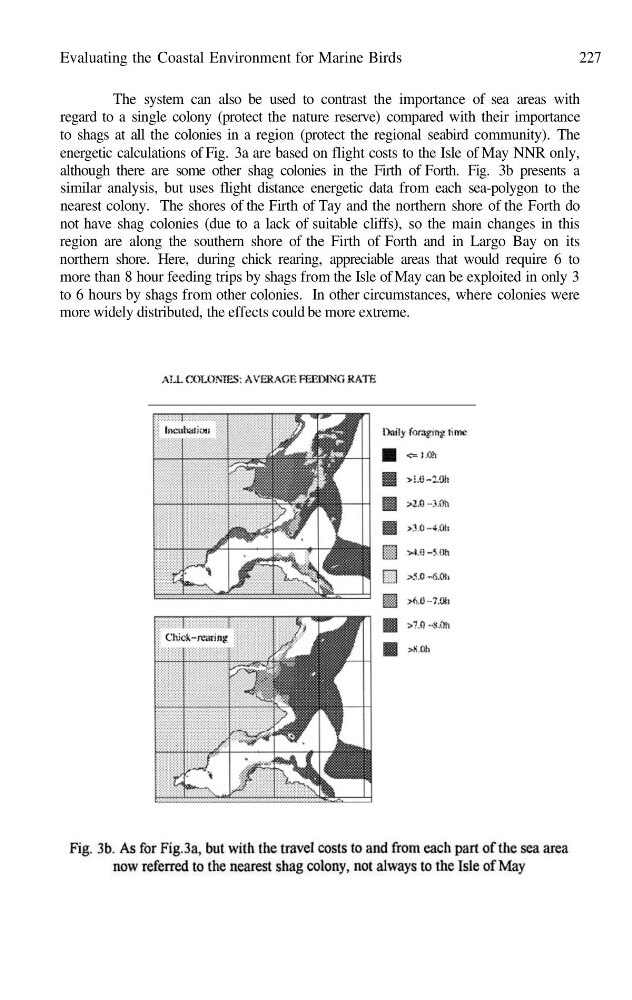
The system can also be used to contrast the importance of sea areas with
regard to a single colony (protect the nature reserve) compared with their importance
to shags at all the colonies in a region (protect the regional seabird community). The
energetic calculations of Fig. 3a are based on flight costs to the Isle of May NNR only,
although there are some other shag colonies in the Firth of Forth. Fig. 3b presents a
similar analysis, but uses flight distance energetic data from each sea-polygon to the
nearest colony. The shores of the Firth of Tay and the northern shore of the Forth do
not have shag colonies (due to a lack of suitable cliffs), so the main changes in this
region are along the southern shore of the Firth of Forth and in Largo Bay on its
northern shore. Here, during chick rearing, appreciable areas that would require 6 to
more than 8 hour feeding trips by shags from the Isle of May can be exploited in only 3
to 6 hours by shags from other colonies. In other circumstances, where colonies were
more widely distributed, the effects could be more extreme.