

184
L. P. Humphries and C. N. Ligdas
Discussion
These results indicate the extent to which the spoil on the beaches for years has
masked the impact of mining activity. With the erosion of the spoil following the
cessation of tipping the impact on beach geomorphology has begun to emerge and will
do so for some years to come. The impact of mining on other areas not protected to the
same extent has been reported to the north of this study area.
At Newbiggin, subsidence from undersea mining is believed to have caused
sand to migrate to the centre of the bay and coastal dumping of mine waste north of the
town may have been responsible for a change in sea currents so that sand is now no
longer replaced on the beach. The loss of sand was blamed on mining subsidence in
the bay and in areas of offshore rocks which protected the bay by absorbing wave
energy (Tooley, 1989). Tooley (1989) stated that wherever there is significant mining
settlement on the foreshore along the north east coast, coastal erosion and coastal
protection problems are the result.
Similar results were recorded in the report of an overall survey of the coastline
for Castle Morpeth Borough Council (Anon, 1985) which was conducted to calculate
the amount of subsidence from coal-mining and how it had affected the coast. The
subsidence contours showed a maximum subsidence of 3.6 metres between 200 and
800 metres from the cliff line. Immediately north of the study area a consultant’s report
for Sunderland Borough Council reported problems with ground control points,
notably discrepancies in the vertical plane which could not be accounted for. The
general conclusion was that this was due to a general drop in level of between 200 and
300 mm between 1974 and 1988. There does not to have been any subsidence impacts
in this area from 1988 onwards.
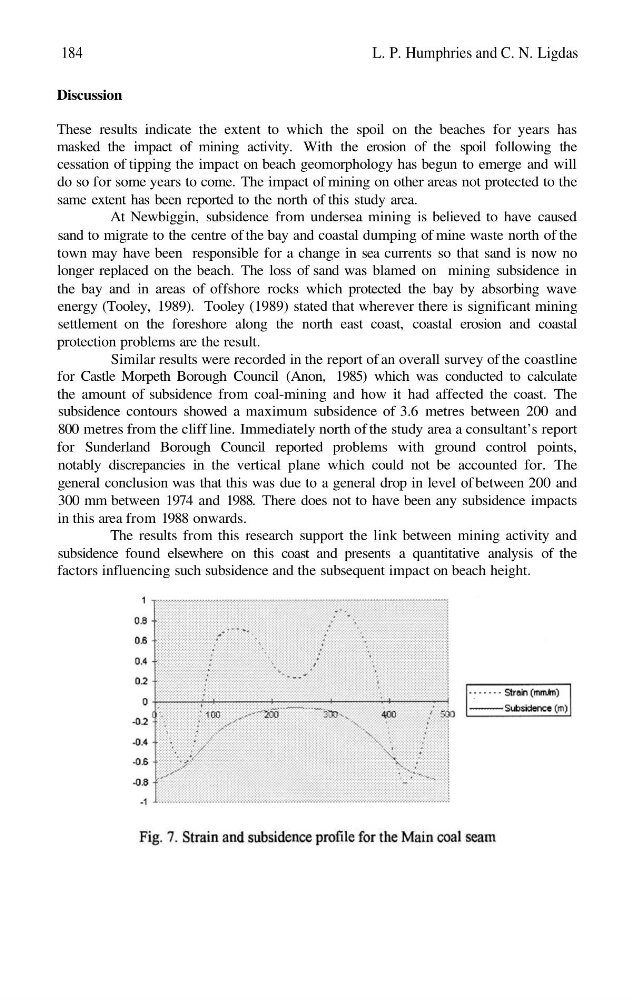
The results from this research support the link between mining activity and
subsidence found elsewhere on this coast and presents a quantitative analysis of the
factors influencing such subsidence and the subsequent impact on beach height.
L. P. Humphries and C. N. Ligdas
Discussion
These results indicate the extent to which the spoil on the beaches for years has
masked the impact of mining activity. With the erosion of the spoil following the
cessation of tipping the impact on beach geomorphology has begun to emerge and will
do so for some years to come. The impact of mining on other areas not protected to the
same extent has been reported to the north of this study area.
At Newbiggin, subsidence from undersea mining is believed to have caused
sand to migrate to the centre of the bay and coastal dumping of mine waste north of the
town may have been responsible for a change in sea currents so that sand is now no
longer replaced on the beach. The loss of sand was blamed on mining subsidence in
the bay and in areas of offshore rocks which protected the bay by absorbing wave
energy (Tooley, 1989). Tooley (1989) stated that wherever there is significant mining
settlement on the foreshore along the north east coast, coastal erosion and coastal
protection problems are the result.
Similar results were recorded in the report of an overall survey of the coastline
for Castle Morpeth Borough Council (Anon, 1985) which was conducted to calculate
the amount of subsidence from coal-mining and how it had affected the coast. The
subsidence contours showed a maximum subsidence of 3.6 metres between 200 and
800 metres from the cliff line. Immediately north of the study area a consultant’s report
for Sunderland Borough Council reported problems with ground control points,
notably discrepancies in the vertical plane which could not be accounted for. The
general conclusion was that this was due to a general drop in level of between 200 and
300 mm between 1974 and 1988. There does not to have been any subsidence impacts
in this area from 1988 onwards.
The results from this research support the link between mining activity and
subsidence found elsewhere on this coast and presents a quantitative analysis of the
factors influencing such subsidence and the subsequent impact on beach height.