

Collating the Past for Assessing the Future
137
responsibility of promoting the most appropriate means of coastal defence and flood
protection in England and Wales within identified shoreline units. These units are
based on the concept of littoral cells (Motyka and Brampton, 1993) and they represent
a first attempt to classify processes by natural not administrative region. For example,
the Wash marks the divide between two littoral cells and within the embayment there
is a sub-cell boundary near Snettisham. The sub-cell boundary is defined by the way
open shingle beaches are replaced to the south, at Wolferton Creek, by mudflats and
saltmarsh (NNSMP, 1996). A key tenet of SMPs is that computational processing
should exploit existing technology such as GIS and that the maximum use should be
made of existing data sets rather than in the commissioning of new survey work. This
research, through the use of a generic GIS, explores the potential of this
recommendation to ascertain if this advice is appropriate.
The Selection of Datum
Given the research emphasis of the sea to land perspective, Chart Datum was selected
in order to produce a surface with reference to the tidal range not to mean sea level.
Chart Datum or the Lowest Astronomical Tide (LAT) is used on HO charts and
represents the level below which the tide will not fall under prevalent barometric
conditions. This provides an indication of the minimum level of tidal water that can be
expected at any one location. However, in coastal and shoreline research, sounding
data is frequently converted from a level relative to Chart Datum, to the Ordnance
Datum Newlyn (a calculation of mean sea level). By using Ordnance Datum (OD)
direct comparisons can be made from a national perspective relieving the difficulties of
variables introduced by local tidal regimes. However, it is because of these local
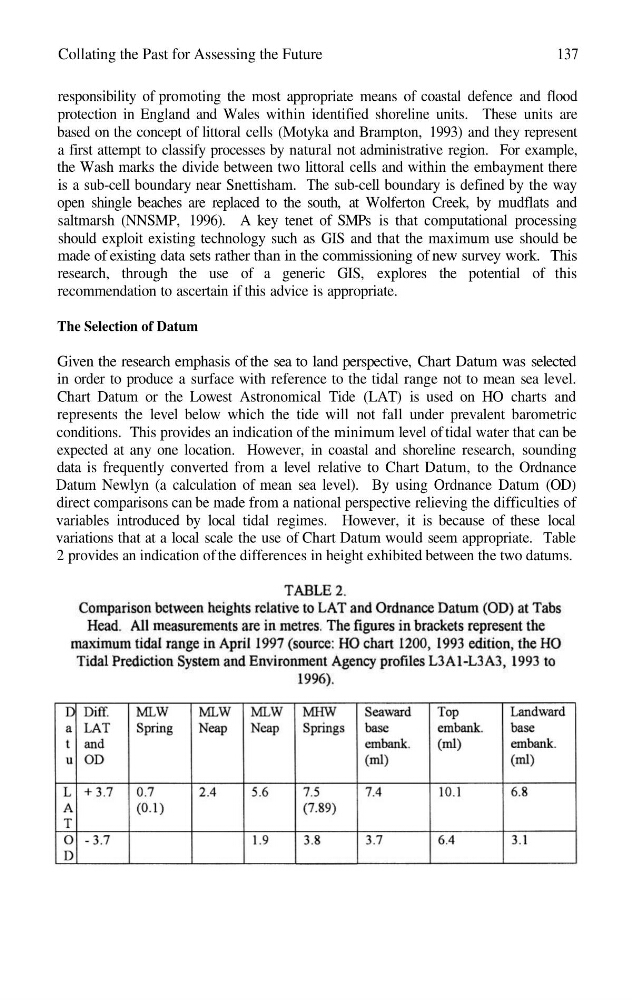
variations that at a local scale the use of Chart Datum would seem appropriate. Table
2 provides an indication of the differences in height exhibited between the two datums.
137
responsibility of promoting the most appropriate means of coastal defence and flood
protection in England and Wales within identified shoreline units. These units are
based on the concept of littoral cells (Motyka and Brampton, 1993) and they represent
a first attempt to classify processes by natural not administrative region. For example,
the Wash marks the divide between two littoral cells and within the embayment there
is a sub-cell boundary near Snettisham. The sub-cell boundary is defined by the way
open shingle beaches are replaced to the south, at Wolferton Creek, by mudflats and
saltmarsh (NNSMP, 1996). A key tenet of SMPs is that computational processing
should exploit existing technology such as GIS and that the maximum use should be
made of existing data sets rather than in the commissioning of new survey work. This
research, through the use of a generic GIS, explores the potential of this
recommendation to ascertain if this advice is appropriate.
The Selection of Datum
Given the research emphasis of the sea to land perspective, Chart Datum was selected
in order to produce a surface with reference to the tidal range not to mean sea level.
Chart Datum or the Lowest Astronomical Tide (LAT) is used on HO charts and
represents the level below which the tide will not fall under prevalent barometric
conditions. This provides an indication of the minimum level of tidal water that can be
expected at any one location. However, in coastal and shoreline research, sounding
data is frequently converted from a level relative to Chart Datum, to the Ordnance
Datum Newlyn (a calculation of mean sea level). By using Ordnance Datum (OD)
direct comparisons can be made from a national perspective relieving the difficulties of
variables introduced by local tidal regimes. However, it is because of these local
variations that at a local scale the use of Chart Datum would seem appropriate. Table
2 provides an indication of the differences in height exhibited between the two datums.