

80 Marine Macro- and Microalgae: An Overview
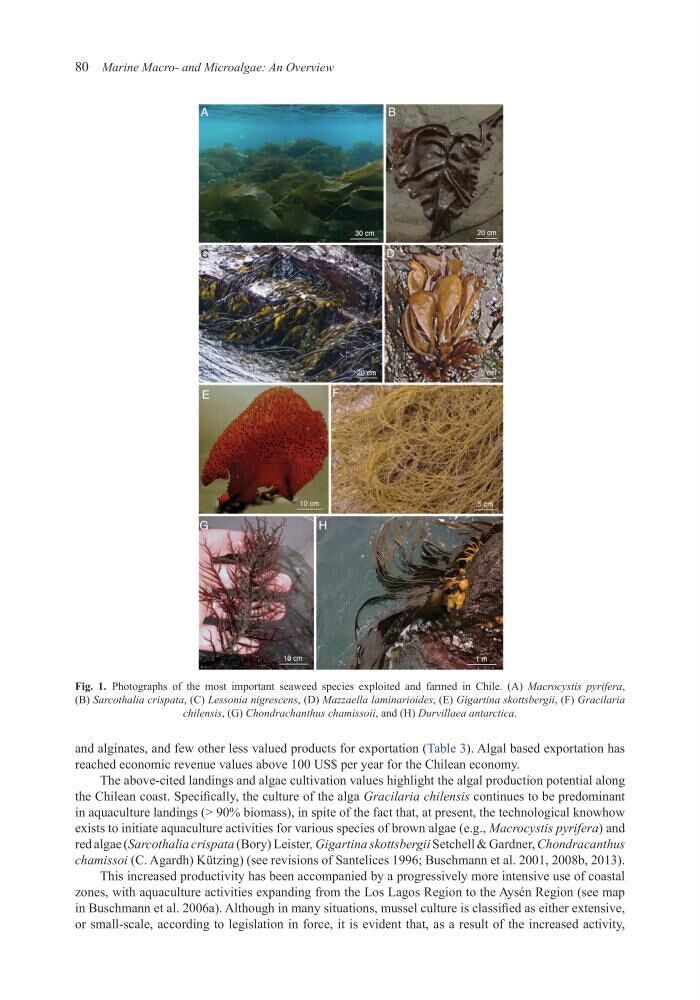
Fig. 1. Photographs of the most important seaweed species exploited and farmed in Chile. (A) Macrocystis pyrifera,
(B) Sarcothalia crispata, (C) Lessonia nigrescens, (D) Mazzaella laminarioides, (E) Gigartina skottsbergii, (F) Gracilaria
chilensis, (G) Chondrachanthus chamissoii, and (H) Durvillaea antarctica.
and alginates, and few other less valued products for exportation (Table 3). Algal based exportation has
reached economic revenue values above 100 US$ per year for the Chilean economy.
The above-cited landings and algae cultivation values highlight the algal production potential along
the Chilean coast. Specifically, the culture of the alga Gracilaria chilensis continues to be predominant
in aquaculture landings (> 90% biomass), in spite of the fact that, at present, the technological knowhow
exists to initiate aquaculture activities for various species of brown algae (e.g., Macrocystis pyrifera) and
red algae (Sarcothalia crispata (Bory) Leister, Gigartina skottsbergii Setchell & Gardner, Chondracanthus
chamissoi (C. Agardh) Kützing) (see revisions of Santelices 1996; Buschmann et al. 2001, 2008b, 2013).
This increased productivity has been accompanied by a progressively more intensive use of coastal
zones, with aquaculture activities expanding from the Los Lagos Region to the Aysén Region (see map
in Buschmann et al. 2006a). Although in many situations, mussel culture is classified as either extensive,
or small-scale, according to legislation in force, it is evident that, as a result of the increased activity,
Fig. 1. Photographs of the most important seaweed species exploited and farmed in Chile. (A) Macrocystis pyrifera,
(B) Sarcothalia crispata, (C) Lessonia nigrescens, (D) Mazzaella laminarioides, (E) Gigartina skottsbergii, (F) Gracilaria
chilensis, (G) Chondrachanthus chamissoii, and (H) Durvillaea antarctica.
and alginates, and few other less valued products for exportation (Table 3). Algal based exportation has
reached economic revenue values above 100 US$ per year for the Chilean economy.
The above-cited landings and algae cultivation values highlight the algal production potential along
the Chilean coast. Specifically, the culture of the alga Gracilaria chilensis continues to be predominant
in aquaculture landings (> 90% biomass), in spite of the fact that, at present, the technological knowhow
exists to initiate aquaculture activities for various species of brown algae (e.g., Macrocystis pyrifera) and
red algae (Sarcothalia crispata (Bory) Leister, Gigartina skottsbergii Setchell & Gardner, Chondracanthus
chamissoi (C. Agardh) Kützing) (see revisions of Santelices 1996; Buschmann et al. 2001, 2008b, 2013).
This increased productivity has been accompanied by a progressively more intensive use of coastal
zones, with aquaculture activities expanding from the Los Lagos Region to the Aysén Region (see map
in Buschmann et al. 2006a). Although in many situations, mussel culture is classified as either extensive,
or small-scale, according to legislation in force, it is evident that, as a result of the increased activity,