

Microalgal Biomass Production 73
interpret because of the confounding effects of other microalgal nutrients (Richmond 2004; Durmaz
2007). Microalgae grown to late logarithmic growth phase typically contain 30–40% protein, 10–20%
lipid and 5–15% carbohydrate (Fujii et al. 2010). In the stationary phase, the proximate composition
of microalgae can change significantly, e.g., when nitrate is limiting, carbohydrate levels can double
at the expense of protein (Liang et al. 2009). There does not appear to be a strong correlation between
the proximate composition of microalgae and nutritional value, though algal diets with high levels
of carbohydrate are reported to produce the best growth for juvenile oysters, Ostrea edulis (Ponis et
al. 2006). Larval scallops, Patinopecten yessoensis provided polyunsaturated fatty acids in adequate
proportions. In contrast, high dietary protein provided best growth for juvenile mussels, Mytilus trossulus
and Pacific oysters, Crassostrea gigas (Knuckey et al. 2002). Large sized hatcheries require highly paid
technicians, multimillion dollar investments and highly controlled medium conditions. The observed
trend is toward specialized production, particularly with the supply of post larvae in the hands of big
centralized hatcheries. They open a pathway to new techniques especially the genetic selection of strains
with stronger immunity.
Biofuel
Microalgae have high growth rates and photosynthetic efficiencies due to their simple structures. The
efficiency is much higher (6–8%) than that of terrestrial plants (it is, 1.8–2.2%). The idea of using
microalgae is not new, but it is now being taken seriously in several countries because of the emerging
concern about global warming that is closely associated with burning of fossil fuels (Omer 2012).
Microalgal biomass contains approximately 50% carbon by dry weight; therefore, it is also used to
produce methane by anaerobic digestion. The process is technically feasible, but it cannot compete with
many other low-cost organic substrates that are available for anaerobic digestion (Hussain et al. 2010).
Depending on species, microalgae produce different kinds of lipids, hydrocarbons, and other complex
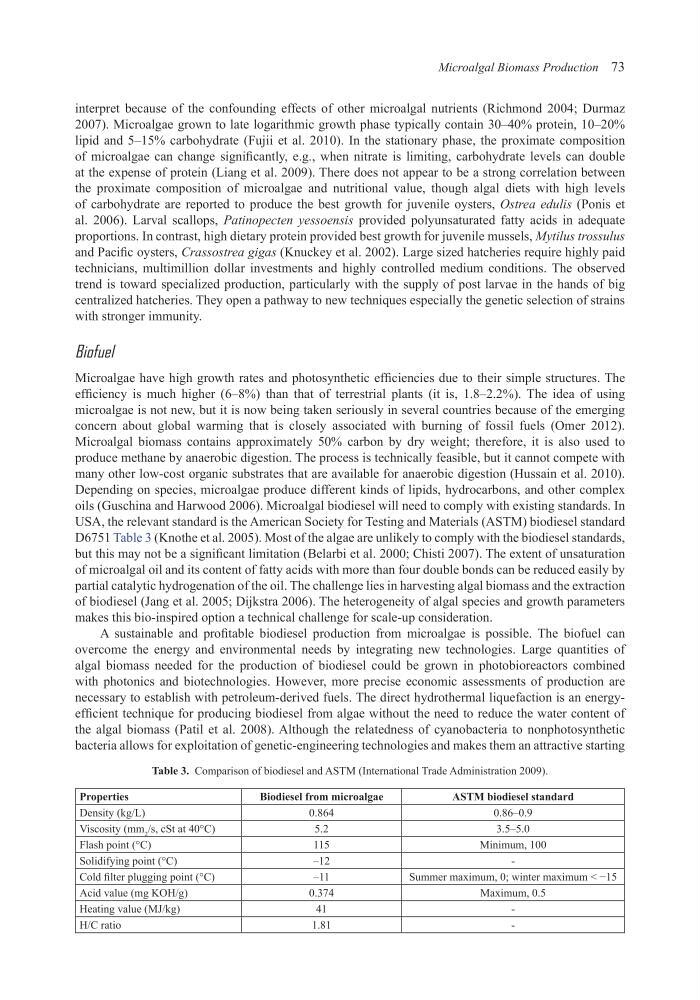
oils (Guschina and Harwood 2006). Microalgal biodiesel will need to comply with existing standards. In
USA, the relevant standard is the American Society for Testing and Materials (ASTM) biodiesel standard
D6751 Table 3 (Knothe et al. 2005). Most of the algae are unlikely to comply with the biodiesel standards,
but this may not be a significant limitation (Belarbi et al. 2000; Chisti 2007). The extent of unsaturation
of microalgal oil and its content of fatty acids with more than four double bonds can be reduced easily by
partial catalytic hydrogenation of the oil. The challenge lies in harvesting algal biomass and the extraction
of biodiesel (Jang et al. 2005; Dijkstra 2006). The heterogeneity of algal species and growth parameters
makes this bio-inspired option a technical challenge for scale-up consideration.
A sustainable and profitable biodiesel production from microalgae is possible. The biofuel can
overcome the energy and environmental needs by integrating new technologies. Large quantities of
algal biomass needed for the production of biodiesel could be grown in photobioreactors combined
with photonics and biotechnologies. However, more precise economic assessments of production are
necessary to establish with petroleum-derived fuels. The direct hydrothermal liquefaction is an energyefficient technique for producing biodiesel from algae without the need to reduce the water content of
the algal biomass (Patil et al. 2008). Although the relatedness of cyanobacteria to nonphotosynthetic
bacteria allows for exploitation of genetic-engineering technologies and makes them an attractive starting
Table 3. Comparison of biodiesel and ASTM (International Trade Administration 2009).
Properties
Biodiesel from microalgae
ASTM biodiesel standard
Density (kg/L)
0.864
0.86–0.9
Viscosity (mm 2 /s, cSt at 40°C)
5.2
3.5–5.0
Flash point (°C)
115
Minimum, 100
Solidifying point (°C)
–12
-
Cold filter plugging point (°C)
–11
Summer maximum, 0; winter maximum < −15
Acid value (mg KOH/g)
0.374
Maximum, 0.5
Heating value (MJ/kg)
41
-
H/C ratio
1.81
-
interpret because of the confounding effects of other microalgal nutrients (Richmond 2004; Durmaz
2007). Microalgae grown to late logarithmic growth phase typically contain 30–40% protein, 10–20%
lipid and 5–15% carbohydrate (Fujii et al. 2010). In the stationary phase, the proximate composition
of microalgae can change significantly, e.g., when nitrate is limiting, carbohydrate levels can double
at the expense of protein (Liang et al. 2009). There does not appear to be a strong correlation between
the proximate composition of microalgae and nutritional value, though algal diets with high levels
of carbohydrate are reported to produce the best growth for juvenile oysters, Ostrea edulis (Ponis et
al. 2006). Larval scallops, Patinopecten yessoensis provided polyunsaturated fatty acids in adequate
proportions. In contrast, high dietary protein provided best growth for juvenile mussels, Mytilus trossulus
and Pacific oysters, Crassostrea gigas (Knuckey et al. 2002). Large sized hatcheries require highly paid
technicians, multimillion dollar investments and highly controlled medium conditions. The observed
trend is toward specialized production, particularly with the supply of post larvae in the hands of big
centralized hatcheries. They open a pathway to new techniques especially the genetic selection of strains
with stronger immunity.
Biofuel
Microalgae have high growth rates and photosynthetic efficiencies due to their simple structures. The
efficiency is much higher (6–8%) than that of terrestrial plants (it is, 1.8–2.2%). The idea of using
microalgae is not new, but it is now being taken seriously in several countries because of the emerging
concern about global warming that is closely associated with burning of fossil fuels (Omer 2012).
Microalgal biomass contains approximately 50% carbon by dry weight; therefore, it is also used to
produce methane by anaerobic digestion. The process is technically feasible, but it cannot compete with
many other low-cost organic substrates that are available for anaerobic digestion (Hussain et al. 2010).
Depending on species, microalgae produce different kinds of lipids, hydrocarbons, and other complex
oils (Guschina and Harwood 2006). Microalgal biodiesel will need to comply with existing standards. In
USA, the relevant standard is the American Society for Testing and Materials (ASTM) biodiesel standard
D6751 Table 3 (Knothe et al. 2005). Most of the algae are unlikely to comply with the biodiesel standards,
but this may not be a significant limitation (Belarbi et al. 2000; Chisti 2007). The extent of unsaturation
of microalgal oil and its content of fatty acids with more than four double bonds can be reduced easily by
partial catalytic hydrogenation of the oil. The challenge lies in harvesting algal biomass and the extraction
of biodiesel (Jang et al. 2005; Dijkstra 2006). The heterogeneity of algal species and growth parameters
makes this bio-inspired option a technical challenge for scale-up consideration.
A sustainable and profitable biodiesel production from microalgae is possible. The biofuel can
overcome the energy and environmental needs by integrating new technologies. Large quantities of
algal biomass needed for the production of biodiesel could be grown in photobioreactors combined
with photonics and biotechnologies. However, more precise economic assessments of production are
necessary to establish with petroleum-derived fuels. The direct hydrothermal liquefaction is an energyefficient technique for producing biodiesel from algae without the need to reduce the water content of
the algal biomass (Patil et al. 2008). Although the relatedness of cyanobacteria to nonphotosynthetic
bacteria allows for exploitation of genetic-engineering technologies and makes them an attractive starting
Table 3. Comparison of biodiesel and ASTM (International Trade Administration 2009).
Properties
Biodiesel from microalgae
ASTM biodiesel standard
Density (kg/L)
0.864
0.86–0.9
Viscosity (mm 2 /s, cSt at 40°C)
5.2
3.5–5.0
Flash point (°C)
115
Minimum, 100
Solidifying point (°C)
–12
-
Cold filter plugging point (°C)
–11
Summer maximum, 0; winter maximum < −15
Acid value (mg KOH/g)
0.374
Maximum, 0.5
Heating value (MJ/kg)
41
-
H/C ratio
1.81
-