

72 Marine Macro- and Microalgae: An Overview
cohnii are being useful in the aquaculture industry which do not have these selective advantages and
it must be grown in closed systems. Commercial large scale systems such as the cascade system were
developed in Trebon, Czech Republic in the 1970s and heterotrophic fermenters have been used for the
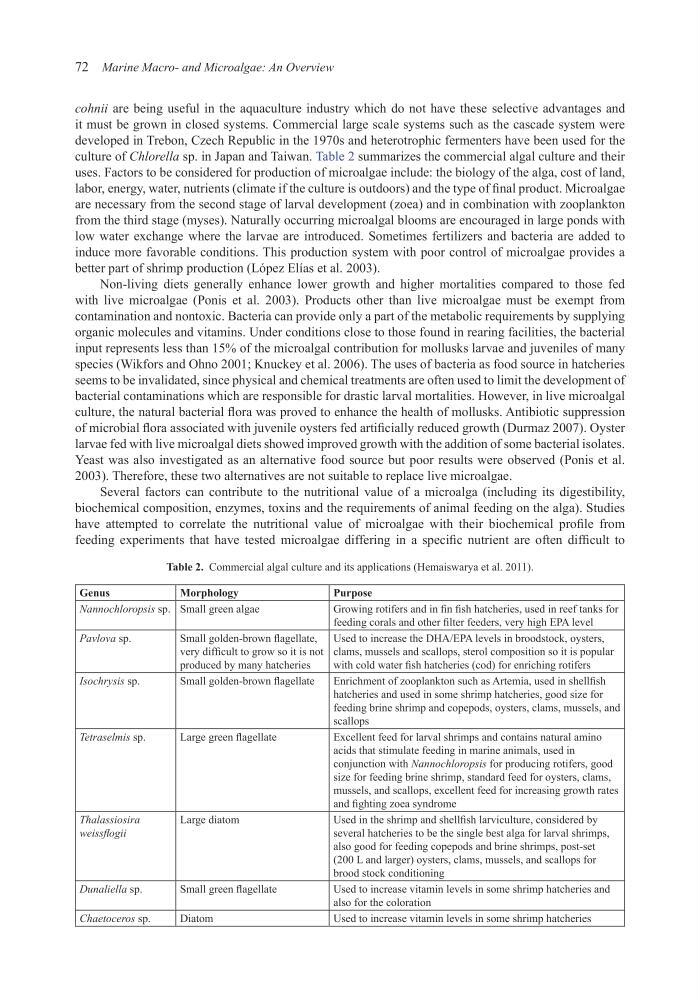
culture of Chlorella sp. in Japan and Taiwan. Table 2 summarizes the commercial algal culture and their
uses. Factors to be considered for production of microalgae include: the biology of the alga, cost of land,
labor, energy, water, nutrients (climate if the culture is outdoors) and the type of final product. Microalgae
are necessary from the second stage of larval development (zoea) and in combination with zooplankton
from the third stage (myses). Naturally occurring microalgal blooms are encouraged in large ponds with
low water exchange where the larvae are introduced. Sometimes fertilizers and bacteria are added to
induce more favorable conditions. This production system with poor control of microalgae provides a
better part of shrimp production (López Elías et al. 2003).
Non-living diets generally enhance lower growth and higher mortalities compared to those fed
with live microalgae (Ponis et al. 2003). Products other than live microalgae must be exempt from
contamination and nontoxic. Bacteria can provide only a part of the metabolic requirements by supplying
organic molecules and vitamins. Under conditions close to those found in rearing facilities, the bacterial
input represents less than 15% of the microalgal contribution for mollusks larvae and juveniles of many
species (Wikfors and Ohno 2001; Knuckey et al. 2006). The uses of bacteria as food source in hatcheries
seems to be invalidated, since physical and chemical treatments are often used to limit the development of
bacterial contaminations which are responsible for drastic larval mortalities. However, in live microalgal
culture, the natural bacterial flora was proved to enhance the health of mollusks. Antibiotic suppression
of microbial flora associated with juvenile oysters fed artificially reduced growth (Durmaz 2007). Oyster
larvae fed with live microalgal diets showed improved growth with the addition of some bacterial isolates.
Yeast was also investigated as an alternative food source but poor results were observed (Ponis et al.
2003). Therefore, these two alternatives are not suitable to replace live microalgae.
Several factors can contribute to the nutritional value of a microalga (including its digestibility,
biochemical composition, enzymes, toxins and the requirements of animal feeding on the alga). Studies
have attempted to correlate the nutritional value of microalgae with their biochemical profile from
feeding experiments that have tested microalgae differing in a specific nutrient are often difficult to
Table 2. Commercial algal culture and its applications (Hemaiswarya et al. 2011).
Genus
Morphology
Purpose
Nannochloropsis sp. Small green algae
Growing rotifers and in fin fish hatcheries, used in reef tanks for
feeding corals and other filter feeders, very high EPA level
Pavlova sp.
Small golden-brown flagellate,
very difficult to grow so it is not
produced by many hatcheries
Used to increase the DHA/EPA levels in broodstock, oysters,
clams, mussels and scallops, sterol composition so it is popular
with cold water fish hatcheries (cod) for enriching rotifers
Isochrysis sp.
Small golden-brown flagellate
Enrichment of zooplankton such as Artemia, used in shellfish
hatcheries and used in some shrimp hatcheries, good size for
feeding brine shrimp and copepods, oysters, clams, mussels, and
scallops
Tetraselmis sp.
Large green flagellate
Excellent feed for larval shrimps and contains natural amino
acids that stimulate feeding in marine animals, used in
conjunction with Nannochloropsis for producing rotifers, good
size for feeding brine shrimp, standard feed for oysters, clams,
mussels, and scallops, excellent feed for increasing growth rates
and fighting zoea syndrome
Thalassiosira
weissflogii
Large diatom
Used in the shrimp and shellfish larviculture, considered by
several hatcheries to be the single best alga for larval shrimps,
also good for feeding copepods and brine shrimps, post-set
(200 L and larger) oysters, clams, mussels, and scallops for
brood stock conditioning
Dunaliella sp.
Small green flagellate
Used to increase vitamin levels in some shrimp hatcheries and
also for the coloration
Chaetoceros sp.
Diatom
Used to increase vitamin levels in some shrimp hatcheries
cohnii are being useful in the aquaculture industry which do not have these selective advantages and
it must be grown in closed systems. Commercial large scale systems such as the cascade system were
developed in Trebon, Czech Republic in the 1970s and heterotrophic fermenters have been used for the
culture of Chlorella sp. in Japan and Taiwan. Table 2 summarizes the commercial algal culture and their
uses. Factors to be considered for production of microalgae include: the biology of the alga, cost of land,
labor, energy, water, nutrients (climate if the culture is outdoors) and the type of final product. Microalgae
are necessary from the second stage of larval development (zoea) and in combination with zooplankton
from the third stage (myses). Naturally occurring microalgal blooms are encouraged in large ponds with
low water exchange where the larvae are introduced. Sometimes fertilizers and bacteria are added to
induce more favorable conditions. This production system with poor control of microalgae provides a
better part of shrimp production (López Elías et al. 2003).
Non-living diets generally enhance lower growth and higher mortalities compared to those fed
with live microalgae (Ponis et al. 2003). Products other than live microalgae must be exempt from
contamination and nontoxic. Bacteria can provide only a part of the metabolic requirements by supplying
organic molecules and vitamins. Under conditions close to those found in rearing facilities, the bacterial
input represents less than 15% of the microalgal contribution for mollusks larvae and juveniles of many
species (Wikfors and Ohno 2001; Knuckey et al. 2006). The uses of bacteria as food source in hatcheries
seems to be invalidated, since physical and chemical treatments are often used to limit the development of
bacterial contaminations which are responsible for drastic larval mortalities. However, in live microalgal
culture, the natural bacterial flora was proved to enhance the health of mollusks. Antibiotic suppression
of microbial flora associated with juvenile oysters fed artificially reduced growth (Durmaz 2007). Oyster
larvae fed with live microalgal diets showed improved growth with the addition of some bacterial isolates.
Yeast was also investigated as an alternative food source but poor results were observed (Ponis et al.
2003). Therefore, these two alternatives are not suitable to replace live microalgae.
Several factors can contribute to the nutritional value of a microalga (including its digestibility,
biochemical composition, enzymes, toxins and the requirements of animal feeding on the alga). Studies
have attempted to correlate the nutritional value of microalgae with their biochemical profile from
feeding experiments that have tested microalgae differing in a specific nutrient are often difficult to
Table 2. Commercial algal culture and its applications (Hemaiswarya et al. 2011).
Genus
Morphology
Purpose
Nannochloropsis sp. Small green algae
Growing rotifers and in fin fish hatcheries, used in reef tanks for
feeding corals and other filter feeders, very high EPA level
Pavlova sp.
Small golden-brown flagellate,
very difficult to grow so it is not
produced by many hatcheries
Used to increase the DHA/EPA levels in broodstock, oysters,
clams, mussels and scallops, sterol composition so it is popular
with cold water fish hatcheries (cod) for enriching rotifers
Isochrysis sp.
Small golden-brown flagellate
Enrichment of zooplankton such as Artemia, used in shellfish
hatcheries and used in some shrimp hatcheries, good size for
feeding brine shrimp and copepods, oysters, clams, mussels, and
scallops
Tetraselmis sp.
Large green flagellate
Excellent feed for larval shrimps and contains natural amino
acids that stimulate feeding in marine animals, used in
conjunction with Nannochloropsis for producing rotifers, good
size for feeding brine shrimp, standard feed for oysters, clams,
mussels, and scallops, excellent feed for increasing growth rates
and fighting zoea syndrome
Thalassiosira
weissflogii
Large diatom
Used in the shrimp and shellfish larviculture, considered by
several hatcheries to be the single best alga for larval shrimps,
also good for feeding copepods and brine shrimps, post-set
(200 L and larger) oysters, clams, mussels, and scallops for
brood stock conditioning
Dunaliella sp.
Small green flagellate
Used to increase vitamin levels in some shrimp hatcheries and
also for the coloration
Chaetoceros sp.
Diatom
Used to increase vitamin levels in some shrimp hatcheries