

Importance of Seaweed in the Climate Change—Seaweed Solution 29
Generally, seaweeds cannot grow on soft and fine sediments. Because their habitats have been
degraded to barren rocky grounds, the term ‘kelp (seaweed) forests (or beds)’ was used here to encompass
communities that occur on artificial substrates, for examples, blocks, ropes, man-made reefs, abandoned
ships, Triton (made of slag from the iron-making process, etc.), or a complex of such elements. These
substrates were installed so that seaweeds could be attached for construction and/or restoration. One
method, developed by RIST, enabled a crew to construct reefs after a hard bottom forms. This improved
substrate property on the soft floor, making it possible to cultivate or grow seaweeds in challenging
locations where it is difficult to apply more conventional methods.
The minimum area that can be populated by a seaweed forest (i.e., the crown cover in the A/R)
differs among substrates. For example, when ropes are used, the coverage is over 70% whereas that with
artificial reefs is 30%. This estimate is based on a community in which plants of the target species grow
longer than 30 cm.
To utilize the marine space for these project activities, an operator must obtain a license and
permission from relevant authorities, such as local governments and stakeholders as well as other
agencies. According to the Fisheries Act in Korea, these types of fisheries licenses are valid for 10 years.
The technology employed for this CDM project involved mid-water rope construction, which is
appropriate for cultivating Ecklonia and Saccharina (Chung et al. 2013). Seedlings of both were produced
at the NIFSNFRDDI, per their well-established nursery method for culturing young sporophytes.
Transplantation occurred at the seaweed forest farm, which was established during the pilot survey.
Growth data, standing stock, and plant sizes were recorded from July 2009 to April 2011. After their
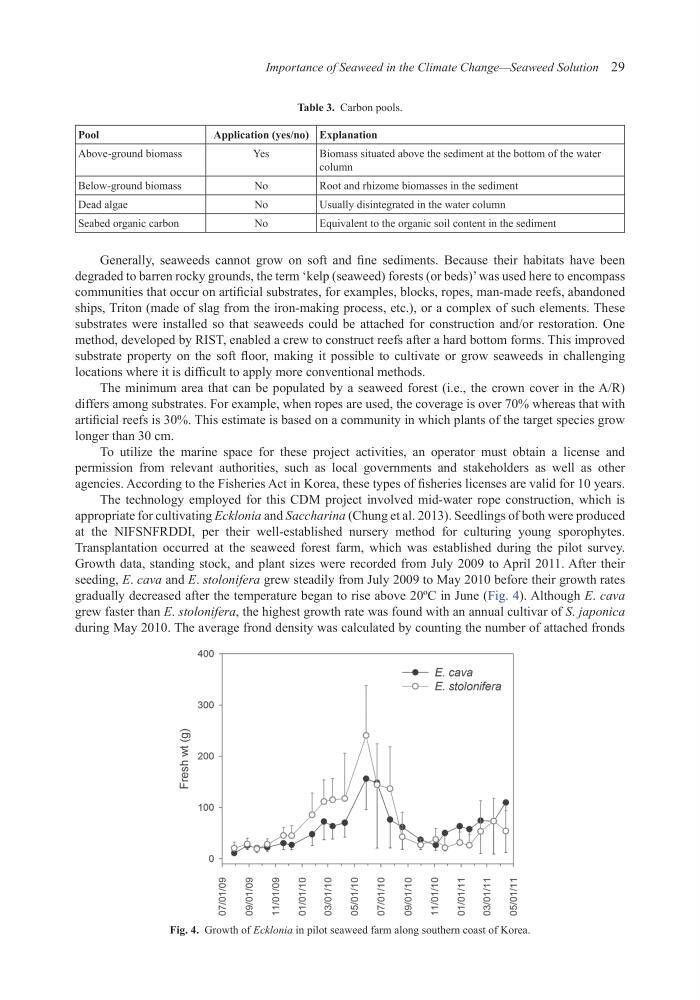
seeding, E. cava and E. stolonifera grew steadily from July 2009 to May 2010 before their growth rates
gradually decreased after the temperature began to rise above 20ºC in June (Fig. 4). Although E. cava
grew faster than E. stolonifera, the highest growth rate was found with an annual cultivar of S. japonica
during May 2010. The average frond density was calculated by counting the number of attached fronds
Table 3. Carbon pools.
Pool
Application (yes/no) Explanation
Above-ground biomass
Yes
Biomass situated above the sediment at the bottom of the water
column
Below-ground biomass
No
Root and rhizome biomasses in the sediment
Dead algae
No
Usually disintegrated in the water column
Seabed organic carbon
No
Equivalent to the organic soil content in the sediment
Fig. 4. Growth of Ecklonia in pilot seaweed farm along southern coast of Korea.
400
--e- E. cava
--o-- E. stolonifera
300
§
~ 200
.<::
(/)
~
LL.
100
0
Ol
Ol
Ol
0
0
0
0
0
0
e e e ~ ~ ~ ~ ~ ~ ~ ~ ~
~ ~ e ~ ~ ~
0
~ e e e ~
~
0
t:::
~
0
C'l
0
0
0
0
0
0
0
0
Generally, seaweeds cannot grow on soft and fine sediments. Because their habitats have been
degraded to barren rocky grounds, the term ‘kelp (seaweed) forests (or beds)’ was used here to encompass
communities that occur on artificial substrates, for examples, blocks, ropes, man-made reefs, abandoned
ships, Triton (made of slag from the iron-making process, etc.), or a complex of such elements. These
substrates were installed so that seaweeds could be attached for construction and/or restoration. One
method, developed by RIST, enabled a crew to construct reefs after a hard bottom forms. This improved
substrate property on the soft floor, making it possible to cultivate or grow seaweeds in challenging
locations where it is difficult to apply more conventional methods.
The minimum area that can be populated by a seaweed forest (i.e., the crown cover in the A/R)
differs among substrates. For example, when ropes are used, the coverage is over 70% whereas that with
artificial reefs is 30%. This estimate is based on a community in which plants of the target species grow
longer than 30 cm.
To utilize the marine space for these project activities, an operator must obtain a license and
permission from relevant authorities, such as local governments and stakeholders as well as other
agencies. According to the Fisheries Act in Korea, these types of fisheries licenses are valid for 10 years.
The technology employed for this CDM project involved mid-water rope construction, which is
appropriate for cultivating Ecklonia and Saccharina (Chung et al. 2013). Seedlings of both were produced
at the NIFSNFRDDI, per their well-established nursery method for culturing young sporophytes.
Transplantation occurred at the seaweed forest farm, which was established during the pilot survey.
Growth data, standing stock, and plant sizes were recorded from July 2009 to April 2011. After their
seeding, E. cava and E. stolonifera grew steadily from July 2009 to May 2010 before their growth rates
gradually decreased after the temperature began to rise above 20ºC in June (Fig. 4). Although E. cava
grew faster than E. stolonifera, the highest growth rate was found with an annual cultivar of S. japonica
during May 2010. The average frond density was calculated by counting the number of attached fronds
Table 3. Carbon pools.
Pool
Application (yes/no) Explanation
Above-ground biomass
Yes
Biomass situated above the sediment at the bottom of the water
column
Below-ground biomass
No
Root and rhizome biomasses in the sediment
Dead algae
No
Usually disintegrated in the water column
Seabed organic carbon
No
Equivalent to the organic soil content in the sediment
Fig. 4. Growth of Ecklonia in pilot seaweed farm along southern coast of Korea.
400
--e- E. cava
--o-- E. stolonifera
300
§
~ 200
.<::
(/)
~
LL.
100
0
Ol
Ol
Ol
0
0
0
0
0
0
e e e ~ ~ ~ ~ ~ ~ ~ ~ ~
~ ~ e ~ ~ ~
0
~ e e e ~
~
0
t:::
~
0
C'l
0
0
0
0
0
0
0
0