

28 Marine Macro- and Microalgae: An Overview
The PDD included a description of current environmental conditions in the area, for example,
climate, hydrology, soils, ecosystems, and the possible presence of rare or endangered species and their
habits. Data such as temperature (°C), salinity, pH, dissolved oxygen (mg L
–1
), Chemical Oxygen Demand
(mg L
–1
), Dissolved Inorganic Nitrogen (mg L
–1
), Dissolved Inorganic Phosphorus (mg L
–1
), Suspended
Solids (mg L
–1
), and the concentration of Chlorophyll a (μg L
–1
) were obtained from an environmental
report by the National Institute of Fisheries Research (NIFS; http://www.nifs.re.kr).
Seaweeds used in this project were chosen by a group of experts from academia, research institutes,
and industries. The NIFS, PNU, Chonnam National University, and the Research Institute of Industrial
Science and Technology (RIST) participated in the selection process, during which rates of CO 2
uptake, survival, and growth, as well as other related characteristics, were discussed. Opinions from
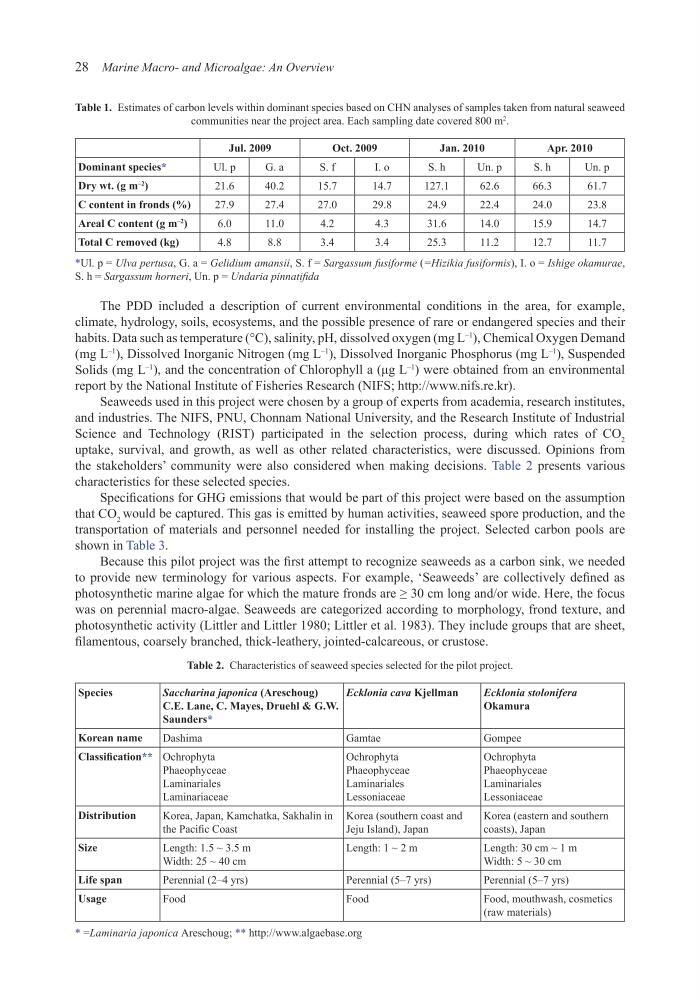
the stakeholders’ community were also considered when making decisions. Table 2 presents various
characteristics for these selected species.
Specifications for GHG emissions that would be part of this project were based on the assumption
that CO 2 would be captured. This gas is emitted by human activities, seaweed spore production, and the
transportation of materials and personnel needed for installing the project. Selected carbon pools are
shown in Table 3.
Because this pilot project was the first attempt to recognize seaweeds as a carbon sink, we needed
to provide new terminology for various aspects. For example, ‘Seaweeds’ are collectively defined as
photosynthetic marine algae for which the mature fronds are ≥ 30 cm long and/or wide. Here, the focus
was on perennial macro-algae. Seaweeds are categorized according to morphology, frond texture, and
photosynthetic activity (Littler and Littler 1980; Littler et al. 1983). They include groups that are sheet,
filamentous, coarsely branched, thick-leathery, jointed-calcareous, or crustose.
Table 1. Estimates of carbon levels within dominant species based on CHN analyses of samples taken from natural seaweed
communities near the project area. Each sampling date covered 800 m
2
.
Jul. 2009
Oct. 2009
Jan. 2010
Apr. 2010
Dominant species*
Ul. p
G. a
S. f
I. o
S. h
Un. p
S. h
Un. p
Dry wt. (g m
–2
)
21.6
40.2
15.7
14.7
127.1
62.6
66.3
61.7
C content in fronds (%)
27.9
27.4
27.0
29.8
24.9
22.4
24.0
23.8
Areal C content (g m
–2
)
6.0
11.0
4.2
4.3
31.6
14.0
15.9
14.7
Total C removed (kg)
4.8
8.8
3.4
3.4
25.3
11.2
12.7
11.7
*Ul. p = Ulva pertusa, G. a = Gelidium amansii, S. f = Sargassum fusiforme (=Hizikia fusiformis), I. o = Ishige okamurae,
S. h = Sargassum horneri, Un. p = Undaria pinnatifida
Table 2. Characteristics of seaweed species selected for the pilot project.
Species
Saccharina japonica (Areschoug)
C.E. Lane, C. Mayes, Druehl & G.W.
Saunders*
Ecklonia cava Kjellman
Ecklonia stolonifera
Okamura
Korean name
Dashima
Gamtae
Gompee
Classification** Ochrophyta
Phaeophyceae
Laminariales
Laminariaceae
Ochrophyta
Phaeophyceae
Laminariales
Lessoniaceae
Ochrophyta
Phaeophyceae
Laminariales
Lessoniaceae
Distribution
Korea, Japan, Kamchatka, Sakhalin in
the Pacific Coast
Korea (southern coast and
Jeju Island), Japan
Korea (eastern and southern
coasts), Japan
Size
Length: 1.5 ~ 3.5 m
Width: 25 ~ 40 cm
Length: 1 ~ 2 m
Length: 30 cm ~ 1 m
Width: 5 ~ 30 cm
Life span
Perennial (2–4 yrs)
Perennial (5–7 yrs)
Perennial (5–7 yrs)
Usage
Food
Food
Food, mouthwash, cosmetics
(raw materials)
* =Laminaria japonica Areschoug; ** http://www.algaebase.org
The PDD included a description of current environmental conditions in the area, for example,
climate, hydrology, soils, ecosystems, and the possible presence of rare or endangered species and their
habits. Data such as temperature (°C), salinity, pH, dissolved oxygen (mg L
–1
), Chemical Oxygen Demand
(mg L
–1
), Dissolved Inorganic Nitrogen (mg L
–1
), Dissolved Inorganic Phosphorus (mg L
–1
), Suspended
Solids (mg L
–1
), and the concentration of Chlorophyll a (μg L
–1
) were obtained from an environmental
report by the National Institute of Fisheries Research (NIFS; http://www.nifs.re.kr).
Seaweeds used in this project were chosen by a group of experts from academia, research institutes,
and industries. The NIFS, PNU, Chonnam National University, and the Research Institute of Industrial
Science and Technology (RIST) participated in the selection process, during which rates of CO 2
uptake, survival, and growth, as well as other related characteristics, were discussed. Opinions from
the stakeholders’ community were also considered when making decisions. Table 2 presents various
characteristics for these selected species.
Specifications for GHG emissions that would be part of this project were based on the assumption
that CO 2 would be captured. This gas is emitted by human activities, seaweed spore production, and the
transportation of materials and personnel needed for installing the project. Selected carbon pools are
shown in Table 3.
Because this pilot project was the first attempt to recognize seaweeds as a carbon sink, we needed
to provide new terminology for various aspects. For example, ‘Seaweeds’ are collectively defined as
photosynthetic marine algae for which the mature fronds are ≥ 30 cm long and/or wide. Here, the focus
was on perennial macro-algae. Seaweeds are categorized according to morphology, frond texture, and
photosynthetic activity (Littler and Littler 1980; Littler et al. 1983). They include groups that are sheet,
filamentous, coarsely branched, thick-leathery, jointed-calcareous, or crustose.
Table 1. Estimates of carbon levels within dominant species based on CHN analyses of samples taken from natural seaweed
communities near the project area. Each sampling date covered 800 m
2
.
Jul. 2009
Oct. 2009
Jan. 2010
Apr. 2010
Dominant species*
Ul. p
G. a
S. f
I. o
S. h
Un. p
S. h
Un. p
Dry wt. (g m
–2
)
21.6
40.2
15.7
14.7
127.1
62.6
66.3
61.7
C content in fronds (%)
27.9
27.4
27.0
29.8
24.9
22.4
24.0
23.8
Areal C content (g m
–2
)
6.0
11.0
4.2
4.3
31.6
14.0
15.9
14.7
Total C removed (kg)
4.8
8.8
3.4
3.4
25.3
11.2
12.7
11.7
*Ul. p = Ulva pertusa, G. a = Gelidium amansii, S. f = Sargassum fusiforme (=Hizikia fusiformis), I. o = Ishige okamurae,
S. h = Sargassum horneri, Un. p = Undaria pinnatifida
Table 2. Characteristics of seaweed species selected for the pilot project.
Species
Saccharina japonica (Areschoug)
C.E. Lane, C. Mayes, Druehl & G.W.
Saunders*
Ecklonia cava Kjellman
Ecklonia stolonifera
Okamura
Korean name
Dashima
Gamtae
Gompee
Classification** Ochrophyta
Phaeophyceae
Laminariales
Laminariaceae
Ochrophyta
Phaeophyceae
Laminariales
Lessoniaceae
Ochrophyta
Phaeophyceae
Laminariales
Lessoniaceae
Distribution
Korea, Japan, Kamchatka, Sakhalin in
the Pacific Coast
Korea (southern coast and
Jeju Island), Japan
Korea (eastern and southern
coasts), Japan
Size
Length: 1.5 ~ 3.5 m
Width: 25 ~ 40 cm
Length: 1 ~ 2 m
Length: 30 cm ~ 1 m
Width: 5 ~ 30 cm
Life span
Perennial (2–4 yrs)
Perennial (5–7 yrs)
Perennial (5–7 yrs)
Usage
Food
Food
Food, mouthwash, cosmetics
(raw materials)
* =Laminaria japonica Areschoug; ** http://www.algaebase.org