

Present and Future Economic and Environmental Impacts of Microalgal Technology 305
Over the last decade and in response to the perceived increase in microalgal research and commercial
activities in San Diego County, SD-CAB has commissioned several studies on the economic impact of
algal biofuel research in the area (Mayfield, S. personal communication). Three studies have been released
(April 2009, June 2010 and January 2012) which indicate an increasing trend in positive economic
impact in the County. The economic impacts were quantified as follows: direct impacts (reflecting jobs
and expenditures that are directly related to research in algal biofuels), indirect impacts (reflecting the
numerous business products, materials, and services required and supplied locally to support the direct
activities of the research) and induced impacts (reflecting the local household expenditures of employees
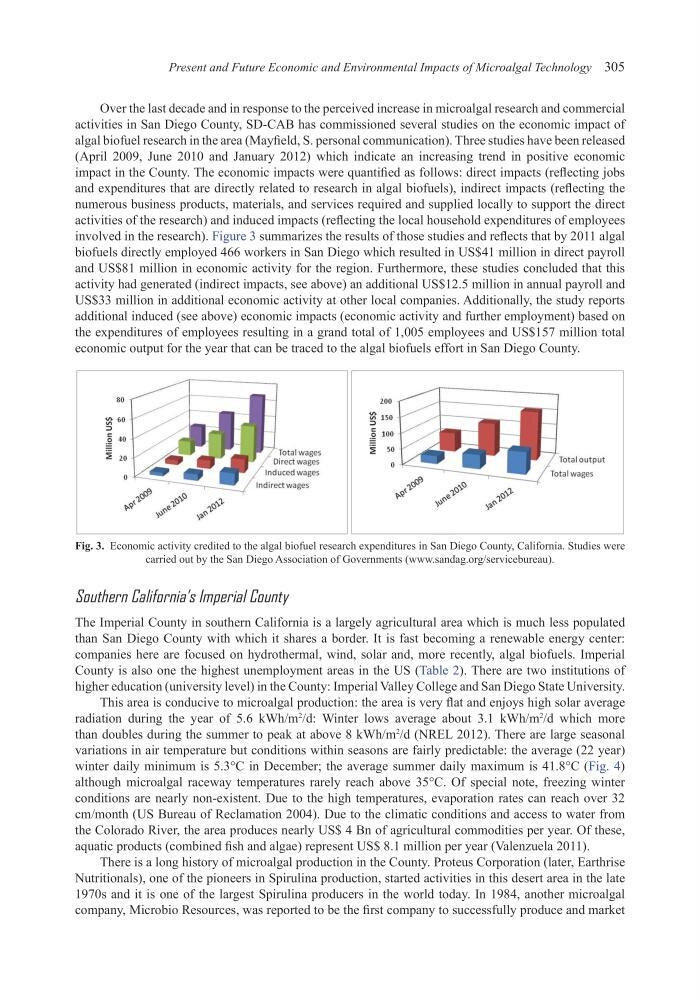
involved in the research). Figure 3 summarizes the results of those studies and reflects that by 2011 algal
biofuels directly employed 466 workers in San Diego which resulted in US$41 million in direct payroll
and US$81 million in economic activity for the region. Furthermore, these studies concluded that this
activity had generated (indirect impacts, see above) an additional US$12.5 million in annual payroll and
US$33 million in additional economic activity at other local companies. Additionally, the study reports
additional induced (see above) economic impacts (economic activity and further employment) based on
the expenditures of employees resulting in a grand total of 1,005 employees and US$157 million total
economic output for the year that can be traced to the algal biofuels effort in San Diego County.
Fig. 3. Economic activity credited to the algal biofuel research expenditures in San Diego County, California. Studies were
carried out by the San Diego Association of Governments (www.sandag.org/servicebureau).
Southern California’s Imperial County
The Imperial County in southern California is a largely agricultural area which is much less populated
than San Diego County with which it shares a border. It is fast becoming a renewable energy center:
companies here are focused on hydrothermal, wind, solar and, more recently, algal biofuels. Imperial
County is also one the highest unemployment areas in the US (Table 2). There are two institutions of
higher education (university level) in the County: Imperial Valley College and San Diego State University.
This area is conducive to microalgal production: the area is very flat and enjoys high solar average
radiation during the year of 5.6 kWh/m
2
/d: Winter lows average about 3.1 kWh/m
2
/d which more
than doubles during the summer to peak at above 8 kWh/m
2
/d (NREL 2012). There are large seasonal
variations in air temperature but conditions within seasons are fairly predictable: the average (22 year)
winter daily minimum is 5.3°C in December; the average summer daily maximum is 41.8°C (Fig. 4)
although microalgal raceway temperatures rarely reach above 35°C. Of special note, freezing winter
conditions are nearly non-existent. Due to the high temperatures, evaporation rates can reach over 32
cm/month (US Bureau of Reclamation 2004). Due to the climatic conditions and access to water from
the Colorado River, the area produces nearly US$ 4 Bn of agricultural commodities per year. Of these,
aquatic products (combined fish and algae) represent US$ 8.1 million per year (Valenzuela 2011).
There is a long history of microalgal production in the County. Proteus Corporation (later, Earthrise
Nutritionals), one of the pioneers in Spirulina production, started activities in this desert area in the late
1970s and it is one of the largest Spirulina producers in the world today. In 1984, another microalgal
company, Microbio Resources, was reported to be the first company to successfully produce and market
Over the last decade and in response to the perceived increase in microalgal research and commercial
activities in San Diego County, SD-CAB has commissioned several studies on the economic impact of
algal biofuel research in the area (Mayfield, S. personal communication). Three studies have been released
(April 2009, June 2010 and January 2012) which indicate an increasing trend in positive economic
impact in the County. The economic impacts were quantified as follows: direct impacts (reflecting jobs
and expenditures that are directly related to research in algal biofuels), indirect impacts (reflecting the
numerous business products, materials, and services required and supplied locally to support the direct
activities of the research) and induced impacts (reflecting the local household expenditures of employees
involved in the research). Figure 3 summarizes the results of those studies and reflects that by 2011 algal
biofuels directly employed 466 workers in San Diego which resulted in US$41 million in direct payroll
and US$81 million in economic activity for the region. Furthermore, these studies concluded that this
activity had generated (indirect impacts, see above) an additional US$12.5 million in annual payroll and
US$33 million in additional economic activity at other local companies. Additionally, the study reports
additional induced (see above) economic impacts (economic activity and further employment) based on
the expenditures of employees resulting in a grand total of 1,005 employees and US$157 million total
economic output for the year that can be traced to the algal biofuels effort in San Diego County.
Fig. 3. Economic activity credited to the algal biofuel research expenditures in San Diego County, California. Studies were
carried out by the San Diego Association of Governments (www.sandag.org/servicebureau).
Southern California’s Imperial County
The Imperial County in southern California is a largely agricultural area which is much less populated
than San Diego County with which it shares a border. It is fast becoming a renewable energy center:
companies here are focused on hydrothermal, wind, solar and, more recently, algal biofuels. Imperial
County is also one the highest unemployment areas in the US (Table 2). There are two institutions of
higher education (university level) in the County: Imperial Valley College and San Diego State University.
This area is conducive to microalgal production: the area is very flat and enjoys high solar average
radiation during the year of 5.6 kWh/m
2
/d: Winter lows average about 3.1 kWh/m
2
/d which more
than doubles during the summer to peak at above 8 kWh/m
2
/d (NREL 2012). There are large seasonal
variations in air temperature but conditions within seasons are fairly predictable: the average (22 year)
winter daily minimum is 5.3°C in December; the average summer daily maximum is 41.8°C (Fig. 4)
although microalgal raceway temperatures rarely reach above 35°C. Of special note, freezing winter
conditions are nearly non-existent. Due to the high temperatures, evaporation rates can reach over 32
cm/month (US Bureau of Reclamation 2004). Due to the climatic conditions and access to water from
the Colorado River, the area produces nearly US$ 4 Bn of agricultural commodities per year. Of these,
aquatic products (combined fish and algae) represent US$ 8.1 million per year (Valenzuela 2011).
There is a long history of microalgal production in the County. Proteus Corporation (later, Earthrise
Nutritionals), one of the pioneers in Spirulina production, started activities in this desert area in the late
1970s and it is one of the largest Spirulina producers in the world today. In 1984, another microalgal
company, Microbio Resources, was reported to be the first company to successfully produce and market