

244 Marine Macro- and Microalgae: An Overview
IMTA concept is an argument in favor of its implementation which must be also transferred to the public,
since the potential to exceed the carrying capacity of the water is one of the issues of concern considering
aquaculture intensification (Froehlich et al. 2017). Another concern is the excessive occupation of coastal
areas, which may also lead to a rejection by the local populations due to negative aesthetic impacts on
the landscapes. These issues are being addressed in the context of spatial planning, and possible solutions
may rely on moving aquaculture offshore or on the implementation of multi-use platforms, associating
different activities such as wind energy production and aquaculture (Troell et al. 2009; Jansen et al. 2016;
Holm et al. 2017).
The argument for producing seaweed in IMTA systems, under the production point of view, is the high
nutrient availability in areas associated (in land-based systems) or near fish or shellfish aquaculture (in
open water) that increases productivity and yield. From an environmental point of view, other arguments
may be made on the benefits of seaweed production, related to the ecosystem services they provide,
besides nutrient bioremediation. Natural seaweed assemblages, including kelp forests, provide a number
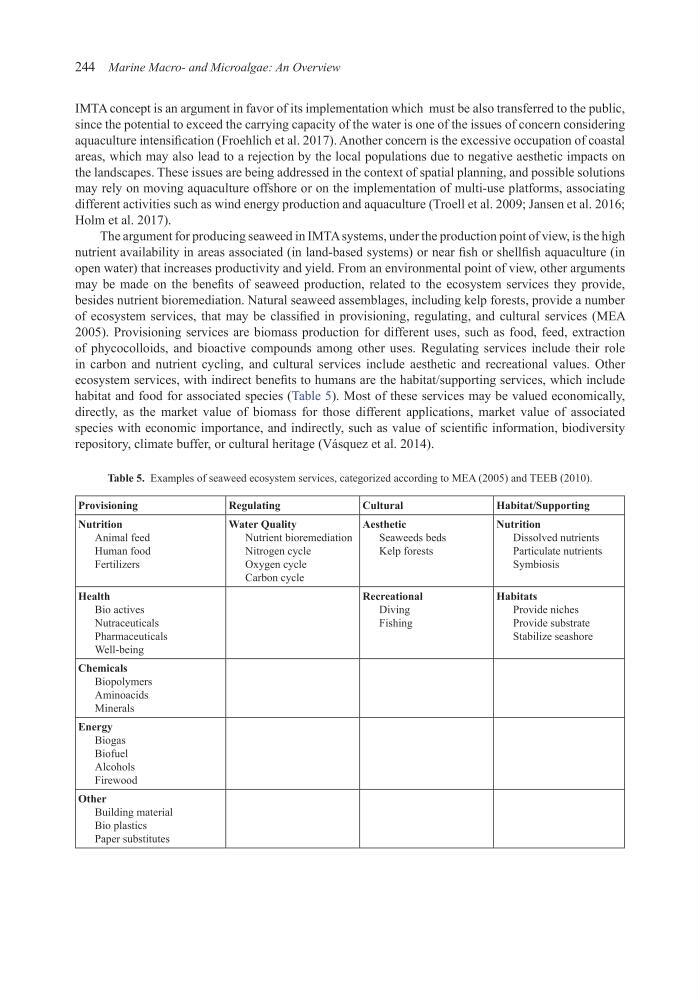
of ecosystem services, that may be classified in provisioning, regulating, and cultural services (MEA
2005). Provisioning services are biomass production for different uses, such as food, feed, extraction
of phycocolloids, and bioactive compounds among other uses. Regulating services include their role
in carbon and nutrient cycling, and cultural services include aesthetic and recreational values. Other
ecosystem services, with indirect benefits to humans are the habitat/supporting services, which include
habitat and food for associated species (Table 5). Most of these services may be valued economically,
directly, as the market value of biomass for those different applications, market value of associated
species with economic importance, and indirectly, such as value of scientific information, biodiversity
repository, climate buffer, or cultural heritage (Vásquez et al. 2014).
Table 5. Examples of seaweed ecosystem services, categorized according to MEA (2005) and TEEB (2010).
Provisioning
Regulating
Cultural
Habitat/Supporting
Nutrition
Animal feed
Human food
Fertilizers
Water Quality
Nutrient bioremediation
Nitrogen cycle
Oxygen cycle
Carbon cycle
Aesthetic
Seaweeds beds
Kelp forests
Nutrition
Dissolved nutrients
Particulate nutrients
Symbiosis
Health
Bio actives
Nutraceuticals
Pharmaceuticals
Well-being
Recreational
Diving
Fishing
Habitats
Provide niches
Provide substrate
Stabilize seashore
Chemicals
Biopolymers
Aminoacids
Minerals
Energy
Biogas
Biofuel
Alcohols
Firewood
Other
Building material
Bio plastics
Paper substitutes
IMTA concept is an argument in favor of its implementation which must be also transferred to the public,
since the potential to exceed the carrying capacity of the water is one of the issues of concern considering
aquaculture intensification (Froehlich et al. 2017). Another concern is the excessive occupation of coastal
areas, which may also lead to a rejection by the local populations due to negative aesthetic impacts on
the landscapes. These issues are being addressed in the context of spatial planning, and possible solutions
may rely on moving aquaculture offshore or on the implementation of multi-use platforms, associating
different activities such as wind energy production and aquaculture (Troell et al. 2009; Jansen et al. 2016;
Holm et al. 2017).
The argument for producing seaweed in IMTA systems, under the production point of view, is the high
nutrient availability in areas associated (in land-based systems) or near fish or shellfish aquaculture (in
open water) that increases productivity and yield. From an environmental point of view, other arguments
may be made on the benefits of seaweed production, related to the ecosystem services they provide,
besides nutrient bioremediation. Natural seaweed assemblages, including kelp forests, provide a number
of ecosystem services, that may be classified in provisioning, regulating, and cultural services (MEA
2005). Provisioning services are biomass production for different uses, such as food, feed, extraction
of phycocolloids, and bioactive compounds among other uses. Regulating services include their role
in carbon and nutrient cycling, and cultural services include aesthetic and recreational values. Other
ecosystem services, with indirect benefits to humans are the habitat/supporting services, which include
habitat and food for associated species (Table 5). Most of these services may be valued economically,
directly, as the market value of biomass for those different applications, market value of associated
species with economic importance, and indirectly, such as value of scientific information, biodiversity
repository, climate buffer, or cultural heritage (Vásquez et al. 2014).
Table 5. Examples of seaweed ecosystem services, categorized according to MEA (2005) and TEEB (2010).
Provisioning
Regulating
Cultural
Habitat/Supporting
Nutrition
Animal feed
Human food
Fertilizers
Water Quality
Nutrient bioremediation
Nitrogen cycle
Oxygen cycle
Carbon cycle
Aesthetic
Seaweeds beds
Kelp forests
Nutrition
Dissolved nutrients
Particulate nutrients
Symbiosis
Health
Bio actives
Nutraceuticals
Pharmaceuticals
Well-being
Recreational
Diving
Fishing
Habitats
Provide niches
Provide substrate
Stabilize seashore
Chemicals
Biopolymers
Aminoacids
Minerals
Energy
Biogas
Biofuel
Alcohols
Firewood
Other
Building material
Bio plastics
Paper substitutes