

Integrated Multitrophic Aquaculture: An Overview 237
amphipods, and other small invertebrates fed on the solid wastes from the shellfish and were fed upon
by flounder and lobsters. Commercial red seaweeds (Chondrus, Gracilaria, Agardhiella, Hypnea) then
removed the dissolved wastes excreted by the shellfish and other animals and any nutrients not initially
removed by the unicellular algae (Ryther et al. 1975). This resulted in a low nutrient discharge that was
not suitable for the proliferation of algae and, thus, did not contribute to the eutrophication of adjacent
wet areas. Since then many studies have been done on the utilization of seaweeds as a biofilter in IMTA
systems.
Between 1975 and 1993, the cultivation of seaweeds in integrated systems was mainly investigated
for treating effluents from enclosed land-based mariculture systems. This line of research was initiated
in the mid-1970s (Haines 1975; Ryther et al. 1975; Langton et al. 1977). But it was only in the 1990s,
that renewed and increased research into the development of seaweed-based integrated techniques took
place, mainly as a consequence of the rapid expansion of intensive offshore mariculture systems (i.e.,
fish farming and shrimp cultivation) and the concern for negative effects on the environment from such
practices (Vandermeulen and Gordin 1990; Cohen and Neori 1991; Neori et al. 1991; Neori et al. 1996).
Kautsky and Folke (1991) introduced the concept of “integrated open sea aquaculture”, in which
coastal waters, made eutrophic by fish net pens, agricultural runoff, and sewage discharge, are used to
supply cultured seaweed with dissolved nutrients and shellfish with plankton. One year later, the same
authors suggested that a coastal culturing system of seaweeds, mussels, and salmon could be developed
as an ecologically and economic viable option to integrate culturing activities in coastal areas. In their
own words, “a successful aquaculture system does not have wastes, only by-products, to be used as
positive contributors to the surrounding ecosystems and the economy” (Folke and Kautsky 1992). In
1993, Hirata and co-authors, tested the cultivation of Ulva sp. in crab cages placed in a yellowtail farm at
sea at a depth of about 50 cm. The authors concluded that the sterile Ulva sp. is a suitable aquatic plant
for introducing a polyculture of seaweed and fish in the sea (Hirata et al. 1993).
However, during this period and until 2004, most studies were still mainly focused on demonstrating
that wastewater from intensive and semi-intensive mariculture in land based systems is a suitable nutrient
source for the intensive production of seaweed, thereby reducing the discharge of dissolved nutrients to
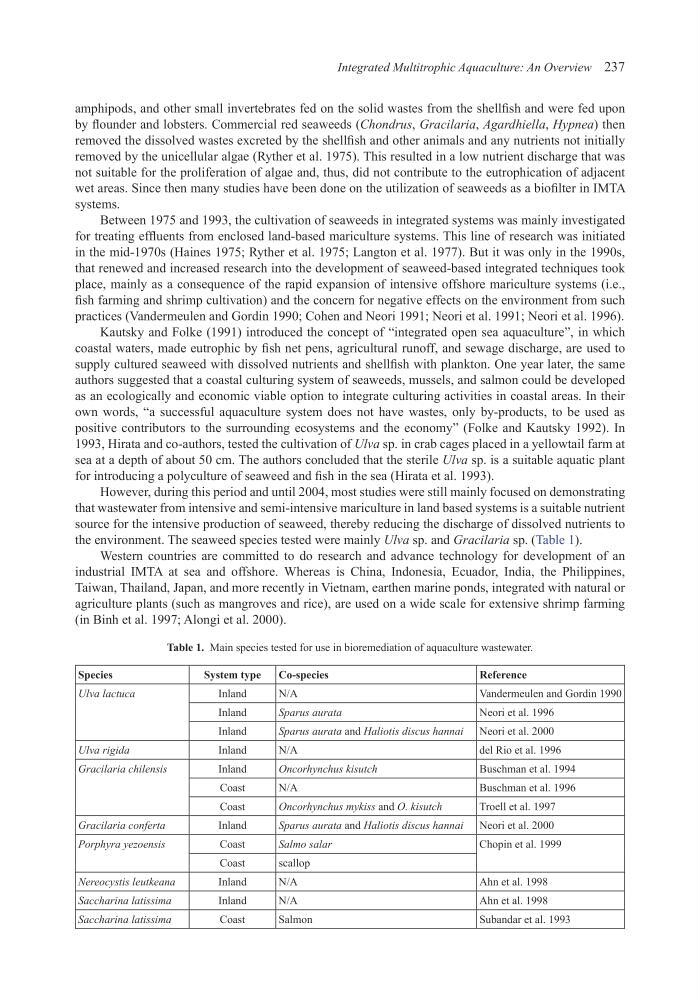
the environment. The seaweed species tested were mainly Ulva sp. and Gracilaria sp. (Table 1).
Western countries are committed to do research and advance technology for development of an
industrial IMTA at sea and offshore. Whereas is China, Indonesia, Ecuador, India, the Philippines,
Taiwan, Thailand, Japan, and more recently in Vietnam, earthen marine ponds, integrated with natural or
agriculture plants (such as mangroves and rice), are used on a wide scale for extensive shrimp farming
(in Binh et al. 1997; Alongi et al. 2000).
Table 1. Main species tested for use in bioremediation of aquaculture wastewater.
Species
System type
Co-species
Reference
Ulva lactuca
Inland
N/A
Vandermeulen and Gordin 1990
Inland
Sparus aurata
Neori et al. 1996
Inland
Sparus aurata and Haliotis discus hannai Neori et al. 2000
Ulva rigida
Inland
N/A
del Rio et al. 1996
Gracilaria chilensis
Inland
Oncorhynchus kisutch
Buschman et al. 1994
Coast
N/A
Buschman et al. 1996
Coast
Oncorhynchus mykiss and O. kisutch
Troell et al. 1997
Gracilaria conferta
Inland
Sparus aurata and Haliotis discus hannai Neori et al. 2000
Porphyra yezoensis
Coast
Salmo salar
Chopin et al. 1999
Coast
scallop
Nereocystis leutkeana
Inland
N/A
Ahn et al. 1998
Saccharina latissima
Inland
N/A
Ahn et al. 1998
Saccharina latissima
Coast
Salmon
Subandar et al. 1993
amphipods, and other small invertebrates fed on the solid wastes from the shellfish and were fed upon
by flounder and lobsters. Commercial red seaweeds (Chondrus, Gracilaria, Agardhiella, Hypnea) then
removed the dissolved wastes excreted by the shellfish and other animals and any nutrients not initially
removed by the unicellular algae (Ryther et al. 1975). This resulted in a low nutrient discharge that was
not suitable for the proliferation of algae and, thus, did not contribute to the eutrophication of adjacent
wet areas. Since then many studies have been done on the utilization of seaweeds as a biofilter in IMTA
systems.
Between 1975 and 1993, the cultivation of seaweeds in integrated systems was mainly investigated
for treating effluents from enclosed land-based mariculture systems. This line of research was initiated
in the mid-1970s (Haines 1975; Ryther et al. 1975; Langton et al. 1977). But it was only in the 1990s,
that renewed and increased research into the development of seaweed-based integrated techniques took
place, mainly as a consequence of the rapid expansion of intensive offshore mariculture systems (i.e.,
fish farming and shrimp cultivation) and the concern for negative effects on the environment from such
practices (Vandermeulen and Gordin 1990; Cohen and Neori 1991; Neori et al. 1991; Neori et al. 1996).
Kautsky and Folke (1991) introduced the concept of “integrated open sea aquaculture”, in which
coastal waters, made eutrophic by fish net pens, agricultural runoff, and sewage discharge, are used to
supply cultured seaweed with dissolved nutrients and shellfish with plankton. One year later, the same
authors suggested that a coastal culturing system of seaweeds, mussels, and salmon could be developed
as an ecologically and economic viable option to integrate culturing activities in coastal areas. In their
own words, “a successful aquaculture system does not have wastes, only by-products, to be used as
positive contributors to the surrounding ecosystems and the economy” (Folke and Kautsky 1992). In
1993, Hirata and co-authors, tested the cultivation of Ulva sp. in crab cages placed in a yellowtail farm at
sea at a depth of about 50 cm. The authors concluded that the sterile Ulva sp. is a suitable aquatic plant
for introducing a polyculture of seaweed and fish in the sea (Hirata et al. 1993).
However, during this period and until 2004, most studies were still mainly focused on demonstrating
that wastewater from intensive and semi-intensive mariculture in land based systems is a suitable nutrient
source for the intensive production of seaweed, thereby reducing the discharge of dissolved nutrients to
the environment. The seaweed species tested were mainly Ulva sp. and Gracilaria sp. (Table 1).
Western countries are committed to do research and advance technology for development of an
industrial IMTA at sea and offshore. Whereas is China, Indonesia, Ecuador, India, the Philippines,
Taiwan, Thailand, Japan, and more recently in Vietnam, earthen marine ponds, integrated with natural or
agriculture plants (such as mangroves and rice), are used on a wide scale for extensive shrimp farming
(in Binh et al. 1997; Alongi et al. 2000).
Table 1. Main species tested for use in bioremediation of aquaculture wastewater.
Species
System type
Co-species
Reference
Ulva lactuca
Inland
N/A
Vandermeulen and Gordin 1990
Inland
Sparus aurata
Neori et al. 1996
Inland
Sparus aurata and Haliotis discus hannai Neori et al. 2000
Ulva rigida
Inland
N/A
del Rio et al. 1996
Gracilaria chilensis
Inland
Oncorhynchus kisutch
Buschman et al. 1994
Coast
N/A
Buschman et al. 1996
Coast
Oncorhynchus mykiss and O. kisutch
Troell et al. 1997
Gracilaria conferta
Inland
Sparus aurata and Haliotis discus hannai Neori et al. 2000
Porphyra yezoensis
Coast
Salmo salar
Chopin et al. 1999
Coast
scallop
Nereocystis leutkeana
Inland
N/A
Ahn et al. 1998
Saccharina latissima
Inland
N/A
Ahn et al. 1998
Saccharina latissima
Coast
Salmon
Subandar et al. 1993