

210 Marine Macro- and Microalgae: An Overview
Mycosporine like amino acids (MAAs) (e.g., mycosporine-glycine) are a group of over 20 UV
absorbing compounds that are found in a diverse range of marine organisms where they act as sunscreens
to reduce UV induced damage. Their main role is in screening against energetic UVA radiation. Besides
their role as a sunscreen in aquatic organisms, it has been suggested that some MAAs can act as antioxidants
(Dunlap and Yamamoto 1995). Their antioxidant nature increases their therapeutic effectiveness. MAAs
also play a role in protecting against sunlight damage by acting as antioxidant molecules scavenging toxic
oxygen radicals (Dunlap and Yamamoto 1995) and providing protection against photo-oxidative stress
induced by ROS. They also act to protect cells against salt stress, against desiccation or thermal stress,
and as an intracellular nitrogen reserve (Oren and Gunde-Cimerman 2007).
MAAs are colorless, water soluble compounds with low molecular weights (< 400 g mol
−1
).
They have a strong UV absorption maxima between 310–362 nm, a very high molar absorptivity
(ε = 28,000–50,000 M
−1
cm
−1
) (Conde et al. 2000), and are photostable in both distilled and sea water in
the presence of photosensitizers. This photoprotective effect is the primary function of MAAs (Carignan
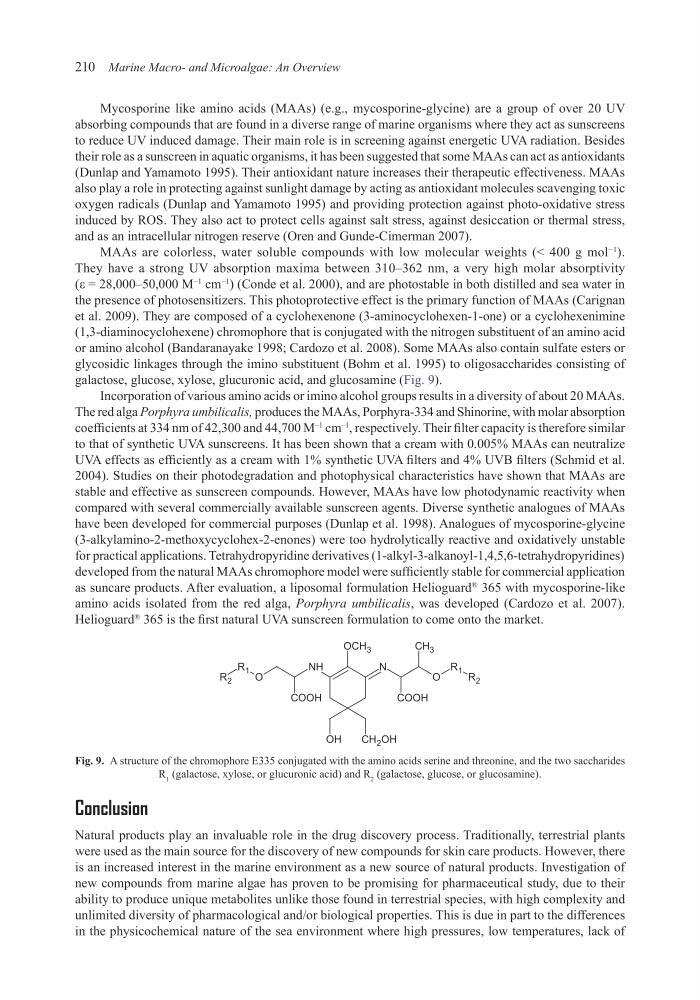
et al. 2009). They are composed of a cyclohexenone (3-aminocyclohexen-1-one) or a cyclohexenimine
(1,3-diaminocyclohexene) chromophore that is conjugated with the nitrogen substituent of an amino acid
or amino alcohol (Bandaranayake 1998; Cardozo et al. 2008). Some MAAs also contain sulfate esters or
glycosidic linkages through the imino substituent (Bohm et al. 1995) to oligosaccharides consisting of
galactose, glucose, xylose, glucuronic acid, and glucosamine (Fig. 9).
Incorporation of various amino acids or imino alcohol groups results in a diversity of about 20 MAAs.
The red alga Porphyra umbilicalis, produces the MAAs, Porphyra-334 and Shinorine, with molar absorp tion
coefficients at 334 nm of 42,300 and 44,700 M
–1
cm
–1
, respective ly. Their filter capacity is therefore similar
to that of synthetic UVA sunscreens. It has been shown that a cream with 0.005% MAAs can neutralize
UVA effects as efficiently as a cream with 1% synthetic UVA filters and 4% UVB filters (Schmid et al.
2004). Studies on their photodegradation and photophysical characteristics have shown that MAAs are
stable and effective as sunscreen compounds. However, MAAs have low photodynamic reactivity when
compared with several commercially available sunscreen agents. Diverse synthetic analogues of MAAs
have been developed for commercial purposes (Dunlap et al. 1998). Analogues of mycosporine-glycine
(3-alkylamino-2-methoxycyclohex-2-enones) were too hydrolytically reactive and oxidatively unstable
for practical applications. Tetrahydropyridine derivatives (1-alkyl-3-alkanoyl-1,4,5,6-tetrahydropyridines)
developed from the natural MAAs chromophore model were sufficiently stable for commercial application
as suncare products. After evaluation, a liposomal formulation Helioguard
®
365 with mycosporine-like
amino acids isolated from the red alga, Porphyra umbilicalis, was developed (Cardozo et al. 2007).
Helioguard
®
365 is the first natural UVA sunscreen formulation to come onto the market.
Fig. 9. A structure of the chromophore E335 conjugated with the amino acids serine and threonine, and the two saccharides
R 1 (galactose, xylose, or glucuronic acid) and R 2 (galactose, glucose, or glucosamine).
CH 2 OH
OH
OCH 3
NH
COOH
O
R 1
R 2
COOH
N
O
R 2
R 1
CH 3
Conclusion
Natural products play an invaluable role in the drug discovery process. Traditionally, terrestrial plants
were used as the main source for the discovery of new compounds for skin care products. However, there
is an increased interest in the marine environment as a new source of natural products. Investigation of
new compounds from marine algae has proven to be promising for pharmaceutical study, due to their
ability to produce unique metabolites unlike those found in terrestrial species, with high complexity and
unlimited diversity of pharmacological and/or biological properties. This is due in part to the differences
in the physicochemical nature of the sea environment where high pressures, low temperatures, lack of
Mycosporine like amino acids (MAAs) (e.g., mycosporine-glycine) are a group of over 20 UV
absorbing compounds that are found in a diverse range of marine organisms where they act as sunscreens
to reduce UV induced damage. Their main role is in screening against energetic UVA radiation. Besides
their role as a sunscreen in aquatic organisms, it has been suggested that some MAAs can act as antioxidants
(Dunlap and Yamamoto 1995). Their antioxidant nature increases their therapeutic effectiveness. MAAs
also play a role in protecting against sunlight damage by acting as antioxidant molecules scavenging toxic
oxygen radicals (Dunlap and Yamamoto 1995) and providing protection against photo-oxidative stress
induced by ROS. They also act to protect cells against salt stress, against desiccation or thermal stress,
and as an intracellular nitrogen reserve (Oren and Gunde-Cimerman 2007).
MAAs are colorless, water soluble compounds with low molecular weights (< 400 g mol
−1
).
They have a strong UV absorption maxima between 310–362 nm, a very high molar absorptivity
(ε = 28,000–50,000 M
−1
cm
−1
) (Conde et al. 2000), and are photostable in both distilled and sea water in
the presence of photosensitizers. This photoprotective effect is the primary function of MAAs (Carignan
et al. 2009). They are composed of a cyclohexenone (3-aminocyclohexen-1-one) or a cyclohexenimine
(1,3-diaminocyclohexene) chromophore that is conjugated with the nitrogen substituent of an amino acid
or amino alcohol (Bandaranayake 1998; Cardozo et al. 2008). Some MAAs also contain sulfate esters or
glycosidic linkages through the imino substituent (Bohm et al. 1995) to oligosaccharides consisting of
galactose, glucose, xylose, glucuronic acid, and glucosamine (Fig. 9).
Incorporation of various amino acids or imino alcohol groups results in a diversity of about 20 MAAs.
The red alga Porphyra umbilicalis, produces the MAAs, Porphyra-334 and Shinorine, with molar absorp tion
coefficients at 334 nm of 42,300 and 44,700 M
–1
cm
–1
, respective ly. Their filter capacity is therefore similar
to that of synthetic UVA sunscreens. It has been shown that a cream with 0.005% MAAs can neutralize
UVA effects as efficiently as a cream with 1% synthetic UVA filters and 4% UVB filters (Schmid et al.
2004). Studies on their photodegradation and photophysical characteristics have shown that MAAs are
stable and effective as sunscreen compounds. However, MAAs have low photodynamic reactivity when
compared with several commercially available sunscreen agents. Diverse synthetic analogues of MAAs
have been developed for commercial purposes (Dunlap et al. 1998). Analogues of mycosporine-glycine
(3-alkylamino-2-methoxycyclohex-2-enones) were too hydrolytically reactive and oxidatively unstable
for practical applications. Tetrahydropyridine derivatives (1-alkyl-3-alkanoyl-1,4,5,6-tetrahydropyridines)
developed from the natural MAAs chromophore model were sufficiently stable for commercial application
as suncare products. After evaluation, a liposomal formulation Helioguard
®
365 with mycosporine-like
amino acids isolated from the red alga, Porphyra umbilicalis, was developed (Cardozo et al. 2007).
Helioguard
®
365 is the first natural UVA sunscreen formulation to come onto the market.
Fig. 9. A structure of the chromophore E335 conjugated with the amino acids serine and threonine, and the two saccharides
R 1 (galactose, xylose, or glucuronic acid) and R 2 (galactose, glucose, or glucosamine).
CH 2 OH
OH
OCH 3
NH
COOH
O
R 1
R 2
COOH
N
O
R 2
R 1
CH 3
Conclusion
Natural products play an invaluable role in the drug discovery process. Traditionally, terrestrial plants
were used as the main source for the discovery of new compounds for skin care products. However, there
is an increased interest in the marine environment as a new source of natural products. Investigation of
new compounds from marine algae has proven to be promising for pharmaceutical study, due to their
ability to produce unique metabolites unlike those found in terrestrial species, with high complexity and
unlimited diversity of pharmacological and/or biological properties. This is due in part to the differences
in the physicochemical nature of the sea environment where high pressures, low temperatures, lack of