

174 Marine Macro- and Microalgae: An Overview
If a company wants to enter into the positive list, it has to file an application at the Commission. The
primary criteria for the inclusion of a straight feeding stuff in the positive list comprise (i) a substantiated
feed value (the product must be consumed orally in an effective quantity and thereby make a relevant
contribution to the supply of energy and/or nutrition, or make a contribution to satiety and maintaining the
function of intestinal tract, be safe with regard to the health of animals and humans, not negatively affect
the quality of animal products, and do not present a hazard to the ecological balance due to undesirable
substances it may contain); (ii) a recognisable importance in the market (it must be currently traded and
used regardless of its market share); (iii) the legal admissible use as a straight feeding stuff (Anonymous
2011).
An example of an approved ingredient is astaxanthin [(3S,3’S)-3,3’-dihydroxy-b,b-carotene-4,4’dione), a natural carotenoid with red-pigmenting properties occurring in yeasts, algae, crustaceans, and
predator fish like salmons. It is approved at EU level as feed additive for salmon and trout (at 100 mg kg
–1
complete feed, from 6 months of age onwards without time limit) and for ornamental fish (http://www.
efsa.europa.eu/en/efsajournal/pub/291.htm).
Commercially important microalgae species
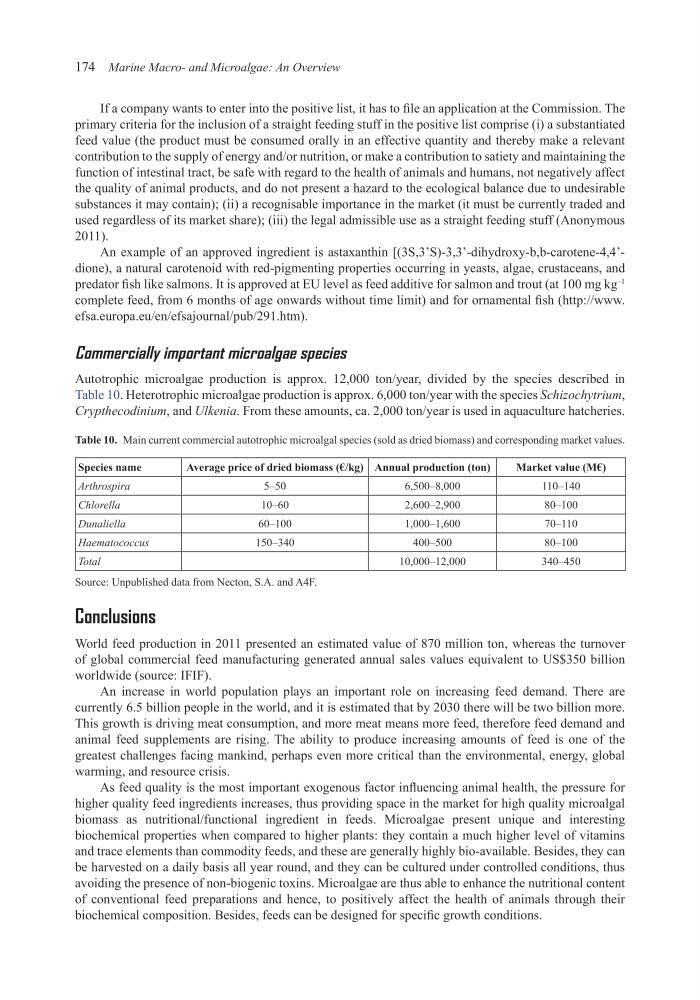
Autotrophic microalgae production is approx. 12,000 ton/year, divided by the species described in
Table 10. Heterotrophic microalgae production is approx. 6,000 ton/year with the species Schizochytrium,
Crypthecodinium, and Ulkenia. From these amounts, ca. 2,000 ton/year is used in aquaculture hatcheries.
Table 10. Main current commercial autotrophic microalgal species (sold as dried biomass) and corresponding market values.
Species name
Average price of dried biomass (€/kg) Annual production (ton)
Market value (M€)
Arthrospira
5–50
6,500–8,000
110–140
Chlorella
10–60
2,600–2,900
80–100
Dunaliella
60–100
1,000–1,600
70–110
Haematococcus
150–340
400–500
80–100
Total
10,000–12,000
340–450
Source: Unpublished data from Necton, S.A. and A4F.
Conclusions
World feed production in 2011 presented an estimated value of 870 million ton, whereas the turnover
of global commercial feed manufacturing generated annual sales values equivalent to US$350 billion
worldwide (source: IFIF).
An increase in world population plays an important role on increasing feed demand. There are
currently 6.5 billion people in the world, and it is estimated that by 2030 there will be two billion more.
This growth is driving meat consumption, and more meat means more feed, therefore feed demand and
animal feed supplements are rising. The ability to produce increasing amounts of feed is one of the
greatest challenges facing mankind, perhaps even more critical than the environmental, energy, global
warming, and resource crisis.
As feed quality is the most important exogenous factor influencing animal health, the pressure for
higher quality feed ingredients increases, thus providing space in the market for high quality microalgal
biomass as nutritional/functional ingredient in feeds. Microalgae present unique and interesting
biochemical properties when compared to higher plants: they contain a much higher level of vitamins
and trace elements than commodity feeds, and these are generally highly bio-available. Besides, they can
be harvested on a daily basis all year round, and they can be cultured under controlled conditions, thus
avoiding the presence of non-biogenic toxins. Microalgae are thus able to enhance the nutritional content
of conventional feed preparations and hence, to positively affect the health of animals through their
biochemical composition. Besides, feeds can be designed for specific growth conditions.
If a company wants to enter into the positive list, it has to file an application at the Commission. The
primary criteria for the inclusion of a straight feeding stuff in the positive list comprise (i) a substantiated
feed value (the product must be consumed orally in an effective quantity and thereby make a relevant
contribution to the supply of energy and/or nutrition, or make a contribution to satiety and maintaining the
function of intestinal tract, be safe with regard to the health of animals and humans, not negatively affect
the quality of animal products, and do not present a hazard to the ecological balance due to undesirable
substances it may contain); (ii) a recognisable importance in the market (it must be currently traded and
used regardless of its market share); (iii) the legal admissible use as a straight feeding stuff (Anonymous
2011).
An example of an approved ingredient is astaxanthin [(3S,3’S)-3,3’-dihydroxy-b,b-carotene-4,4’dione), a natural carotenoid with red-pigmenting properties occurring in yeasts, algae, crustaceans, and
predator fish like salmons. It is approved at EU level as feed additive for salmon and trout (at 100 mg kg
–1
complete feed, from 6 months of age onwards without time limit) and for ornamental fish (http://www.
efsa.europa.eu/en/efsajournal/pub/291.htm).
Commercially important microalgae species
Autotrophic microalgae production is approx. 12,000 ton/year, divided by the species described in
Table 10. Heterotrophic microalgae production is approx. 6,000 ton/year with the species Schizochytrium,
Crypthecodinium, and Ulkenia. From these amounts, ca. 2,000 ton/year is used in aquaculture hatcheries.
Table 10. Main current commercial autotrophic microalgal species (sold as dried biomass) and corresponding market values.
Species name
Average price of dried biomass (€/kg) Annual production (ton)
Market value (M€)
Arthrospira
5–50
6,500–8,000
110–140
Chlorella
10–60
2,600–2,900
80–100
Dunaliella
60–100
1,000–1,600
70–110
Haematococcus
150–340
400–500
80–100
Total
10,000–12,000
340–450
Source: Unpublished data from Necton, S.A. and A4F.
Conclusions
World feed production in 2011 presented an estimated value of 870 million ton, whereas the turnover
of global commercial feed manufacturing generated annual sales values equivalent to US$350 billion
worldwide (source: IFIF).
An increase in world population plays an important role on increasing feed demand. There are
currently 6.5 billion people in the world, and it is estimated that by 2030 there will be two billion more.
This growth is driving meat consumption, and more meat means more feed, therefore feed demand and
animal feed supplements are rising. The ability to produce increasing amounts of feed is one of the
greatest challenges facing mankind, perhaps even more critical than the environmental, energy, global
warming, and resource crisis.
As feed quality is the most important exogenous factor influencing animal health, the pressure for
higher quality feed ingredients increases, thus providing space in the market for high quality microalgal
biomass as nutritional/functional ingredient in feeds. Microalgae present unique and interesting
biochemical properties when compared to higher plants: they contain a much higher level of vitamins
and trace elements than commodity feeds, and these are generally highly bio-available. Besides, they can
be harvested on a daily basis all year round, and they can be cultured under controlled conditions, thus
avoiding the presence of non-biogenic toxins. Microalgae are thus able to enhance the nutritional content
of conventional feed preparations and hence, to positively affect the health of animals through their
biochemical composition. Besides, feeds can be designed for specific growth conditions.