

Microalgae for Feed 171
iii) High stress periods: stress is a condition in which an organism is unable to maintain its normal
physiologic state. It results from physical (handling, capture, confinement, and transport) and/or
abiotic challenges (contaminants, temperature and salinity fluctuation, low oxygen, high ammonia),
which modify animal’s natural or homeostatic state. The above stressors can be categorized as either
acute or chronic, depending on their duration and frequency, and have severe negative effects on an
animal’s growth and health. Microalga-based diets have been shown to bring positive effects on fish
immune system, mainly attributed to their antioxidant potential and polyphenol contents. They may
also be used following fish vaccination, as their bioactive constituents could act as vaccine adjuvants
and potentiate its antigenic effect (Dias and Sendão unpublished data).
Microalgae in husbandry
Studies with incorporation of 5–10% microalgae in poultry feeds revealed their positive influence in
terms of (i) visual enhancements on skin’s colour and egg yolk, as well as weight gain; (ii) healthier final
products (egg yolk with reduced cholesterol levels and increased linoleic and arachidonic acid contents);
and (iii) probiotic effects (algal meal reduced caecal colonization of Clostridium perfringens) (Ginzberg
et al. 2000; Waldenstedt et al. 2003; Spolaore et al. 2006). Other poultry feeding studies with Spirulina
(up to 30%) showed that both protein and energy efficiency of this alga were similar to other conventional
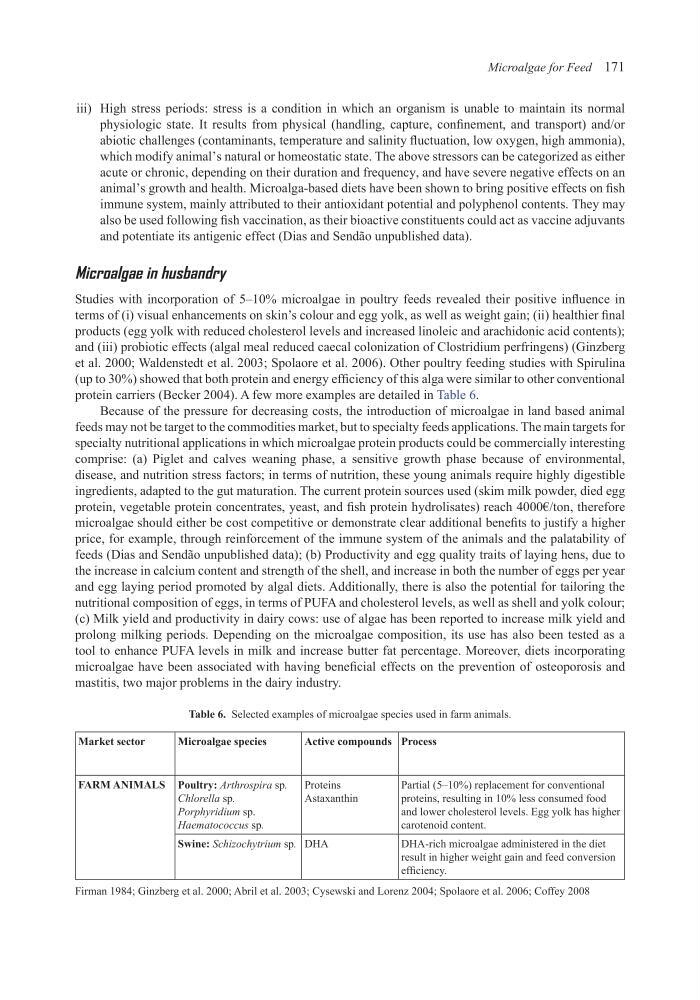
protein carriers (Becker 2004). A few more examples are detailed in Table 6.
Because of the pressure for decreasing costs, the introduction of microalgae in land based animal
feeds may not be target to the commodities market, but to specialty feeds applications. The main targets for
specialty nutritional applications in which microalgae protein products could be commercially interesting
comprise: (a) Piglet and calves weaning phase, a sensitive growth phase because of environmental,
disease, and nutrition stress factors; in terms of nutrition, these young animals require highly digestible
ingredients, adapted to the gut maturation. The current protein sources used (skim milk powder, died egg
protein, vegetable protein concentrates, yeast, and fish protein hydrolisates) reach 4000€/ton, therefore
microalgae should either be cost competitive or demonstrate clear additional benefits to justify a higher
price, for example, through reinforcement of the immune system of the animals and the palatability of
feeds (Dias and Sendão unpublished data); (b) Productivity and egg quality traits of laying hens, due to
the increase in calcium content and strength of the shell, and increase in both the number of eggs per year
and egg laying period promoted by algal diets. Additionally, there is also the potential for tailoring the
nutritional composition of eggs, in terms of PUFA and cholesterol levels, as well as shell and yolk colour;
(c) Milk yield and productivity in dairy cows: use of algae has been reported to increase milk yield and
prolong milking periods. Depending on the microalgae composition, its use has also been tested as a
tool to enhance PUFA levels in milk and increase butter fat percentage. Moreover, diets incorporating
microalgae have been associated with having beneficial effects on the prevention of osteoporosis and
mastitis, two major problems in the dairy industry.
Table 6. Selected examples of microalgae species used in farm animals.
Market sector
Microalgae species
Active compounds Process
FARM ANIMALS Poultry: Arthrospira sp.
Chlorella sp.
Porphyridium sp.
Haematococcus sp.
Proteins
Astaxanthin
Partial (5–10%) replacement for conventional
proteins, resulting in 10% less consumed food
and lower cholesterol levels. Egg yolk has higher
carotenoid content.
Swine: Schizochytrium sp. DHA
DHA-rich microalgae administered in the diet
result in higher weight gain and feed conversion
efficiency.
Firman 1984; Ginzberg et al. 2000; Abril et al. 2003; Cysewski and Lorenz 2004; Spolaore et al. 2006; Coffey 2008
iii) High stress periods: stress is a condition in which an organism is unable to maintain its normal
physiologic state. It results from physical (handling, capture, confinement, and transport) and/or
abiotic challenges (contaminants, temperature and salinity fluctuation, low oxygen, high ammonia),
which modify animal’s natural or homeostatic state. The above stressors can be categorized as either
acute or chronic, depending on their duration and frequency, and have severe negative effects on an
animal’s growth and health. Microalga-based diets have been shown to bring positive effects on fish
immune system, mainly attributed to their antioxidant potential and polyphenol contents. They may
also be used following fish vaccination, as their bioactive constituents could act as vaccine adjuvants
and potentiate its antigenic effect (Dias and Sendão unpublished data).
Microalgae in husbandry
Studies with incorporation of 5–10% microalgae in poultry feeds revealed their positive influence in
terms of (i) visual enhancements on skin’s colour and egg yolk, as well as weight gain; (ii) healthier final
products (egg yolk with reduced cholesterol levels and increased linoleic and arachidonic acid contents);
and (iii) probiotic effects (algal meal reduced caecal colonization of Clostridium perfringens) (Ginzberg
et al. 2000; Waldenstedt et al. 2003; Spolaore et al. 2006). Other poultry feeding studies with Spirulina
(up to 30%) showed that both protein and energy efficiency of this alga were similar to other conventional
protein carriers (Becker 2004). A few more examples are detailed in Table 6.
Because of the pressure for decreasing costs, the introduction of microalgae in land based animal
feeds may not be target to the commodities market, but to specialty feeds applications. The main targets for
specialty nutritional applications in which microalgae protein products could be commercially interesting
comprise: (a) Piglet and calves weaning phase, a sensitive growth phase because of environmental,
disease, and nutrition stress factors; in terms of nutrition, these young animals require highly digestible
ingredients, adapted to the gut maturation. The current protein sources used (skim milk powder, died egg
protein, vegetable protein concentrates, yeast, and fish protein hydrolisates) reach 4000€/ton, therefore
microalgae should either be cost competitive or demonstrate clear additional benefits to justify a higher
price, for example, through reinforcement of the immune system of the animals and the palatability of
feeds (Dias and Sendão unpublished data); (b) Productivity and egg quality traits of laying hens, due to
the increase in calcium content and strength of the shell, and increase in both the number of eggs per year
and egg laying period promoted by algal diets. Additionally, there is also the potential for tailoring the
nutritional composition of eggs, in terms of PUFA and cholesterol levels, as well as shell and yolk colour;
(c) Milk yield and productivity in dairy cows: use of algae has been reported to increase milk yield and
prolong milking periods. Depending on the microalgae composition, its use has also been tested as a
tool to enhance PUFA levels in milk and increase butter fat percentage. Moreover, diets incorporating
microalgae have been associated with having beneficial effects on the prevention of osteoporosis and
mastitis, two major problems in the dairy industry.
Table 6. Selected examples of microalgae species used in farm animals.
Market sector
Microalgae species
Active compounds Process
FARM ANIMALS Poultry: Arthrospira sp.
Chlorella sp.
Porphyridium sp.
Haematococcus sp.
Proteins
Astaxanthin
Partial (5–10%) replacement for conventional
proteins, resulting in 10% less consumed food
and lower cholesterol levels. Egg yolk has higher
carotenoid content.
Swine: Schizochytrium sp. DHA
DHA-rich microalgae administered in the diet
result in higher weight gain and feed conversion
efficiency.
Firman 1984; Ginzberg et al. 2000; Abril et al. 2003; Cysewski and Lorenz 2004; Spolaore et al. 2006; Coffey 2008