

Algae and Plants
39
Mentha arvensis (Linnaeus)
Order: Lamiales
Family: Lamiaceae
Common name: Wild mint, corn mint.
Distribution: Native to the temperate
regions of Europe and western and
central Asia; east to the Himalayas and
eastern Siberia, and North America.
Habitat: Higher elevations along creeks
and in meadows.
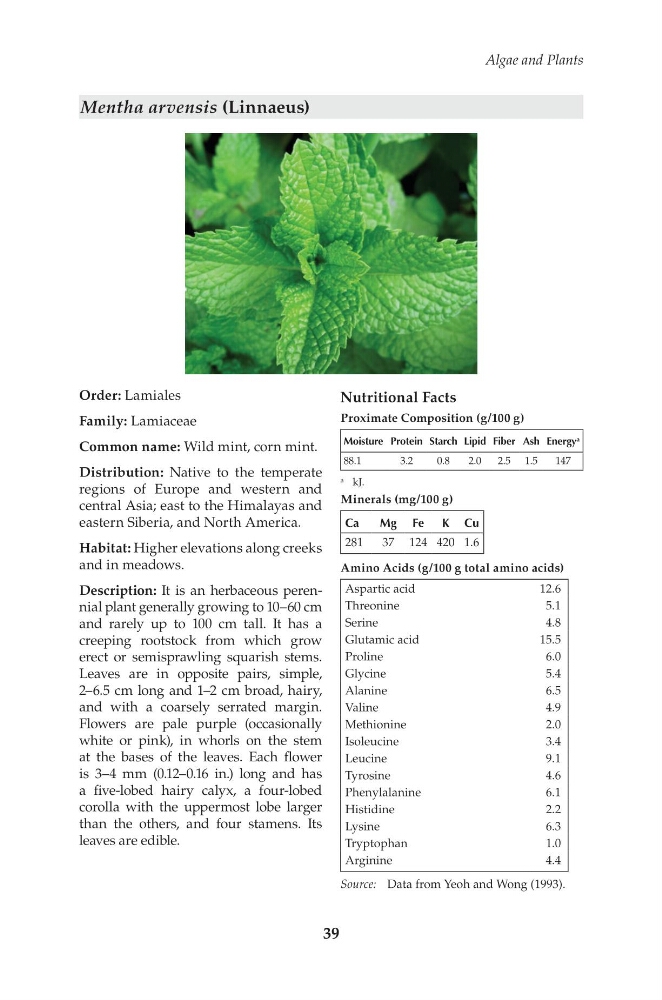
Description: It is an herbaceous perennial plant generally growing to 10–60 cm
and rarely up to 100 cm tall. It has a
creeping rootstock from which grow
erect or semisprawling squarish stems.
Leaves are in opposite pairs, simple,
2–6.5 cm long and 1–2 cm broad, hairy,
and with a coarsely serrated margin.
Flowers are pale purple (occasionally
white or pink), in whorls on the stem
at the bases of the leaves. Each flower
is 3–4 mm (0.12–0.16 in.) long and has
a five-lobed hairy calyx, a four-lobed
corolla with the uppermost lobe larger
than the others, and four stamens. Its
leaves are edible.
Nutritional Facts
Proximate Composition (g/100 g)
Moisture Protein Starch Lipid Fiber Ash Energy a
88.1
3.2
0.8
2.0
2.5 1.5
147
a kJ.
Minerals (mg/100 g)
Ca
Mg Fe K Cu
281
37 124 420 1.6
Amino Acids (g/100 g total amino acids)
Aspartic acid
12.6
Threonine
5.1
Serine
4.8
Glutamic acid
15.5
Proline
6.0
Glycine
5.4
Alanine
6.5
Valine
4.9
Methionine
2.0
Isoleucine
3.4
Leucine
9.1
Tyrosine
4.6
Phenylalanine
6.1
Histidine
2.2
Lysine
6.3
Tryptophan
1.0
Arginine
4.4
Source: Data from Yeoh and Wong (1993).
39
Mentha arvensis (Linnaeus)
Order: Lamiales
Family: Lamiaceae
Common name: Wild mint, corn mint.
Distribution: Native to the temperate
regions of Europe and western and
central Asia; east to the Himalayas and
eastern Siberia, and North America.
Habitat: Higher elevations along creeks
and in meadows.
Description: It is an herbaceous perennial plant generally growing to 10–60 cm
and rarely up to 100 cm tall. It has a
creeping rootstock from which grow
erect or semisprawling squarish stems.
Leaves are in opposite pairs, simple,
2–6.5 cm long and 1–2 cm broad, hairy,
and with a coarsely serrated margin.
Flowers are pale purple (occasionally
white or pink), in whorls on the stem
at the bases of the leaves. Each flower
is 3–4 mm (0.12–0.16 in.) long and has
a five-lobed hairy calyx, a four-lobed
corolla with the uppermost lobe larger
than the others, and four stamens. Its
leaves are edible.
Nutritional Facts
Proximate Composition (g/100 g)
Moisture Protein Starch Lipid Fiber Ash Energy a
88.1
3.2
0.8
2.0
2.5 1.5
147
a kJ.
Minerals (mg/100 g)
Ca
Mg Fe K Cu
281
37 124 420 1.6
Amino Acids (g/100 g total amino acids)
Aspartic acid
12.6
Threonine
5.1
Serine
4.8
Glutamic acid
15.5
Proline
6.0
Glycine
5.4
Alanine
6.5
Valine
4.9
Methionine
2.0
Isoleucine
3.4
Leucine
9.1
Tyrosine
4.6
Phenylalanine
6.1
Histidine
2.2
Lysine
6.3
Tryptophan
1.0
Arginine
4.4
Source: Data from Yeoh and Wong (1993).