

Nutritional Freshwater Life
38
Amino Acids (% DM)
Arginine
3.07
Histidine
1.08
Isoleucine
2.61
Leucine
4.38
Methionine
0.97
Phenylalanine
2.90
Threonine
2.26
Valine
2.60
Source: Data from Boyd (1968b).
Bacopa monniera (L.) (Pennell)
Order: Lamiales
Family: Plantaginaceae
Common name: Indian pennywort,
water hyssop.
Distribution: Native to the wetlands
of southern India; Australia, Europe,
Africa, Asia, and North and South
America; throughout India, Nepal, Sri
Lanka, China, Pakistan, Taiwan, and
Vietnam. It is also found in Florida,
Hawaii, and other southern states of the
United States.
Habitat: Damp conditions by a pond or
bog garden.
Description: The leaves of this plant,
which are edible, are succulent, oblong,
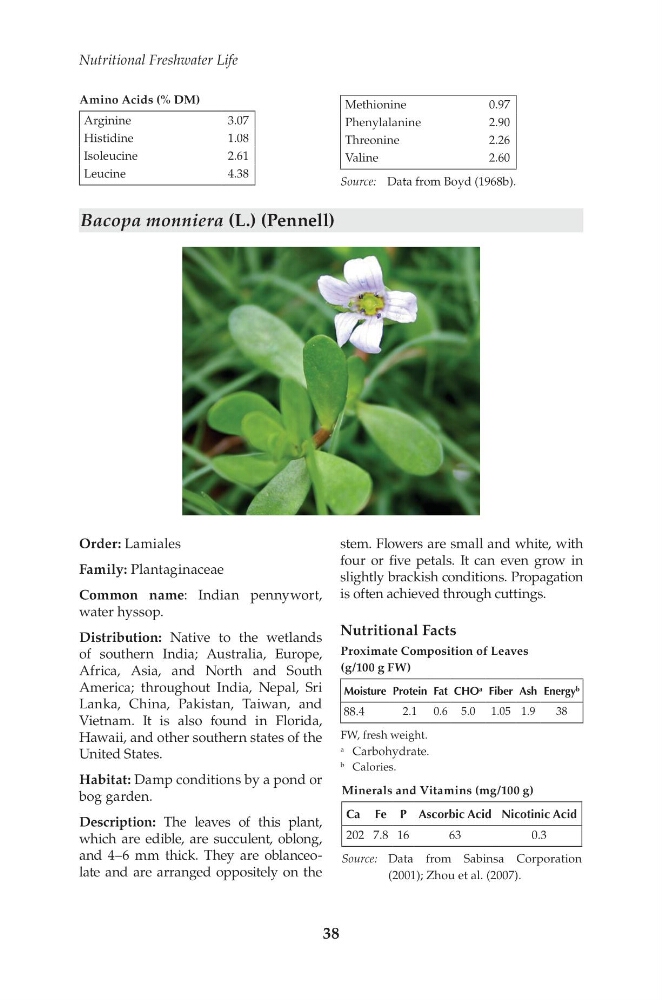
and 4–6 mm thick. They are oblanceolate and are arranged oppositely on the
stem. Flowers are small and white, with
four or five petals. It can even grow in
slightly brackish conditions. Propagation
is often achieved through cuttings.
Nutritional Facts
Proximate Composition of Leaves
(g/100 g FW)
Moisture Protein Fat CHO a Fiber Ash Energy b
88.4
2.1 0.6 5.0 1.05 1.9
38
FW, fresh weight.
a Carbohydrate.
b Calories.
Minerals and Vitamins (mg/100 g)
Ca Fe P Ascorbic Acid Nicotinic Acid
202 7.8 16
63
0.3
Source: Data from Sabinsa Corporation
(2001); Zhou et al. (2007).
38
Amino Acids (% DM)
Arginine
3.07
Histidine
1.08
Isoleucine
2.61
Leucine
4.38
Methionine
0.97
Phenylalanine
2.90
Threonine
2.26
Valine
2.60
Source: Data from Boyd (1968b).
Bacopa monniera (L.) (Pennell)
Order: Lamiales
Family: Plantaginaceae
Common name: Indian pennywort,
water hyssop.
Distribution: Native to the wetlands
of southern India; Australia, Europe,
Africa, Asia, and North and South
America; throughout India, Nepal, Sri
Lanka, China, Pakistan, Taiwan, and
Vietnam. It is also found in Florida,
Hawaii, and other southern states of the
United States.
Habitat: Damp conditions by a pond or
bog garden.
Description: The leaves of this plant,
which are edible, are succulent, oblong,
and 4–6 mm thick. They are oblanceolate and are arranged oppositely on the
stem. Flowers are small and white, with
four or five petals. It can even grow in
slightly brackish conditions. Propagation
is often achieved through cuttings.
Nutritional Facts
Proximate Composition of Leaves
(g/100 g FW)
Moisture Protein Fat CHO a Fiber Ash Energy b
88.4
2.1 0.6 5.0 1.05 1.9
38
FW, fresh weight.
a Carbohydrate.
b Calories.
Minerals and Vitamins (mg/100 g)
Ca Fe P Ascorbic Acid Nicotinic Acid
202 7.8 16
63
0.3
Source: Data from Sabinsa Corporation
(2001); Zhou et al. (2007).